If you work as an independent contractor, freelancer, vendor, or business owner, you may be asked to complete an IRS Form W-9 before receiving payment.
A W-9 form is a simple tax document, but small mistakes can create problems. A wrong Taxpayer Identification Number (TIN), incorrect business name, or missing certification can lead to reporting issues and possible backup withholding.
IRS Form W-9, officially called the Request for Taxpayer Identification Number and Certification, is used by businesses to collect tax information from people or companies they pay.
The business requesting the form uses the information to prepare tax documents such as Form 1099-NEC for certain payments.
This guide explains what Form W-9 is, who needs to complete it, how to fill it out correctly, differences between W-9 and W-4, LLC examples, backup withholding rules, and common mistakes to avoid.
What Is IRS Form W-9?
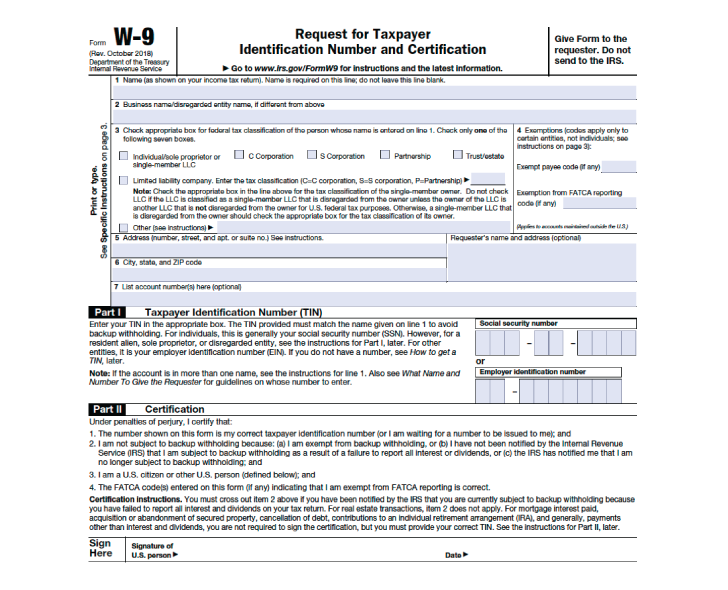
IRS Form W-9 is a form used to collect a taxpayer’s name, business information, and Taxpayer Identification Number for tax reporting purposes.
A W-9 is usually completed by the person or business receiving payment. This person is called the payee.
The company requesting the information is called the requester or payer.
The W-9 collects information such as:
- Legal name
- Business name (if different)
- Federal tax classification
- Address
- Social Security Number (SSN) or Employer Identification Number (EIN)
The requester keeps the completed W-9 in its records and uses the information when preparing required IRS information returns.
You do not send Form W-9 directly to the IRS.
For example:
A company hires a freelance graphic designer and pays more than the reporting threshold for services. Before payment, the company asks the designer to complete Form W-9. The company uses the information to prepare Form 1099-NEC if required.
Who Needs to Fill Out a W-9 Form?
Anyone receiving certain types of business payments may need to complete Form W-9 when requested by the payer.
Common people and businesses that receive W-9 requests include:
- Independent contractors
- Freelancers
- Consultants
- Vendors
- Self-employed individuals
- LLC owners
- Partnerships
- Corporations
- Certain trusts and estates
Businesses commonly request W-9 forms during:
- New vendor setup
- Contractor onboarding
- Accounts payable processes
- Procurement procedures
A W-9 is not only for individuals. Businesses also provide W-9 information when another company needs their tax details.
Why Do Businesses Request a W-9?
Businesses request Form W-9 to collect accurate taxpayer information before making reportable payments.
The main purpose is tax reporting.
A business may need information from Form W-9 to prepare forms such as:
- Form 1099-NEC for nonemployee compensation
- Form 1099-MISC for certain other payments
For example:
A marketing agency hires a freelance writer for $5,000 during the year. The agency requests a W-9 from the writer so it has the correct name and TIN when preparing tax reporting documents.
Keeping W-9 forms also helps businesses maintain accurate vendor records.
What Is the Difference Between Form W-9 and Form W-4?
Form W-9 is used for contractors and vendors, while Form W-4 is used by employees.
Many people confuse these forms because both collect tax-related information.
| Feature | Form W-9 | Form W-4 |
| Used by | Independent contractors, vendors, businesses | Employees |
| Purpose | Collect taxpayer information | Calculate employee tax withholding |
| Submitted to | Business requesting information | Employer |
| Used for | 1099 reporting | Payroll withholding |
| Includes withholding choices | No | Yes |
Example:
- A company employee completes Form W-4 when starting a job.
- A freelance consultant completes Form W-9 before receiving contractor payments.
What Is the Difference Between a W-9 and a 1099?
A W-9 provides taxpayer information, while a 1099 reports payments made during the year.
The two forms work together.
The process usually works like this:
- Contractor completes Form W-9.
- Business stores the information.
- Business makes payments.
- Business issues Form 1099 when required.
The contractor does not fill out the 1099 form. The paying business prepares it.
How to Fill Out Form W-9 Step by Step
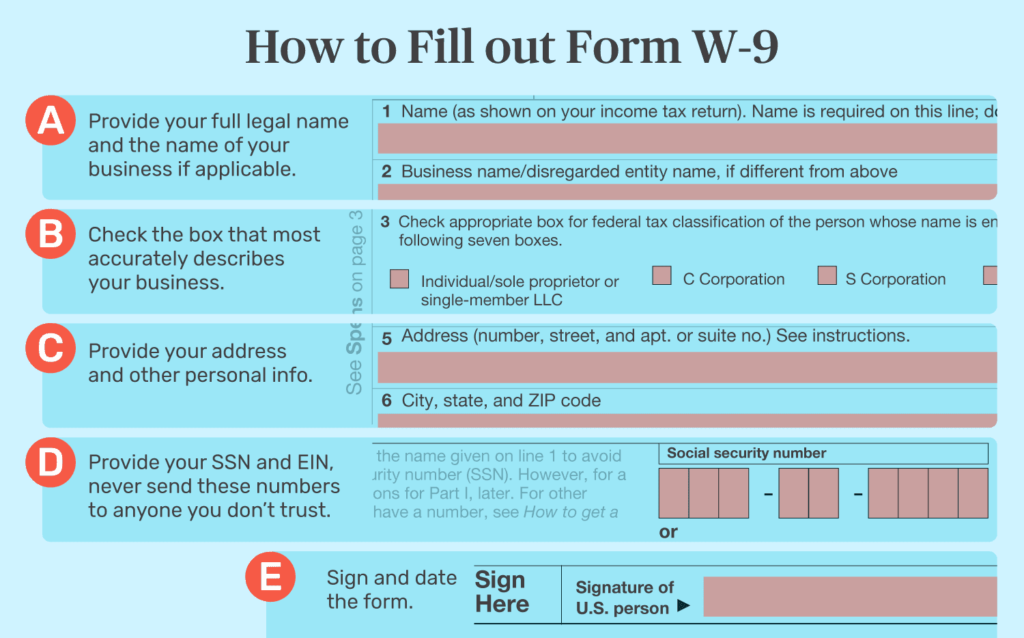
Form W-9 has two main sections: taxpayer information and certification.
Completing the form correctly helps prevent reporting problems.
Line 1: Enter Your Name
Line 1 requires the name shown on your federal tax return.
This should match IRS records.
Examples:
Individual
John Smith files taxes under his personal name.
Line 1:
John Smith
Business Owner
Maria owns an LLC but reports income under her personal tax information.
Line 1:
Maria Lopez
A common mistake is putting only a company name on Line 1 when the IRS expects the owner’s legal name.
Line 2: Enter Your Business Name
Line 2 is used for your business or trade name if it is different from Line 1.
Examples:
Line 1:
John Smith
Line 2:
Smith Digital Marketing
This section is commonly used by:
- Sole proprietors
- LLC owners
- Businesses operating under a DBA name
Line 3a: Select Your Federal Tax Classification
Line 3a identifies how your business is classified for federal tax purposes.
Options include:
- Individual/sole proprietor or single-member LLC
- C corporation
- S corporation
- Partnership
- Trust/estate
- LLC
Your selection should match your IRS tax classification, not only your state registration.
Example:
A single-member LLC normally selects:
Individual/sole proprietor or single-member LLC
Line 3b: LLC Classification
Line 3b provides additional information for certain LLC classifications.
This line helps identify the tax treatment of an LLC.
For example:
- Single-member LLC treated as a disregarded entity
- Multi-member LLC treated as a partnership
- LLC taxed as a corporation
The classification should match your federal tax election.
Line 4: Enter Exemptions If Applicable
Line 4 is completed only if you qualify for certain exemptions.
Most individuals and small businesses leave this section blank.
Examples of exemptions include:
- Certain exempt payees
- Certain FATCA reporting exemptions
Do not enter an exemption code unless you qualify.
Lines 5 and 6: Enter Your Address
Lines 5 and 6 require the address where tax documents should be sent.
Provide:
- Street address
- City
- State
- ZIP code
Use an address where you can reliably receive tax-related information.
Part I: Enter Your Taxpayer Identification Number (TIN)
Part I requires your Social Security Number, Employer Identification Number, or another valid Taxpayer Identification Number.
A TIN can be:
- Social Security Number (SSN)
- Employer Identification Number (EIN)
- Individual Taxpayer Identification Number (ITIN)
Businesses usually provide an EIN.
Individuals commonly provide an SSN.
Using an EIN instead of an SSN may help business owners protect personal information.
Part II: Sign and Certify the Form
Part II confirms that the information provided is correct.
By signing Form W-9, you certify that:
- The TIN provided is correct
- You are not subject to certain backup withholding rules
- Your exemption information is accurate if provided
The form should include:
- Signature
- Date
An unsigned W-9 may not be accepted.
How Should a Single-Member LLC Complete Form W-9?
A single-member LLC usually provides the owner’s name on Line 1 and the LLC name on Line 2.
A single-member LLC is generally treated as a disregarded entity for federal tax purposes unless it elects otherwise.
Example:
Owner:
Sarah Johnson
LLC:
Johnson Consulting LLC
The W-9 would generally show:
Line 1: Sarah Johnson
Line 2: Johnson Consulting LLC
Line 3a: Individual/sole proprietor or single-member LLC
For Part I, the owner may use:
- SSN
- EIN
Many business owners choose to use an EIN to avoid sharing their personal SSN.
What Is Backup Withholding on Form W-9?
Backup withholding is a tax withholding requirement that applies when required taxpayer information is missing or incorrect.
The current backup withholding rate is 24%.
Backup withholding may apply when:
- A payee does not provide a TIN
- The IRS notifies the payer of an incorrect TIN
- The payee fails certain certifications
Example:
A contractor refuses to provide a valid W-9. The business may need to withhold part of future payments and send that amount to the IRS.
Providing accurate W-9 information helps avoid backup withholding.
What Happens If the TIN on Form W-9 Is Wrong?
A wrong TIN can create IRS reporting problems and may result in backup withholding.
If the IRS finds a mismatch, the payer may receive a notice such as:
- CP2100 Notice
- B-Notice
The payer may then need to request corrected information from the payee.
Common causes of TIN mismatches include:
- Typing errors
- Name changes
- Using a business name instead of legal name
- Incorrect EIN or SSN
Always check that the name and TIN match IRS records before submitting the form.
What Changed on the 2026 Form W-9?
The 2026 Form W-9 includes updates related to digital asset reporting and LLC classification information.
Changes include:
- New digital asset broker certification options
- Updated exempt payee code information
- Additional LLC classification details
Businesses and tax professionals should use the latest IRS version of Form W-9 to avoid using outdated forms.
Common W-9 Form Mistakes
Most W-9 problems happen because people enter incorrect names, tax classifications, or identification numbers.
Common mistakes include:
Using a Business Name Instead of Legal Name
Line 1 should generally match the tax return name.
Choosing the Wrong Tax Classification
An LLC’s state registration does not always match its federal tax classification.
Missing the Signature
A missing signature makes the certification incomplete.
Providing the Wrong TIN
Always verify SSN or EIN information.
Sending W-9 Directly to the IRS
The payer keeps the form. The payee does not send it to the IRS.
Case Study: Correct W-9 Setup for an LLC Contractor
Correctly completing Form W-9 helps contractors avoid payment delays and tax reporting issues.
Example:
David operates a single-member LLC that provides software consulting services.
A client requests a W-9 before paying him.
David provides:
- His legal name on Line 1
- His LLC name on Line 2
- Correct LLC classification
- EIN in Part I
- Signature and date
The client can now properly maintain vendor records and prepare any required tax reporting.
The mistake many new LLC owners make is assuming the LLC name alone should appear everywhere. Federal tax reporting often depends on the owner’s tax classification.
Final Thoughts
IRS Form W-9 is a basic but important tax document for contractors, vendors, and businesses. Its main purpose is simple: collect correct taxpayer information for accurate reporting.
The biggest mistakes happen when people enter the wrong legal name, choose the wrong tax classification, or provide an incorrect TIN.
Taking a few minutes to complete Form W-9 correctly can prevent payment delays, reporting problems, and backup withholding issues later.
Frequently Asked Questions
Do I have to provide a W-9 to a client?
If a business requests a W-9 for a legitimate tax reporting purpose, refusing to provide it may delay payment or result in backup withholding.
Is Form W-9 sent to the IRS?
No, the requester keeps the completed W-9 for its records.
Can an LLC use an EIN on Form W-9?
Yes, many LLC owners use an EIN instead of their SSN.
Do employees complete Form W-9?
No, Employees complete Form W-4. Contractors and vendors typically complete Form W-9.
What happens if I provide false information on a W-9?
Providing false information may result in penalties and possible legal consequences.
Is Form W-9 required every year?
Usually no, a new W-9 is generally requested when information changes, such as a name, address, or tax classification change.