IRS Form 944 is the Employer’s Annual Federal Tax Return. It is designed for certain small employers so they can report federal income tax withheld from employees and Social Security and Medicare taxes once a year instead of filing Form 941 quarterly.
There is one rule that causes the most confusion: having less than $1,000 in annual employment-tax liability does not automatically give a business permission to file Form 944. The IRS must notify the employer in writing that it is in the Form 944 program or approve the employer’s request to change from Form 941 to Form 944.
For employers preparing for the 2026 tax year, the IRS’s current published Form 944 materials still show a 2025 revision, while the related Form 944-X correction instructions were revised in February 2026. This page should therefore be used together with the latest IRS Form 944 materials available when the return is filed.
What Is Form 944?
Form 944 is an annual federal payroll-tax return for qualifying small employers.
It is used to report employment taxes such as:
- Federal income tax withheld from employees
- Employee and employer Social Security tax
- Employee and employer Medicare tax
- Additional Medicare Tax withheld from employees, when applicable
- Certain payroll-tax adjustments
- Qualified small-business payroll-tax credits, when applicable
- Deposits made during the year
The IRS designed Form 944 for the smallest employers so they can report and, in certain circumstances, pay these employment taxes annually rather than quarterly.
Form 944 does not replace every payroll-tax form. For example, federal unemployment tax is generally reported separately on Form 940, while agricultural employers may have a different annual filing requirement.
For a broader comparison of the three forms, see our guide to Form 940 vs. Form 941 vs. Form 944.
Form 944 Eligibility: Who Can File?
The IRS says Form 944 is intended for employers whose annual liability for Social Security tax, Medicare tax, and withheld federal income tax is $1,000 or less.
But there is an additional requirement:
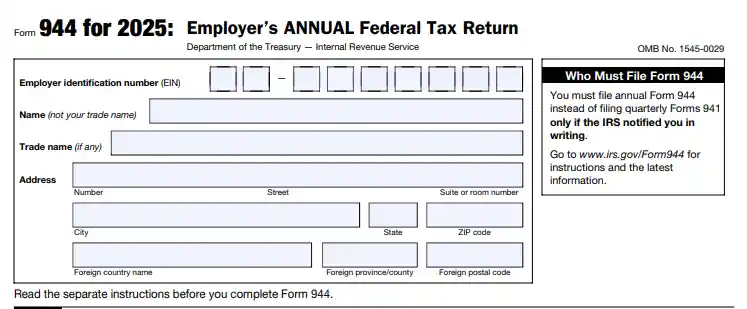
You can file Form 944 only if the IRS has notified you in writing that you are required or permitted to file it.
That means there are two separate questions:
- Is your annual employment-tax liability low enough to potentially qualify?
- Has the IRS actually authorized your business to file Form 944?
Both matter.
New employers
When a business applies for an EIN, the IRS provides information about the federal employment-tax forms the business is expected to file.
If the business has employees but was not assigned Form 944, the general rule is to file Form 941 unless the business contacts the IRS, requests Form 944 treatment, and receives written confirmation.
Who cannot generally file Form 944?
The IRS identifies several categories that use different employment-tax reporting rules.
Household employers who employ only household workers generally use Schedule H rather than Form 944.
Agricultural employers who employ only farm workers generally use Form 943.
Employers who have received IRS notice to file quarterly Forms 941 also cannot simply decide to use Form 944 instead.
What Does the $1,000 Form 944 Payroll Tax Limit Actually Mean?
The phrase “Form 944 payroll tax limit” can be misleading.
The $1,000 figure does not mean:
- $1,000 of employee wages
- $1,000 of payroll expense
- $1,000 of federal income tax withholding alone
- $1,000 of FUTA tax
- $1,000 of employee take-home pay
It refers to the employer’s annual liability for the federal employment taxes covered by Form 944—principally Social Security tax, Medicare tax, and federal income tax withheld from employees.
The IRS’s current Form 944 guidance also says that, based on current tax rates, an employer that pays $5,000 or less in wages subject to Social Security and Medicare taxes and federal income-tax withholding during the calendar year will generally be likely to have $1,000 or less in employment-tax liability. This is a practical estimate, not a separate Form 944 eligibility rule.
Why the $1,000 threshold matters
Consider a business with one employee.
If the business expects its covered federal employment-tax liability to be $900 for the year, it may appear to fit the Form 944 program.
But if the IRS has not authorized the business to file Form 944, it cannot simply skip the quarterly Form 941 process and submit Form 944 at year-end.
The filing designation comes first.
Form 944 vs. Form 941
Form 944 and Form 941 generally report the same core categories of federal employment taxes, but they use different filing frequencies.
| Feature | Form 941 | Form 944 |
| Filing frequency | Quarterly | Annual |
| Main purpose | Employer’s Quarterly Federal Tax Return | Employer’s Annual Federal Tax Return |
| Intended filer | Most employers with employees | Small employers designated for annual filing |
| Annual liability threshold | No Form 944-style $1,000 eligibility threshold | Generally $1,000 or less |
| IRS designation required | No special Form 944 designation | Yes |
| Typical filing deadline | End of month following each quarter | January 31 following the tax year |
The IRS makes the distinction particularly clear: if you have written notification to file Form 944, you generally must file Form 944 instead of Form 941 unless the IRS changes your filing requirement.
For a deeper explanation of quarterly reporting, see our IRS Form 941 guide.
What If Your Form 944 Tax Liability Exceeds $1,000?
This is another area where online explanations can be misleading.
Suppose the IRS has already notified your business to file Form 944, but your actual annual employment-tax liability turns out to be $1,300.
You should not automatically switch to Form 941 simply because you crossed the $1,000 threshold.
The IRS says that if it has notified you to file Form 944, you must continue filing Form 944—even if your annual employment-tax liability is more than $1,000—until the IRS changes your filing requirement.
In other words:
The $1,000 figure helps determine eligibility, but your current IRS filing designation controls which return you should file.
If the IRS later determines that you no longer qualify, it can move you to quarterly Form 941 filing.
How to Change From Form 941 to Form 944
A business cannot switch from Form 941 to Form 944 simply by deciding that annual filing would be more convenient.
For calendar year 2026, the IRS instructions provided a specific request window. Employers that expected their 2026 employment-tax liability to be $1,000 or less could request Form 944 treatment by:
- Calling the IRS at 800-829-4933 between January 1 and April 1, 2026; or
- Sending a written request that was postmarked between January 1 and March 16, 2026.
The IRS then sends written notice if the filing requirement is changed. Until that written notice is received, an employer that was assigned Form 941 must continue filing Form 941.
For written requests, the IRS lists:
Department of the Treasury
Internal Revenue Service
Ogden, UT 84201-0038
or
Department of the Treasury
Internal Revenue Service
Cincinnati, OH 45999-0038
The correct address depends on where the employer’s return would otherwise be mailed.
What about future years?
The request deadlines are tied to the tax year. Do not assume that a request made for one year automatically changes the filing requirement permanently.
Check the instructions for the specific calendar year.
Can You Change From Form 944 to Form 941?
Yes, but again, the employer must follow the IRS process.
For calendar year 2026, an employer designated to file Form 944 could request to file quarterly Forms 941 instead by contacting the IRS within the applicable first-quarter request period.
The 2026 IRS instructions specify:
- Call between January 1 and April 1, 2026, or
- Send a written request postmarked between January 1 and March 16, 2026.
The IRS then sends a written notice confirming whether the filing requirement has changed. Without that notice, the employer must continue filing Form 944 for 2026.
Form 944 Filing Deadline
Form 944 is generally due January 31 following the calendar year being reported.
The deadline can move when January 31 falls on a weekend or legal holiday.
For the 2026 tax year, January 31, 2027 falls on a Sunday. The IRS’s 2026 Form 944-X instructions identify February 1, 2027, as the applicable due date for the annual return year in that situation.
Is there an extra 10 days?
Yes, in the circumstances described by the IRS.
If you made timely deposits in full payment of the taxes due for the year, the IRS generally allows an additional 10 calendar days to file Form 944.
For a 2026 Form 944, that makes February 1, 2027, the standard adjusted deadline and February 10, 2027, the 10-day filing date when the deposit condition is met.
The extra time is a filing rule. It does not create extra time to make deposits that were already due.
Does Filing Form 944 Mean You Only Pay Payroll Taxes Once a Year?
Not necessarily.
Form 944 is an annual return, but the tax-deposit rules still depend on the amount of employment tax involved.
The IRS says a Form 944 filer may generally pay the covered employment taxes with the annual return when the annual liability is less than $2,500, assuming the employer is otherwise permitted to pay with the return.
When the liability is $2,500 or more, federal tax deposits are generally required instead of simply waiting until Form 944 is filed.
All federal tax deposits must generally be made electronically. EFTPS is one free electronic payment option provided by the U.S. Treasury.
So there are two separate concepts:
Annual filing = when Form 944 is submitted.
Tax deposits = when employment-tax payments must be made during the year.
Keeping those two calendars separate prevents one of the most common Form 944 mistakes.
Our guide to payroll tax withholding explains how withholding, deposits, and payroll reporting fit together.
What Information Do You Need to Complete Form 944?
Before completing the return, gather the payroll records for the full calendar year.
You will generally want:
- Employer Identification Number
- Legal business name and address
- Total wages and other compensation
- Federal income tax withheld
- Social Security wages and tips
- Medicare wages and tips
- Additional Medicare Tax withholding, if applicable
- Payroll-tax adjustments
- Federal tax deposits made during the year
- Applicable payroll-tax credits
- Prior corrections
- Year-end payroll reports
The IRS instructions emphasize completing both pages of Form 944 and entering the employer’s EIN and identifying information correctly. An incomplete or incorrectly identified return can delay processing.
A reliable bookkeeping process makes this much easier because payroll reports can be reconciled throughout the year rather than reconstructed when the annual return is due.
Accounts Confidant’s Online Bookkeeping Services page describes payroll processing, account reconciliation, tax preparation, and financial-record management as part of its broader bookkeeping services.
How to Complete Form 944
The exact layout can change between revisions, so always use the current Form 944 and accompanying IRS instructions for the tax year you are filing.
Before completing your return, visit the official IRS Form 944 page to find the form and instructions for the tax year you’re filing.
The process generally follows the same sequence.
1. Enter your employer information
Enter your:
- EIN
- Legal name
- Trade name, if applicable
- Business address
- Applicable tax year
Use the business name associated with the EIN rather than substituting a personal Social Security number.
2. Report wages and compensation
Report total wages, tips, and other compensation covered by the return.
The amount should reconcile with your year-end payroll records.
3. Report federal income tax withheld
Enter the federal income tax withheld from employee wages during the calendar year.
This should be reconciled to payroll reports before you submit the return.
4. Calculate Social Security and Medicare taxes
Form 944 includes Social Security and Medicare tax calculations for both the employer and employees, along with Additional Medicare Tax withholding when applicable.
For 2026, the Social Security wage base is $184,500, while Medicare has no wage base limit.
Because the annual Form 944 instructions currently published by the IRS carry a 2025 revision, use the final applicable year’s instructions and form for the specific return being prepared.
5. Enter adjustments
The form can include adjustments for specific payroll situations, such as:
- Fractions of cents
- Sick pay
- Employee tips
- Group-term life insurance
There may also be applicable payroll tax credits depending on the employer’s circumstances.
6. Calculate total tax
Add the applicable taxes and adjustments according to the form instructions.
7. Enter deposits
Report the federal tax deposits already made for the year.
This is an important reconciliation step.
The amount of annual tax liability and the amount of tax deposits are not automatically the same.
8. Determine balance due or overpayment
Compare the total tax with deposits and applicable credits.
If the deposits are less than the final tax liability, a balance may be due.
If deposits and credits exceed the liability, an overpayment may be available for refund or application, depending on the form instructions.
9. Sign the return
Form 944 must be signed. The IRS instructions require the completed return, including the required signature, to avoid processing delays.
Form 944 Mailing Address
If you are filing a paper Form 944, the mailing address depends on your location and whether the return includes a payment.
For example, employers in New York and the other states assigned to the Kansas City filing group currently use:
Without payment
Department of the Treasury
Internal Revenue Service
Kansas City, MO 64999-0044
With payment
Internal Revenue Service
P.O. Box 932100
Louisville, KY 40293-2100
Other states are generally assigned to Ogden, Utah, or another IRS address. The IRS’s official Form 944 filing page lists the complete state-by-state address table.
Because IRS mailing addresses can change, verify the address in the instructions for the exact revision you are filing rather than relying on an old blog post or a previously used envelope.
Can you hand the return to a private delivery service?
Private delivery services approved by the IRS have different delivery addresses from USPS mailing addresses. Follow the IRS private-delivery instructions if you use FedEx, UPS, DHL, or another approved service.
Can You File Form 944 Online?
Yes.
The IRS supports electronic filing of Form 944 through its Modernized e-File (MeF) system and authorized providers.
However, “can I e-file?” and “is e-filing free?” are different questions.
The IRS says businesses that file employment-tax returns themselves generally need IRS-approved software, and the provider may charge a fee. Authorized reporting agents and e-file providers can also submit the return on the employer’s behalf.
For federal tax payments, EFTPS is free from the U.S. Treasury.
After e-filing, retain the IRS acknowledgement and a copy of the submitted return.
Form 944 Late Filing Penalty
Late filing can create more than one type of penalty.
A failure-to-file penalty can apply when the return is not filed by the due date. The IRS generally calculates this at 5% of unpaid tax for each month or partial month the return is late, up to 25%, subject to the applicable rules.
A separate failure-to-pay penalty can apply when tax is not paid on time.
A failure-to-deposit penalty can also apply when required federal deposits are late or insufficient. The IRS explains that employment-tax deposit penalties can range from 2% to 15%, depending on how late the deposit is and the circumstances.
2026 administrative penalty relief
There is also an important 2026 development.
The IRS announced an Automatic Exemption from Penalty (AEP) beginning in summer 2026 for eligible taxpayers with a history of timely filing and payment. Forms 940, 941, and 944 are among the return series eligible for consideration. For the applicable current-year returns, the IRS says the employer can receive relief automatically if the required prior compliance history is met.
This does not mean employers should intentionally file late. Continue filing and paying on time even when you believe penalty relief might apply.
What If You Filed Form 941 When the IRS Expected Form 944?
Do not assume that filing Form 941 automatically changes your IRS filing requirement.
If the IRS has notified the business to file Form 944, it generally must continue using Form 944 unless the IRS changes that requirement. The IRS also says employers can request to change from Form 944 to Forms 941, but must receive written notice before filing the quarterly returns.
If you have already filed the wrong form, review the filing history with the IRS or a qualified tax professional before submitting additional returns. Sending duplicate or contradictory returns can make reconciliation more difficult.
How to Correct a Form 944 Already Filed
The IRS uses Form 944-X, Adjusted Employer’s Annual Federal Tax Return or Claim for Refund, to correct errors on a previously filed Form 944.
The correction process depends on whether you:
- Underreported tax
- Overreported tax
- Need an adjustment
- Need to claim a refund or abatement
If an employer underreported tax and files Form 944-X properly, the IRS instructions provide a process for reporting the additional amount and making payment.
There is another important detail for late Form 944-X filings: in certain circumstances, an amended Form 945-A may also be required to document federal tax liabilities by deposit period.
Do not simply file a second Form 944 and label it a correction.
What Records Should You Keep?
Good recordkeeping is one of the easiest ways to reduce Form 944 errors.
Keep:
- Payroll registers
- Employee wage records
- Forms W-4
- Federal withholding reports
- Social Security and Medicare calculations
- Tax deposit confirmations
- Copies of filed Form 944
- Form 944-X, if corrections were made
- Forms W-2 and W-3
- Records supporting payroll-tax adjustments and credits
The IRS requires employers to maintain employment-tax records and supporting information for the applicable retention period.
A year-end payroll reconciliation can also identify problems before the W-2 and W-3 filing deadline.
For businesses that want payroll processing and payroll records managed alongside bookkeeping, Accounts Confidant provides Payroll Processing Services covering payroll calculations, records, and compliance-related processes.
What Happens When You Close Your Business?
Closing your business does not automatically eliminate the final employment-tax return.
If you stop paying wages permanently, you generally need to file a final Form 944 when Form 944 is your assigned filing requirement.
The final-return rules require the employer to indicate that the return is final and provide the date on which final wages were paid. Payroll records must also be retained according to IRS requirements.
If the business is sold, transferred, merged, or reorganized, the rules can be different. The IRS instructions contain additional requirements for those situations.
Form 944 Filing Checklist
Before submitting your annual return, verify:
Employer details
- Correct EIN
- Correct legal name
- Correct address
- Correct tax year
Payroll
- Total wages reconciled
- Federal withholding reconciled
- Social Security wages checked
- Medicare wages checked
- Additional Medicare Tax reviewed
Deposits
- All federal deposits accounted for
- Correct deposit amounts recorded
- Balance due or overpayment reviewed
Forms
- Current Form 944 used
- Both pages completed
- Applicable schedules or attachments included
- Final-return box checked when applicable
- Return signed
Records
- Payroll reports saved
- Deposit confirmations saved
- W-2/W-3 totals reconciled
- Copies of the submitted return retained
Final Takeaway
IRS Form 944 is an annual payroll-tax return for certain small employers. Its main advantage is reducing federal employment-tax reporting from four quarterly Form 941 returns to one annual return.
The most important rule is also the easiest to miss:
Having $1,000 or less in annual employment-tax liability does not, by itself, authorize you to file Form 944.
The IRS must designate your business for Form 944 or approve your request to change from Form 941. Once you have that designation, continue following it even if your actual tax liability changes, unless the IRS changes your filing requirement.
For 2026, keep the filing calendar separate from the payment calendar. Form 944 is an annual return, but some employers still have to make federal tax deposits during the year. For the 2026 tax year, the standard adjusted filing date is February 1, 2027, with a potential 10-day filing provision for employers that made timely deposits in full.
Businesses that need help with payroll processing, payroll-tax calculations, reconciliations, and employment-tax records can also review Accounts Confidant’s Payroll Processing Services and Online Bookkeeping Services.
For payroll and bookkeeping assistance, contact Accounts Confidant at +1-877-519-7362.
FAQs About IRS Form 944
How do I know whether my business should file Form 944 or Form 941?
Check the IRS filing notice for your business. You should file Form 944 only when the IRS has notified you to do so or has approved your request. Otherwise, Form 941 generally applies.
Can I file Form 944 if my payroll taxes are less than $1,000?
Not automatically. A liability of $1,000 or less can make you eligible, but you still need IRS authorization to file Form 944.