If your business has employees, IRS Form 941 is one of the payroll forms you may need to file quarterly. The form, officially called the Employer’s Quarterly Federal Tax Return, reports wages paid and certain federal payroll taxes, including federal income tax withheld and Social Security and Medicare taxes.
The form itself is only one part of payroll-tax compliance. You also need to make required federal tax deposits on time, keep accurate payroll records, and make sure the numbers reported on Form 941 agree with your payroll records.
For 2026, the IRS is using a March 2026 revision of Form 941. The 2026 rules include a Social Security wage base of $184,500, a 6.2% Social Security tax rate for both the employee and employer, and a 1.45% Medicare tax rate for both.
What Is Form 941?
Form 941 is the federal quarterly payroll-tax return used by employers to report certain employment taxes.
Employers generally use it to report:
- Wages, tips, and other compensation paid during the quarter
- Federal income tax withheld from employees
- Taxable Social Security wages and tips
- Taxable Medicare wages and tips
- Additional Medicare Tax withholding when applicable
- Certain payroll-tax adjustments and credits
- Total federal tax deposits for the quarter
- Any balance due or overpayment
The IRS explains that Form 941 is used to report federal income tax withheld from employee paychecks and both the employee and employer portions of Social Security and Medicare taxes. It is not the form used to report federal unemployment tax; FUTA is reported separately on Form 940.
For businesses that are unfamiliar with payroll tax calculations, Accounts Confidant’s Payroll Tax Calculator guide provides additional background on the different taxes that can make up an employer’s payroll-tax liability.
Form 941 is not the same as a payroll-tax deposit
One of the most common misunderstandings is treating the Form 941 filing deadline as the deadline for all payroll-tax payments.
They are separate responsibilities.
You may have to deposit federal payroll taxes during the quarter according to an IRS deposit schedule and then file Form 941 after the quarter ends. Your return reports the quarter’s tax liability and the deposits that have been made.
The IRS generally requires employment-tax deposits to be made electronically.
Who Must File IRS Form 941?
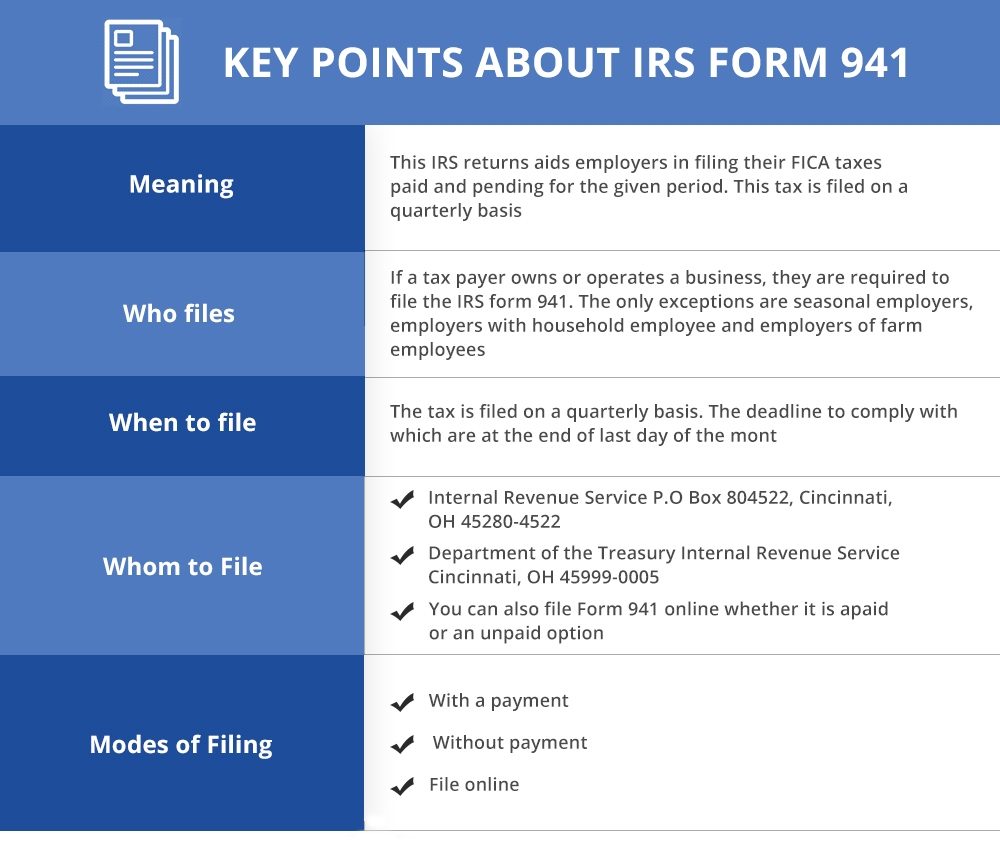
Most employers that pay wages subject to federal income tax withholding or Social Security and Medicare taxes must file Form 941.
The IRS says you generally file the initial Form 941 for the quarter in which you first pay wages subject to these taxes. After that, you generally file quarterly, even if you have no taxes to report.
This can apply to businesses of many sizes. Having only one or two employees does not automatically eliminate the Form 941 requirement.
Who generally does not file Form 941?
There are several exceptions and special situations.
Employers notified to file Form 944: If the IRS has notified you that you must file Form 944 instead, you generally do not file quarterly Form 941 returns.
Seasonal employers: A seasonal employer generally does not need to file Form 941 for a quarter in which no wages were paid and there is no tax liability, provided the employer properly identifies itself as a seasonal employer on the applicable returns.
Household employers: Household employees generally follow different reporting rules and may use Schedule H instead of Form 941.
Agricultural employers: Employers reporting wages for farm employees generally use Form 943 rather than Form 941 for those agricultural wages.
Do You Have to File Form 941 If You Paid No Wages This Quarter?
For most Form 941 employers, yes.
The IRS states that after filing the first Form 941, employers generally must continue filing every quarter, even when there are no taxes to report. The principal exceptions include employers that are seasonal and properly indicate that status, employers filing a final return, and employers that have been directed to file Form 944 instead.
This is different from simply saying, “There was no payroll, so there is no form.”
For example, suppose a small consulting company has two employees but does not pay them during the third quarter because they are temporarily inactive. The company may still have an ongoing Form 941 filing obligation.
A seasonal business can be different. The IRS specifically permits qualifying seasonal employers not to file for quarters when they have no tax liability because they paid no wages.
What Information Do You Need Before Completing Form 941?
Do not start with the form itself. Start with your payroll records.
Having the following information ready makes the return much easier to prepare:
Employer information
- Legal business name
- Employer Identification Number
- Business address
- Applicable quarter
Payroll totals
- Number of employees
- Total wages and compensation
- Taxable Social Security wages
- Social Security tips
- Medicare wages and tips
- Federal income tax withheld
- Federal garnishment
Tax records
- Payroll-tax liability for the quarter
- Federal tax deposits made during the quarter
- Applicable adjustments
- Eligible payroll-tax credits
Supporting records
- Payroll register
- Employee earnings reports
- Payroll journals
- Deposit confirmations
- Prior Form 941
- W-2 and W-3 reconciliation records
The IRS instructions specifically require employers to distinguish tax liability from deposits and to maintain sufficient records to support the return.
How to Complete Form 941 in 2026
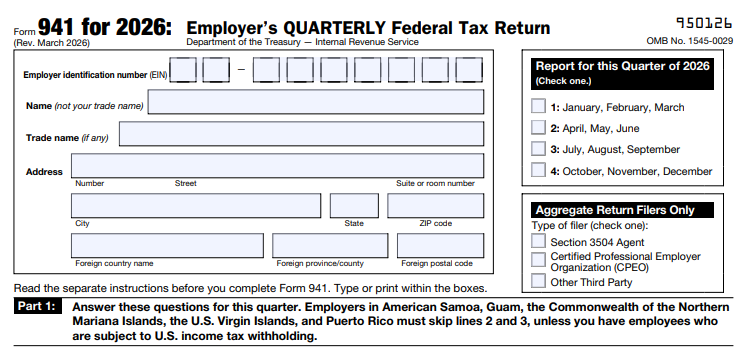
The current Form 941 contains employer information, quarterly wage and tax calculations, deposit information, business-status questions, third-party-designee information, and a signature section. The IRS instructions should always be checked against the specific revision of the form you are filing.
Step 1: Enter your business information
At the top of the form, enter:
- EIN
- Legal name
- Trade name, if applicable
- Business address
- Quarter being reported
Select the correct quarter carefully.
Filing a correct return for the wrong quarter can create reconciliation problems even when the dollar amounts themselves are accurate.
Step 2: Complete Part 1
Part 1 contains the wage and tax information for the quarter.
Line 1: Number of employees
Enter the number of employees who received wages, tips, or other compensation for the designated pay period containing the applicable quarterly count date.
The IRS specifies the relevant count dates as March 12, June 12, September 12, and December 12. Certain categories, including household and farm employees, are excluded from this employee count.
Line 2: Wages, tips, and other compensation
Enter compensation that generally corresponds to amounts included in Box 1 of employees’ Forms W-2, following the Form 941 instructions for special payments such as certain sick pay.
Line 3: Federal income tax withheld
Report federal income tax withheld, or required to be withheld, from employee wages, tips, and other applicable compensation during the quarter.
Lines 5a–5d: Social Security and Medicare taxes
These lines require particular care.
For 2026, the Social Security tax rate is 6.2% for the employee and 6.2% for the employer. The Social Security wage base is $184,500 per employee for 2026. Medicare tax is 1.45% for the employee and 1.45% for the employer and has no wage base limit.
Additional Medicare Tax is an employee-only 0.9% withholding that begins when an employee’s wages exceed $200,000 during the calendar year. There is no employer share of this additional tax.
Step 3: Enter adjustments
Lines 7–9 are used for specific adjustments, including certain fractions-of-cents, sick-pay, tips, and group-term life insurance situations.
Do not use these lines simply to force the Form 941 total to match a desired number. Each adjustment needs to be supported by the applicable payroll records and IRS rules.
Step 4: Calculate total tax
The form calculates total taxes before and after adjustments and applicable credits.
The resulting amount on line 12 becomes an important number when you compare the quarter’s tax liability with the deposits that were made.
Step 5: Enter total deposits
Line 13 reports the federal tax deposits made for the quarter, including certain applicable overpayments carried forward.
This is where many businesses discover a reconciliation issue. If the deposits reported on line 13 do not agree with the employer’s actual deposits or the IRS’s records, the return can show a balance due even when the business believes it has already paid the tax.
Step 6: Review line 14 or line 15
If line 12 is greater than line 13, the difference generally appears as a balance due on line 14.
If line 13 is greater than line 12, the overpayment is reported on line 15a, and the employer can generally choose whether to apply it to the next return or request a refund, subject to the form’s instructions.
What Is Form 941 Schedule B?
Schedule B (Form 941) is the Report of Tax Liability for Semiweekly Schedule Depositors.
You generally need Schedule B when you are a semiweekly schedule depositor. The IRS says a business generally becomes a semiweekly depositor when it reported more than $50,000 of employment taxes during the applicable lookback period. A $100,000 next-day deposit rule can also move a monthly depositor into semiweekly status.
Schedule B records tax liability by the dates wages were paid. It is not simply a list of deposits made.
This distinction matters.
The IRS specifically warns that line 16 and Schedule B report tax liability, not a summary of deposits. A semiweekly depositor that reports its liabilities on line 16 instead of using Schedule B can face an averaged federal tax deposit penalty.
Do monthly depositors file Schedule B?
Generally, no.
If you are a monthly schedule depositor, you report the applicable monthly liabilities on Form 941, line 16.
For 2026, employers with $50,000 or less in employment taxes during the applicable lookback period generally fall into the monthly schedule category unless the $100,000 next-day rule applies.
Form 941 Due Dates for 2026
For calendar-year employers, the standard Form 941 deadlines are:
| Quarter | Period covered | Regular due date | 2026 practical deadline |
| Q1 | January–March 2026 | April 30, 2026 | April 30, 2026 |
| Q2 | April–June 2026 | July 31, 2026 | July 31, 2026 |
| Q3 | July–September 2026 | October 31, 2026 | November 2, 2026 |
| Q4 | October–December 2026 | January 31, 2027 | February 1, 2027 |
The IRS’s basic rule is that Form 941 is due on the last day of the month following the end of the quarter. When the normal due date falls on a weekend or applicable legal holiday, the deadline moves to the next business day.
That matters twice around the end of 2026:
- October 31, 2026 is a Saturday, so the Q3 deadline moves to Monday, November 2, 2026.
- January 31, 2027 is a Sunday, so the Q4 2026 deadline moves to Monday, February 1, 2027.
Is there a 10-day extension?
There is an important filing rule for employers that made timely deposits in full for the quarter.
In that situation, the IRS generally allows Form 941 to be filed by the 10th day of the second month following the end of the quarter. This does not mean that you automatically receive an extra 10 days simply because you have not yet paid the tax.
The deposit obligation still has to be satisfied according to the applicable deposit schedule.
Form 941 Filing Deadlines vs. Payroll Tax Deposit Deadlines
These are not interchangeable.
Your quarterly payroll tax deadline tells you when the Form 941 return is due.
Your deposit schedule determines when you must deposit the taxes during the quarter.
For 2026, employers generally use either a monthly or semiweekly schedule based on their lookback-period tax liability. A $100,000 next-day liability can trigger a faster deposit requirement.
Federal tax deposits generally must be made electronically. The IRS lists EFTPS, business tax account payments, and other electronic payment methods for federal tax deposits.
Accounts Confidant’s Payroll Processing Services can also be relevant for businesses that need a recurring process for payroll calculations, payroll records, and payroll-tax compliance.
Can You File Form 941 Online?
Yes. The IRS supports electronic filing of Form 941 through its employment-tax Modernized e-File system.
There is an important difference between available and free.
The IRS says businesses that want to e-file themselves generally need IRS-approved software, and that software may charge a fee. Businesses can also work with an authorized tax professional or e-file provider.
The IRS does not provide a universal free, direct consumer-style Form 941 e-file service comparable to the way some individual tax returns can be filed through free programs.
Federal tax payments are a separate matter. EFTPS is a free federal payment system operated by the U.S. Treasury.
After e-filing, retain the electronic acknowledgement and the final submitted return with your payroll records.
IRS Form 941 Mailing Address Without Payment
Businesses that file a paper Form 941 need to use the address assigned to their location.
For 2026, the IRS divides paper filers into geographic groups.
Form 941 mailing address without payment
Connecticut, Delaware, District of Columbia, Georgia, Illinois, Indiana, Kentucky, Maine, Maryland, Massachusetts, Michigan, New Hampshire, New Jersey, New York, North Carolina, Ohio, Pennsylvania, Rhode Island, South Carolina, Tennessee, Vermont, Virginia, West Virginia, and Wisconsin:
Department of the Treasury
Internal Revenue Service
Kansas City, MO 64999-0005
Alabama, Alaska, Arizona, Arkansas, California, Colorado, Florida, Hawaii, Idaho, Kansas, Louisiana, Minnesota, Mississippi, Missouri, Montana, Nebraska, Nevada, New Mexico, North Dakota, Oklahoma, South Dakota, Texas, Utah, Washington, Wyoming:
Department of the Treasury
Internal Revenue Service
Ogden, UT 84201-0005
No legal residence or principal place of business in any state, including certain U.S. territories:
Internal Revenue Service
P.O. Box 409101
Ogden, UT 84409
The IRS maintains these addresses on its current Form 941 filing page. Because mailing addresses can change, check the IRS’s current instructions before mailing a paper return.
What if the return includes a payment?
For paper returns with payment, the current IRS instructions generally direct filers to:
Internal Revenue Service
P.O. Box 932100
Louisville, KY 40293-2100
The payment-address rules depend on how you are paying. If you pay electronically by EFT, credit/debit card, or electronic funds withdrawal, the IRS says to use the without-payment filing address and not Form 941-V. For a check or money order, follow the with-payment instructions and complete Form 941-V as required.
Private delivery services generally cannot deliver to IRS P.O. boxes, so use the IRS’s designated street-address instructions when using an approved private delivery service.
What Is the Form 941 Late Filing Penalty?
A late Form 941 can create a failure-to-file penalty, while late tax payments and deposits can create separate penalties.
Under the 2026 employer guidance, the failure-to-file penalty is generally 5% of the unpaid tax due with the return for each whole or partial month if the return is late, up to generally 25%. A separate failure-to-pay penalty can also apply. When both penalties apply in the same month, the failure-to-file penalty is reduced by the failure-to-pay penalty amount.
There can also be a failure-to-deposit penalty when required employment-tax deposits are late, incomplete, or made incorrectly. The IRS currently lists penalty rates of 2%, 5%, 10%, and 15%, depending on how late the deposit is and the circumstances.
These penalties are separate from the underlying tax. Filing a return late can therefore become more expensive even when the tax itself was already calculated correctly.
Reasonable-cause rules may provide relief in appropriate cases, but the taxpayer generally needs to explain why the failure occurred and follow the IRS process for requesting relief.
Common Form 941 Mistakes to Avoid
1. Filing the wrong quarter
Every Form 941 must correspond to the correct quarter.
Review the quarter box before submitting the return.
2. Treating deposits as tax liability
Deposits and tax liability are different in numbers.
Your liability reflects taxes generated by the payroll. Your deposits reflect payments made toward that liability. The IRS specifically warns employers not to substitute deposit amounts for required liability reporting.
3. Using the wrong Schedule B
If you are a semiweekly depositor, Schedule B is required.
A monthly depositor generally reports the monthly liability on line 16 rather than attaching Schedule B.
4. Entering incorrect Social Security wages
The 2026 Social Security wage base is $184,500. Once an employee reaches that threshold in taxable Social Security wages and tips for the year, Social Security tax generally stops, but Medicare withholding continues because Medicare has no wage base limit.
5. Failing to reconcile payroll records before filing
The Form 941 total should be compared with the payroll register, tax reports, and deposit records before submission.
This becomes especially important near year-end because the IRS and SSA compare quarterly Forms 941 with annual W-2 and W-3 information. Discrepancies can result in notices or requests for explanation.
6. Filing a second paper return after e-filing
The IRS specifically instructs employers that if Form 941 has already been electronically filed, they should not file a second paper Form 941 for the same quarter.
7. Assuming a payroll company automatically removes the employer’s responsibility
A payroll provider may prepare or file Form 941, depending on the service agreement.
However, the IRS generally says that using a third-party payer such as a payroll service provider or reporting agent does not by itself eliminate the employer’s responsibility to make sure returns are filed and taxes are paid or deposited correctly and on time. There are specific rules and exceptions for certified professional employer organizations.
Why Does Form 941 Show a Balance Due When You Already Paid?
Start with the relationship between line 12 and line 13.
Line 12 represents total taxes after applicable adjustments and credits.
Line 13 reports total deposits for the quarter.
When line 12 is greater than line 13, Form 941 calculates the difference as a balance due.
If you believe you already paid the full amount, compare:
- The deposits recorded in your payroll system
- EFTPS or other federal payment confirmations
- The tax period selected for each payment
- The EIN used for the payment
- The amount and date of each deposit
- The deposits entered on Form 941
Also check whether you accidentally reported a deposit as a liability or a liability as a deposit.
A mismatch does not automatically mean the IRS is wrong. It means the payroll records, payment records, and Form 941 need to be reconciled.
How Do You Fix an Error on a Form 941 Already Filed?
Do not simply file a second Form 941 for the same quarter to correct the original return.
The IRS uses Form 941-X, Adjusted Employer’s Quarterly Federal Tax Return or Claim for Refund, to correct errors on a previously filed Form 941.
A separate Form 941-X is generally required for each Form 941 being corrected.
Common corrections can involve:
- Wages
- Federal income tax withheld
- Social Security wages
- Social Security tips
- Medicare wages
- Additional Medicare Tax
- Certain payroll-tax adjustments
If you simply failed to file a required Form 941 at all, do not use Form 941-X as a substitute for the missing original return. The IRS instructs employers in that situation to file the required Form 941.
Why Don’t Form 941 Totals Match W-2 and W-3 Totals?
Some differences are legitimate, but unexplained differences can trigger questions.
The IRS matches amounts reported on quarterly Forms 941 against Form W-2 and Form W-3 totals. Among the amounts reconciled are:
- Federal income tax withholding
- Social Security wages
- Social Security tips
- Medicare wages and tips
The IRS recommends reconciling these amounts to reduce year-end discrepancies.
A good practice is to perform the reconciliation before the final Form 941 of the year is filed rather than waiting until W-2 preparation.
Your Online Bookkeeping Services workflow can also be used alongside payroll processes when your business needs recurring reconciliations and organized financial records.
What Happens When You Close Your Business?
Closing a business does not mean you can simply stop filing Form 941.
If you permanently go out of business or stop paying wages, the IRS requires a final return.
On the final Form 941, check the final-return box on line 17 and enter the date you last paid wages. You must also attach a statement identifying the person who will keep the payroll records and the address where those records will be maintained.
If the business is sold or transferred instead of simply closed, different rules may apply. The IRS instructions explain that both the former and new owners can have filing responsibilities for the quarter in which the transfer occurs.
What Is the Difference Between Form 940, Form 941, and Form 944?
The simplest distinction is:
Form 940 reports federal unemployment tax, or FUTA.
Form 941 reports federal income tax withholding and Social Security and Medicare taxes on a quarterly basis.
Form 944 is an annual alternative for certain small employers that have been notified by the IRS to file the annual return instead of Forms 941.
Form 940 is therefore not a replacement for Form 941, and Form 944 is not a form every small business can select independently.
See our detailed Form 940 vs. Form 941 vs. Form 944 comparison for the filing frequencies, taxes reported, deadlines, and current 2026–2027 considerations.
A Practical Form 941 Filing Checklist
Before submitting the return, review the following:
Business details
- Correct EIN
- Correct legal business name
- Correct business address
- Correct quarter
Payroll
- Employee count
- Total wages
- Federal income tax withholding
- Social Security wages and tips
- Medicare wages and tips
- Additional Medicare Tax, when applicable
Taxes and deposits
- Lines 6–12 calculated correctly
- Deposits agree with payment records
- Correct deposit schedule selected
- Schedule B attached when required
- Balance due or overpayment reviewed
Before submitting
- Compare Form 941 with the payroll register
- Review W-2/W-3 year-to-date totals when appropriate
- Confirm the signature
- Keep the completed return and supporting records
- Save electronic filing or payment confirmations
The IRS recommends retaining employment-tax records for at least four years.
Final Takeaway
IRS Form 941 is a quarterly payroll-tax reporting requirement for most employers with employees subject to federal income tax withholding or Social Security and Medicare taxes.
Filing the form correctly requires more than copying numbers from payroll software. You need to reconcile wages, withholding, Social Security and Medicare taxes, adjustments, and federal deposits before submitting the return.
For 2026, pay particular attention to the $184,500 Social Security wage base, the correct deposit schedule, Schedule B requirements for semiweekly depositors, and the adjusted calendar deadlines in November 2026 and February 2027.
Businesses that need help keeping payroll records organized, handling payroll processing, reconciling payroll accounts, and preparing employment-tax information can also review Accounts Confidant’s Payroll Processing Services.
For payroll and accounting assistance, contact Accounts Confidant at +1-877-519-7362.
FAQs About IRS Form 941
What is Form 941, and does my small business need to file it?
Form 941 is the Employer’s Quarterly Federal Tax Return. Most employers that pay employee wages subject to federal income tax withholding or Social Security and Medicare taxes must file it quarterly. Small businesses generally follow the same requirement unless an exception applies, such as being notified to file Form 944 instead.
Do I still need to file Form 941 if I paid no wages this quarter?
Generally, yes, if you are an active Form 941 filer. The main exceptions include qualifying seasonal employers with no wages, employers filing a final return, and employers that have been instructed to file Form 944 instead.
I only pay independent contractors. Do I need Form 941?
Generally, payments to properly classified independent contractors are not reported on Form 941. They may instead be subject to information-reporting requirements such as Form 1099-NEC. Worker classification depends on the facts of the working relationship, not simply how you pay the worker.
I already deposited my payroll taxes. Do I still need to file Form 941?
Yes, depositing the taxes does not replace the quarterly return. Form 941 reports the quarter’s wages and tax liability and accounts for the deposits made.
When is Form 941 due for each quarter of 2026?
For 2026 calendar quarters, the practical deadlines are April 30, 2026; July 31, 2026; November 2, 2026; and February 1, 2027 for Q1 through Q4 respectively. The Q3 and Q4 deadlines move because October 31, 2026 and January 31, 2027 fall on weekends.
Can I file Form 941 online, and is it free?
Yes, Form 941 can be electronically filed through IRS-authorized employment-tax e-file providers. The IRS states that businesses filing themselves generally need approved software, which may charge a fee.
Which payroll reports do I need to complete Form 941?
You should have your payroll register, employee earnings information, federal income-tax withholding totals, taxable Social Security and Medicare wages, payroll-tax liability, and federal deposit records. Keeping these records together makes reconciliation much easier.
Do I need Schedule B with Form 941?
Generally, you need Schedule B if you are a semiweekly schedule depositor. Employers that are monthly schedule depositors generally report their monthly tax liabilities on Form 941 line 16 instead.
What is the difference between Form 940, Form 941, and Form 944?
Form 940 reports FUTA unemployment tax annually. Form 941 generally reports federal income-tax withholding and Social Security and Medicare taxes quarterly. Form 944 reports similar payroll taxes annually for employers that qualify and have been notified by the IRS to use the annual return.
Why does Form 941 show a balance due when I already paid?
Form 941 shows a balance when the tax reported on line 12 is greater than the deposits reported on line 13. Check your payment confirmations, EIN, tax period, deposit amounts, and payroll records to identify a reconciliation problem.
How do I fix an error on a Form 941 I already filed?
Use Form 941-X to correct most errors on a previously filed Form 941. Generally, file a separate Form 941-X for each return that needs correction.
Why don’t my Form 941 totals match my W-2 and W-3 totals?
The IRS compares certain quarterly Form 941 totals with annual Forms W-2 and W-3. Differences in federal withholding, Social Security wages or tips, and Medicare wages and tips can create reconciliation problems. Review payroll adjustments, third-party sick pay, tips, and prior-quarter corrections.
Does my payroll provider file Form 941 for me?
It depends on the payroll service and your service agreement. Some full-service providers file returns on behalf of clients, while others prepare the forms for the employer to submit. The IRS generally says employers remain responsible for ensuring returns and payments are handled correctly unless a specific exception applies.
How do I file my final Form 941 after closing my business?
File Form 941 for the final quarter, check the final-return box on line 17, enter the final date wages were paid, and attach the required statement identifying who will retain the payroll records and where they will be kept.