Doing your own taxes can feel like the obvious way to save money. Tax software has made filing easier by guiding taxpayers through forms, performing calculations, and checking for some common errors. For people with straightforward finances, DIY tax preparation can work perfectly well.
The trouble starts when a tax return becomes more complicated. Self-employment income, business expenses, investments, multiple income sources, and unfamiliar deductions can make even a careful taxpayer vulnerable to mistakes.
That raises an important question: Should I do my own taxes, or should I hire a professional? The answer depends on the complexity of your tax situation, your comfort with tax rules, and how much time you are willing to spend reviewing your return.
This guide explains when DIY tax preparation is reasonable, where taxpayers commonly go wrong, what to check after filing, and when hiring a tax preparer may save more than it costs.
Table of Contents
When Is DIY Tax Preparation Actually Fine?
DIY tax preparation is not automatically a bad choice. In fact, many taxpayers can successfully prepare their own returns when their financial situation is simple and their records are organized.
You may be comfortable doing your own taxes if you:
- Have a straightforward income situation
- Receive W-2 income
- Have limited deductions and credits
- Have few or no investment transactions
- Do not have complicated business income
- Have all your tax documents available
- Understand the information you are entering
- Have enough time to review your return before filing
Tax software can be particularly useful in these situations because it walks you through the filing process and performs many calculations automatically.
When DIY Filing May Not Be Enough
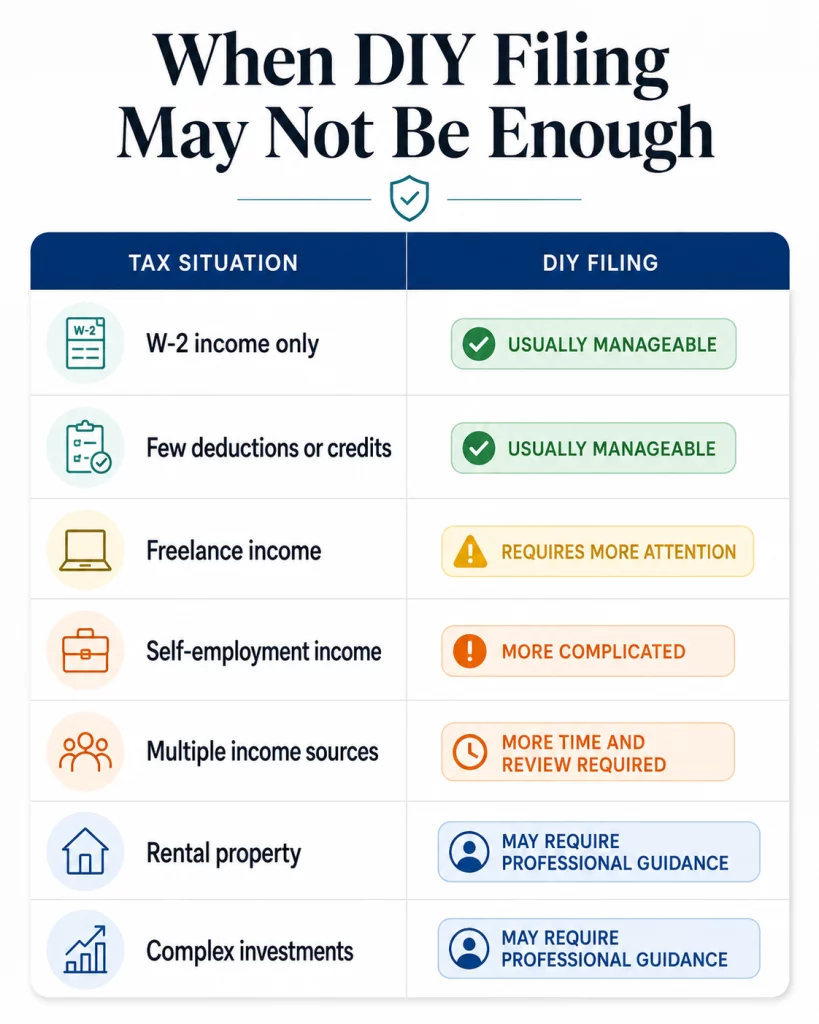
The situation changes when your return involves several types of income or tax decisions that you do not fully understand.
| Tax Situation | DIY Filing |
| W-2 income only | Usually manageable |
| Few deductions or credits | Usually manageable |
| Freelance income | Requires more attention |
| Self-employment income | More complicated |
| Multiple income sources | More time and review required |
| Rental property | May require professional guidance |
| Complex investments | May require professional guidance |
The important question is not simply whether tax software can prepare the return. It is whether you understand what needs to be reported and can support the information you enter.
For a simple return, DIY filing can save the cost of professional preparation. But as your tax situation becomes more complicated, the possibility of overlooking something increases.
That is where common tax filing errors start to matter.
7 Common Tax Preparation Mistakes When Filing on Your Own
Let’s look at some common tax filing errors:
Missing Income or Getting Tax Details Wrong
One of the most common tax preparation mistakes small business owners and individual taxpayers make is reporting incomplete or incorrect income. When you handle your own return, it is easy to overlook freelance payments, interest, investment income, rental income, or other sources of taxable earnings.
The same problem can occur with TDS, withholding information, or income reported under the wrong category. Even a small discrepancy can create questions about the return or result in additional tax being due.
Before filing, compare the information in your return with your income statements and other financial records. If you are self-employed, review both your business and personal records carefully so that no income is accidentally left out.
Paying More Because You Missed Tax-Saving Opportunities
DIY filing is not only about entering income and calculating tax. You also need to identify the deductions, credits, exemptions, and other tax benefits for which you qualify.
Many taxpayers focus on completing the return quickly and overlook legitimate opportunities to reduce their tax liability. Others may know that a deduction exists but are unsure whether they qualify or what documentation is required.
This is one of the biggest differences to consider when comparing DIY taxes vs. professional tax preparation. A professional can review your situation more broadly and identify tax-planning opportunities that may otherwise be missed.
Making Costly Mistakes With Expenses and Deductions
Incorrect deductions can be just as problematic as missed deductions. Taxpayers may claim expenses that do not qualify, use incorrect amounts, or fail to maintain supporting records.
This becomes particularly important for self-employed individuals and small business owners. Mixing personal and business expenses can make it difficult to determine which costs are actually deductible.
Some common self-employed tax mistakes include incorrectly reporting business expenses, estimating expenses instead of using proper records, and claiming deductions without sufficient documentation. Reviewing expenses carefully before filing can help prevent these problems.
Falling Behind on Tax Rules and Filing Requirements
Tax rules and filing requirements can change, and keeping up with every update is not always easy when you prepare your own return.
Changes to tax forms, deduction rules, reporting requirements, income classifications, or other provisions can affect how a return should be prepared. Relying entirely on what you did in a previous year can therefore lead to errors.
This is especially relevant for taxpayers with business income, investments, or other complex financial activities. If you are unsure whether a rule has changed or how it applies to your situation, getting professional guidance can help you avoid an unnecessary common tax filing error.
Underestimating the Consequences of a Filing Mistake
A simple error does not automatically mean that you will face an audit or penalty. However, inaccurate or inconsistent information can create complications, particularly when figures in your return do not match information already reported to tax authorities.
Errors can also result in an incorrect tax liability, delayed refund, additional interest, or requests for clarification.
This is why reviewing your return carefully matters. If you are asking, “Should I do my own taxes?”, consider not only whether you can complete the forms but also whether you are comfortable identifying and correcting errors before filing.
Neglecting Security and Financial Data Protection
DIY tax preparation also involves handling sensitive financial information. Depending on how you file, this may include taxpayer identification details, income information, bank details, investment records, and other personal financial data.
Using unsecured websites, sharing documents through inappropriate channels, or failing to protect digital records can expose this information unnecessarily.
Taxpayers should use reputable filing platforms, secure their accounts, and be careful about where they upload or send financial documents. For people who are uncomfortable managing sensitive information themselves, professional assistance can provide an additional layer of structured handling.
Being Left on Your Own After Filing
Submitting a tax return is not necessarily the end of the process. You may later discover an error, receive a notice, have a question about your refund, or need to correct information that was reported incorrectly.
DIY filers are often responsible for identifying the problem and determining what action to take next. This can become stressful when the mistake involves complicated income, deductions, business activity, or investment transactions.
Professional tax preparation can provide support beyond filing, including helping review potential mistakes, explaining notices, and determining whether a correction or amended return may be necessary.
These seven issues do not mean that everyone should avoid DIY tax preparation. For a straightforward return, filing yourself may be perfectly reasonable. The bigger question is whether your financial situation is simple enough that you can confidently report everything, claim the right tax benefits, follow current requirements, and deal with any problems that arise afterward.
A Simple Self-Employed Tax Checklist
Discovering a mistake after filing can be stressful, especially when you are unsure whether the error is serious. The first step is to slow down and identify exactly what went wrong.
Before filing, review:
- Business income: Have all payments and revenue been accounted for?
- Business expenses: Have applicable expenses been identified and documented?
- Bank records: Do your records match the figures reported?
- Tax payments: Have estimated payments been tracked?
- Receipts: Can you support the expenses you are claiming?
- Records: Are your business and personal transactions clearly separated?
Start by comparing your filed return with your original records.
Check:
- W-2s and 1099s
- Business income records
- Bank and financial records
- Deductions and credits
- Withholding information
- Estimated tax payments
- Forms and schedules included with the return
If you are unsure what to do, getting professional assistance can be more useful than trying to guess your way through the correction.
DIY Taxes vs. Professional Tax Preparation
The DIY taxes vs. Professional decision usually comes down to four things: cost, complexity, time, and confidence.
For a straightforward return, tax software may be all you need. It can guide you through questions, perform calculations, and help organize the filing process.
But software cannot replace your understanding of the information being entered. If you do not know that a particular income source needs to be reported or whether an expense qualifies, the software may not catch the underlying issue.
Professional tax preparation costs more upfront but gives you access to someone who can review your tax situation and help you understand complicated issues.
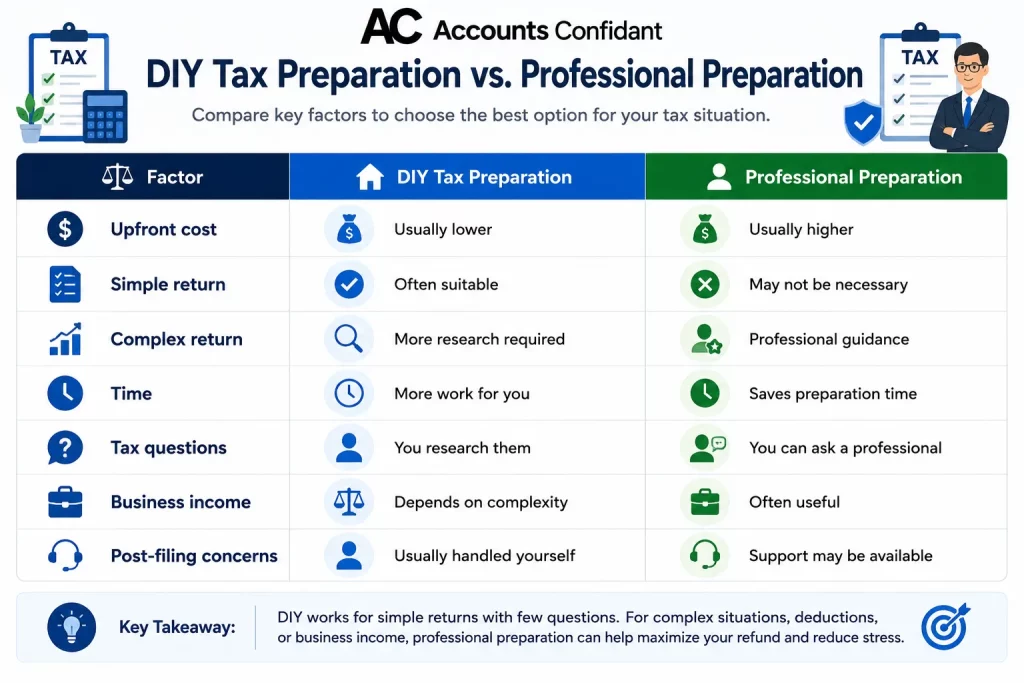
| Factor | DIY Tax Preparation | Professional Preparation |
| Upfront cost | Usually lower | Usually higher |
| Simple return | Often suitable | May not be necessary |
| Complex return | More research required | Professional guidance |
| Time | More work for you | Saves preparation time |
| Tax questions | You research them | You can ask a professional |
| Business income | Depends on complexity | Often useful |
| Post-filing concerns | Usually handled yourself | Support may be available |
The cost of DIY filing is not limited to the price of tax software.
You also spend your own time:
- Gathering documents
- Organizing records
- Researching tax questions
- Entering information
- Reviewing the return
- Fixing mistakes if you discover them later
For a simple return, that extra time may be minimal.
For a complicated return, however, the calculation changes. Spending several hours researching unfamiliar tax rules may not be worthwhile if professional preparation can address the issue more efficiently.
That does not mean hiring a professional is always the better financial choice. It means the real cost of DIY filing depends on more than the software fee.
When Should You Hire a Tax Professional?
Professional help becomes more valuable when the tax return involves situations you do not understand or cannot confidently document.
Consider hiring a tax professional if you have:
- Self-employment or business income
- Multiple sources of income
- Rental property
- Complicated investments
- Significant deductions or credits
- Complicated business expenses
- Major financial changes
- Previous tax filing mistakes
- Tax notices or correspondence
- Several unresolved tax years
A small business owner should also consider professional help when bookkeeping and tax preparation have become difficult to manage together.
The decision ultimately comes down to complexity versus confidence. If you understand your tax situation, have organized records, and can confidently prepare a straightforward return, DIY filing may be fine.
If you are spending hours trying to understand tax rules, worrying about whether you entered something correctly, or dealing with a complicated business return, professional assistance may be worth the cost.
Benefits of Hiring a Tax Professional
Hiring a tax professional can be worthwhile when your return involves more than basic income and deductions. A professional can help you:
- Reduce tax filing errors: Review income, deductions, credits, and supporting information before filing.
- Identify eligible tax savings: Help find deductions and credits you may overlook when filing on your own.
- Save time: Handle calculations, forms, documentation, and other time-consuming parts of tax preparation.
- Handle complex tax situations: Provide guidance for self-employment income, business expenses, investments, rental income, and multiple income sources.
- Stay current with tax rules: Apply relevant tax requirements and filing changes to your situation.
- Get help after filing: Assist if you discover an error, receive a tax notice, or need to address a filing issue.
- Reduce tax-season stress: Give you a professional point of contact when you are unsure how to handle a tax question.
Conclusion
DIY tax preparation can be a practical option when your tax situation is simple. The problem is not doing your own taxes. The problem is doing them without understanding what you are reporting.
Knowing the common tax filing errors, keeping good records, and recognizing when your situation has become too complicated can help you make a better decision between DIY filing and professional tax preparation.
Frequently Asked Questions
Can I do my own tax return without an accountant?
Yes, You can prepare your own tax return using tax software or other available filing options. DIY filing may work well when your income, deductions, and overall tax situation are straightforward.
Is it safe to do my own taxes if I’m self-employed?
It can be, but self-employed taxpayers have more information to track. You need to properly report business income, identify applicable expenses, track tax payments, and maintain supporting records.
What mistakes do people commonly make filing their own taxes?
Common mistakes include forgetting income, missing deductions or credits, entering incorrect information, claiming unsupported expenses, misclassifying income or expenses, forgetting tax payments, and missing deadlines.
Does doing my own taxes increase my chance of an audit?
No, Filing your own taxes does not automatically increase your audit risk. However, inaccurate, incomplete, or inconsistent information can create problems regardless of who prepared the return.
When should a small business owner hire a tax preparer instead of doing it themselves?
A small business owner should consider professional help when the business has multiple income sources, complicated expenses, significant deductions, complex investments, tax notices, or other issues they are not confident handling.
I did my own taxes and I’m worried I made a mistake, what should I check?
Compare your filed return with your W-2s, 1099s, business records, deductions, credits, withholding, and estimated tax payments. If you find a significant error or are unsure how to correct it, consider having a tax professional review the return.
Is tax software good enough for a small business, or do I need a CPA?
Tax software may be sufficient for some straightforward small businesses. A CPA or other qualified tax professional may be more appropriate when the business has complicated finances, multiple income sources, significant deductions, investments, or other complex tax issues.
What’s the real cost difference between DIY tax software and hiring a preparer?
DIY tax software generally costs less upfront, but you also spend your own time gathering documents, researching tax questions, preparing the return, and handling any corrections. A professional preparer usually costs more but can save time and provide guidance for complicated tax situations.