
Running a business means wearing many hats, from managing operations and serving customers to driving sales and planning for growth. Amid these responsibilities, keeping accurate financial records often becomes an afterthought. However, maintaining organized books is one of the most important practices for building a financially healthy business. That’s where bookkeeping services come in.
Professional bookkeeping ensures every financial transaction is accurately recorded, categorized, and reconciled. Many entrepreneurs begin by managing their own books but eventually discover that bookkeeping requires time, consistency, and financial knowledge. As businesses grow, handling bookkeeping internally can become overwhelming, making professional assistance a practical solution.
In this guide, you’ll learn what bookkeeping services include, why they matter, what small business bookkeeping services typically cover, how monthly bookkeeping services work, factors affecting outsourced bookkeeping cost, and when to hire a bookkeeper for your business.
What Are Bookkeeping Services?
Bookkeeping services involve recording, organizing, and maintaining a company’s daily financial transactions. Unlike accounting, which focuses on interpreting financial data and providing strategic insights, bookkeeping ensures financial records remain complete, accurate, and up to date.
Every sale, purchase, expense, payment, and bank transaction contributes to your company’s financial picture. Professional bookkeepers ensure these records are properly categorized and maintained so business owners always know where their money is coming from and where it’s going.
Typical bookkeeping services include:
- Recording daily financial transactions
- Tracking income and expenses
- Managing accounts payable
- Managing accounts receivable
- Reconciling bank and credit card statements
- Processing payroll records
- Maintaining the general ledger
- Organizing financial documents
- Preparing monthly financial reports
- Monitoring cash flow
Rather than waiting until tax season to organize financial information, bookkeeping creates an ongoing system that keeps your records accurate throughout the year.
Why Small Businesses Need Professional Bookkeeping Services
Many entrepreneurs believe bookkeeping is simply entering numbers into accounting software. In reality, effective bookkeeping supports nearly every financial decision a business makes.
Professional small business bookkeeping services provide several long-term benefits.
Better Financial Visibility
Business owners can only make informed decisions when they understand their financial position. Updated bookkeeping provides accurate information about income, expenses, profits, liabilities, and cash availability.
Instead of guessing whether the business is profitable, owners have reliable financial reports to guide decisions.
Improved Cash Flow Management
Cash flow problems remain one of the leading challenges for small businesses. Even profitable businesses can experience financial difficulties if incoming payments don’t align with outgoing expenses.
Bookkeepers monitor:
- Customer payments
- Vendor invoices
- Outstanding receivables
- Upcoming bills
- Bank balances
This visibility helps prevent cash shortages before they become serious problems.
Easier Tax Preparation
Tax season becomes much less stressful when financial records remain organized throughout the year.
Accurate bookkeeping helps:
- Track deductible expenses
- Maintain supporting documentation
- Reduce filing errors
- Minimize last-minute work
- Support tax compliance
Instead of scrambling for receipts, business owners already have organized financial records available.
Fewer Financial Errors
Duplicate entries, missing invoices, incorrect expense classifications, and reconciliation mistakes can significantly impact financial reporting.
Professional bookkeeping helps identify and correct these issues before they affect budgeting, tax filings, or financial statements.
Better Business Decisions
Reliable bookkeeping reports help answer questions like:
- Which products generate the highest profits?
- Are expenses increasing?
- Which customers pay late?
- Is revenue growing?
- Can the business afford new equipment?
- Is hiring another employee financially realistic?
Without accurate records, these decisions rely on assumptions rather than facts.
More Time for Business Growth
Bookkeeping requires consistent attention. Business owners who spend hours reconciling accounts or correcting transactions have less time to focus on customers, marketing, operations, and growth strategies.
Outsourcing bookkeeping allows owners to focus on running their businesses rather than maintaining spreadsheets.
What Is Included in Monthly Bookkeeping Services?
Most businesses choose monthly bookkeeping services because they ensure financial records stay current without requiring daily involvement from business owners.
Depending on the provider and business needs, monthly bookkeeping typically includes the following services.
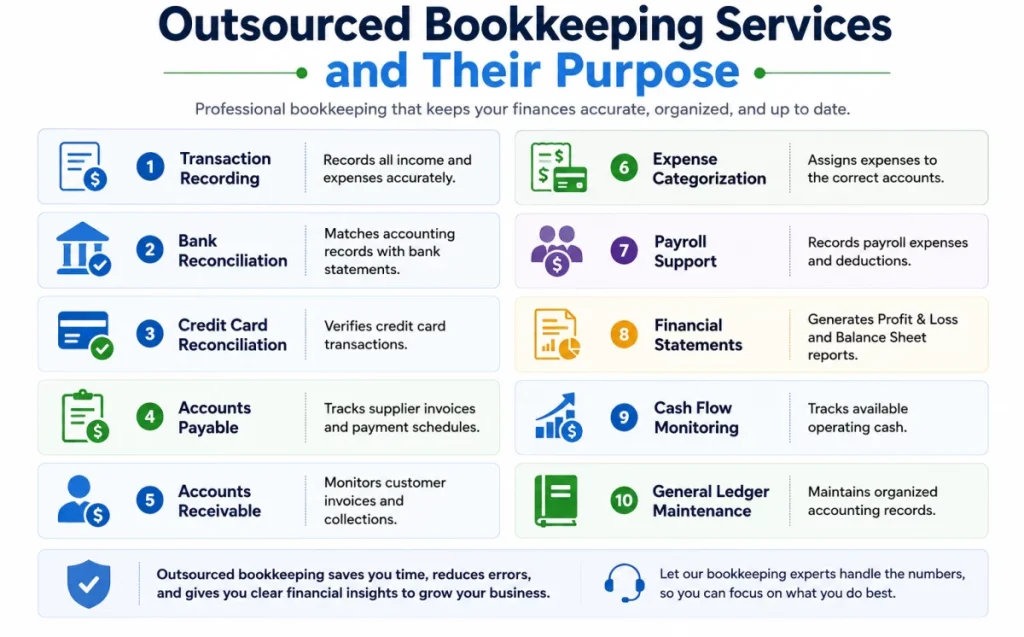
| Service | Purpose |
| Transaction Recording | Records all income and expenses accurately |
| Bank Reconciliation | Matches accounting records with bank statements |
| Credit Card Reconciliation | Verifies credit card transactions |
| Accounts Payable | Tracks supplier invoices and payment schedules |
| Accounts Receivable | Monitors customer invoices and collections |
| Expense Categorization | Assigns expenses to the correct accounts |
| Payroll Support | Records payroll expenses and deductions |
| Financial Statements | Generates Profit & Loss and Balance Sheet reports |
| Cash Flow Monitoring | Tracks available operating cash |
| General Ledger Maintenance | Maintains organized accounting records |
These reports provide valuable insights into business performance.
Bookkeeping vs. Accounting: What’s the Difference?
Although bookkeeping and accounting work together, they serve different purposes.
Bookkeeping focuses on recording financial transactions, while accounting interprets financial data and supports business planning.
| Feature | Bookkeeping | Accounting |
| Primary Focus | Recording financial transactions | Analyzing financial information |
| Objective | Maintain accurate financial records | Support strategic decision-making |
| Daily Activities | Recording expenses, invoices, reconciliations | Financial analysis, forecasting, tax planning |
| Financial Reports | Provides data for reports | Interprets and explains reports |
| Tax Preparation | Organizes financial records | Prepares tax returns and strategies |
| Business Insights | Limited | Extensive financial analysis |
| Required Skills | Recordkeeping and organization | Accounting principles and financial analysis |
Bookkeepers ensure every transaction is properly documented.
Examples include:
- Recording sales
- Entering supplier invoices
- Reconciling bank accounts
- Managing payroll entries
- Tracking expenses
Accountants use bookkeeping records to:
- Analyze profitability
- Prepare tax returns
- Create budgets
- Forecast growth
- Provide financial advice
- Ensure regulatory compliance
Without accurate bookkeeping, accountants lack reliable financial data for analysis.
How Bookkeeping Supports Business Growth
Many business owners view bookkeeping as an administrative task, but its impact extends far beyond compliance. Accurate financial records create opportunities for sustainable growth by providing the information needed to make confident business decisions.
Reliable bookkeeping helps businesses:
- Identify profitable products and services
- Monitor operating costs
- Improve pricing strategies
- Secure business loans with organized financial statements
- Attract investors through transparent reporting
- Plan budgets based on actual financial performance
- Forecast future revenue more accurately
For growing companies, bookkeeping evolves from simply tracking transactions to becoming an essential part of financial management. As revenue increases and operations become more complex, maintaining accurate books becomes even more valuable for supporting expansion and long-term stability.
Signs It’s Time to Hire a Bookkeeper
Many business owners start by managing their own books to save money. While this may work during the early stages, bookkeeping becomes more complex as the business grows. Delayed financial records, cash flow issues, and compliance risks often signal that it’s time to seek professional help.
If you’re wondering when to hire a bookkeeper, here are some common signs to watch for.
You’re Falling Behind on Bookkeeping
When receipts pile up, invoices go unrecorded, or bank reconciliations are weeks behind, your financial records quickly lose accuracy. Catching up can become time-consuming and increase the risk of costly mistakes.
Tax Season Feels Stressful Every Year
If preparing for tax season means scrambling to organize receipts, reconcile accounts, or locate missing invoices, your bookkeeping process needs improvement. A professional bookkeeper keeps your records current throughout the year, making tax preparation far easier.
Cash Flow Is Difficult to Track
Knowing how much money is available is critical for daily operations. If you’re unsure whether you can cover payroll, vendor payments, or upcoming expenses, accurate bookkeeping can provide the visibility needed to manage cash flow effectively.
Your Business Is Growing
As your customer base expands, transaction volumes increase, and new employees join the business, bookkeeping becomes more demanding. Growth often requires more structured financial management than a business owner can realistically handle alone.
You’re Spending Too Much Time on Administrative Tasks
Every hour spent reconciling accounts or organizing financial records is time taken away from serving customers, improving products, or growing your business. Hiring a bookkeeper allows you to focus on activities that generate revenue.
In-House vs. Outsourced Bookkeeping Services
When deciding how to manage your finances, businesses generally choose between hiring an in-house bookkeeper or partnering with an external bookkeeping provider. Both options have advantages depending on your business size, budget, and operational needs.
| In-House Bookkeeper | Outsourced Bookkeeping Services |
| Full-time salary and employee benefits | Fixed monthly service fee |
| Requires recruitment and training | Ready-to-use experienced professionals |
| Limited to one employee’s expertise | Access to a team with diverse experience |
| Employer manages software and tools | Many providers include software support |
| Vacation or sick leave may interrupt work | Continuous service coverage |
| Best for large organizations | Ideal for startups and small businesses |
For many growing companies, outsourcing offers greater flexibility without the overhead costs associated with hiring a full-time employee.
Choosing the Right Bookkeeping Service Tier for Your Small Business
Not every business needs the same level of bookkeeping support. A freelancer tracking a few monthly expenses has different requirements than a growing company managing payroll, invoices, and financial planning. Understanding the differences between bookkeeping service tiers can help you choose the right solution without paying for unnecessary services.
| Bookkeeping Service Tier | What’s Included | Best-Fit Business Type |
| Basic Bookkeeping | Transaction categorization, bank and credit card reconciliation, monthly financial statements, and basic account maintenance | Freelancers, independent contractors, and small businesses with fewer transactions that need organized financial records |
| Full-Service Bookkeeping | Complete bookkeeping management, accounts payable and receivable tracking, payroll support, financial reporting, and regular account reviews | Growing small businesses that need consistent bookkeeping support without hiring an internal accounting team |
| Advanced Bookkeeping & Advisory | Financial forecasting, budgeting assistance, cash flow analysis, KPI reporting, workflow improvements, and strategic financial insights | Established businesses, startups, and companies planning growth, expansion, or improved financial decision-making |
Choosing the right bookkeeping tier depends on your business size, transaction volume, financial complexity, and long-term goals. By matching your needs with the appropriate level of support, you can maintain accurate records, improve cash flow visibility, and spend more time focusing on business growth.
What Affects Outsourced Bookkeeping Cost?
One of the most common questions business owners ask is about outsourced bookkeeping cost. The answer depends on several factors rather than a single standard price.
Some of the primary factors include:
Number of Monthly Transactions
Businesses with hundreds or thousands of transactions require more bookkeeping time than companies with only a few dozen transactions each month.
Payroll Complexity
Managing payroll for multiple employees, contractors, or different pay schedules increases the scope of bookkeeping services.
Number of Financial Accounts
Businesses with multiple bank accounts, credit cards, or payment platforms require additional reconciliation work.
Industry Requirements
Industries such as construction, healthcare, manufacturing, and eCommerce often require more detailed bookkeeping due to inventory management, project costing, or regulatory requirements.
Reporting Requirements
Some businesses only require monthly financial statements, while others need weekly reports, cash flow analysis, or customized management reports.
Additional Services
Costs may also vary depending on whether the bookkeeping provider manages payroll, sales tax filings, accounts receivable, accounts payable, or inventory tracking.
Instead of focusing solely on price, business owners should evaluate the overall value, expertise, and reliability a bookkeeping provider brings to their organization.
How to Choose the Right Bookkeeping Service
Not all bookkeeping providers offer the same level of expertise or support. Choosing the right partner can significantly improve your financial management and business operations.
Consider the following factors when evaluating bookkeeping services.
Industry Experience
A provider familiar with your industry understands common financial challenges, reporting requirements, and best practices.
Cloud Accounting Expertise
Look for professionals experienced with modern accounting platforms that allow secure collaboration, automation, and real-time financial reporting.
Data Security
Financial information is highly sensitive. Choose a provider that follows secure data handling practices and protects confidential business information.
Clear Communication
Reliable bookkeeping involves more than entering transactions. Your provider should explain reports, answer questions promptly, and communicate regularly.
Transparent Pricing
Choose bookkeeping services with clear pricing structures and no unexpected fees.
Scalability
Your bookkeeping needs will evolve as your business grows. Select a provider that can expand its services without requiring you to switch firms later.
Benefits of Outsourcing Bookkeeping
Outsourcing bookkeeping has become increasingly popular among startups and growing businesses because it provides access to financial expertise without the expense of maintaining an internal accounting department.
Some of the key benefits include:
- Lower administrative costs
- Access to experienced bookkeeping professionals
- Improved financial accuracy
- Faster month-end reporting
- Better cash flow management
- Reduced compliance risks
- More time to focus on customers and business growth
- Scalable services as your company expands
Professional bookkeeping also provides business owners with confidence that financial records remain organized, accurate, and ready for tax season or lender requests.
Common Bookkeeping Mistakes Small Businesses Should Avoid
Even successful businesses can experience financial problems when bookkeeping practices are inconsistent. Avoiding these common mistakes helps maintain accurate records and supports better decision-making.
Mixing Business and Personal Expenses
Separate business and personal accounts from the beginning. Combining expenses makes bookkeeping more difficult and complicates tax preparation.
Delaying Transaction Recording
Waiting weeks or months to record transactions increases the likelihood of missing receipts, duplicate entries, and inaccurate financial reports.
Skipping Bank Reconciliations
Regular reconciliations help detect errors, unauthorized transactions, and missing entries before they become larger problems.
Ignoring Financial Reports
Profit and Loss statements, Balance Sheets, and Cash Flow reports provide valuable insights into business performance. Reviewing these reports regularly supports better planning.
Keeping Poor Documentation
Maintain digital copies of invoices, receipts, payroll records, and supporting documents to simplify audits and tax preparation.
Conclusion
Bookkeeping is much more than recording financial transactions. It provides the accurate financial information businesses need to manage operations, improve cash flow, prepare taxes, and make informed decisions with confidence.
Whether you’re a startup handling your own books or an established company looking to improve financial management, investing in professional bookkeeping services can save time, reduce errors, and support long-term growth. As your business expands, reliable monthly bookkeeping services and experienced financial professionals become valuable partners in helping you stay organized, compliant, and prepared for future opportunities.
Frequently Asked Questions
What level of bookkeeping services does my small business need?
The level of bookkeeping services depends on your business size, transaction volume, payroll requirements, and reporting needs. While some businesses only require basic transaction recording and bank reconciliations, others may benefit from comprehensive monthly bookkeeping, payroll support, accounts payable and receivable management, and customized financial reporting.
How much does small business bookkeeping cost per month?
The monthly cost varies based on the number of transactions, payroll complexity, industry requirements, reporting frequency, and additional services required. Rather than focusing solely on price, businesses should consider the experience, service quality, and long-term value provided by the bookkeeping partner.
What’s the difference between a bookkeeper and an accountant?
A bookkeeper records daily financial transactions, reconciles accounts, and maintains accurate financial records. An accountant analyzes that information, prepares financial statements, develops tax strategies, and provides financial advice to support business decisions.
When should I hire a bookkeeper instead of doing it myself?
You should consider hiring a bookkeeper when bookkeeping consumes too much of your time, your business experiences consistent growth, financial records become difficult to manage, or tax preparation becomes increasingly stressful.
What should I look for in a bookkeeping service?
Look for industry experience, cloud accounting expertise, transparent pricing, secure data handling practices, responsive communication, and the ability to scale services as your business grows.

Do I need a full-charge bookkeeper or just basic bookkeeping?
Basic bookkeeping is suitable for businesses that primarily need transaction recording, reconciliations, and financial reporting. A full-charge bookkeeper is more appropriate for businesses requiring payroll management, budgeting support, financial oversight, and broader accounting responsibilities.


