Choosing the right accounting method can affect how well your business manages money, controls costs, and plans for growth.
Many business owners start with a traditional accountant because it feels familiar. They may have someone working in the office, handling documents, recording transactions, and preparing reports.
However, as businesses become more digital, many companies are exploring virtual accounting as an alternative. Virtual accounting allows businesses to work with accounting professionals remotely using cloud software and online communication tools.
The main difference between traditional and virtual accounting is that traditional accounting usually depends on an in-house employee, while virtual accounting provides remote access to accounting experts without the cost of hiring a full-time team member.
Both options can work well depending on the needs of a business. The right choice depends on factors like cost, required expertise, business size, technology needs, and future growth plans.
What Is Traditional Accounting?
Traditional accounting is a method where a business hires an accountant or accounting team to work from a physical office location.
In this model, accounting tasks are handled internally.
A traditional accounting setup may include:
- Full-time accountant
- Bookkeeper
- Finance manager
- Accounting department
These professionals may handle:
- Recording transactions
- Preparing financial reports
- Managing payroll
- Bank reconciliation
- Tax preparation
- Compliance tasks
For many years, this was the standard approach for businesses that needed accounting support.
For example, a growing company may hire an in-house accountant who works every day from the company office and manages all financial activities.
What Is Virtual Accounting?
Virtual accounting is a remote accounting service where businesses work with accounting professionals online instead of hiring a full-time employee.
Virtual accountants use digital tools such as:
- QuickBooks Online
- Xero
- Cloud storage platforms
- Secure client portals
- Video meetings
- Digital communication tools
A virtual accounting provider can help with:
- Bookkeeping
- Bank reconciliation
- Financial reporting
- Tax support
- Payroll assistance
- Cash flow analysis
- Advisory services
Instead of hiring one person, businesses can access a team of professionals based on their needs.
Traditional vs Virtual Accounting: Key Differences
Traditional accounting and virtual accounting differ mainly in cost, working style, expertise access, and scalability.
| Factor | Traditional Accounting | Virtual Accounting |
| Working style | Office-based | Remote and digital |
| Hiring model | Full-time employee | Outsourced service |
| Cost structure | Salary and employee costs | Monthly service fee |
| Expertise | Usually one person or small team | Access to multiple experts |
| Software | May use local systems | Cloud-based systems |
| Scalability | Requires new hires | Easier to increase support |
| Location | Limited by geography | Global access |
Traditional Accounting vs Virtual Accounting Cost Comparison
Virtual accounting is often cheaper because businesses pay for accounting services instead of paying the full cost of an employee.
Many business owners compare only salary when looking at accounting costs. However, hiring an employee includes many additional expenses.
Costs of a Traditional In-House Accountant
A full-time accountant may involve:
- Salary
- Payroll taxes
- Employee benefits
- Health insurance
- Paid leave
- Recruitment costs
- Training costs
- Office space
- Computer equipment
- Accounting software
For example, an employee earning a monthly salary may cost much more after adding benefits, taxes, equipment, and management time.
Costs of Virtual Accounting Services
Virtual accounting usually works through a monthly service plan.
Costs depend on:
- Number of transactions
- Services required
- Business complexity
- Reporting needs
A company may choose support for:
- Basic bookkeeping
- Monthly reconciliation
- Financial reporting
- Tax preparation
- Controller services
This allows businesses to control costs and avoid paying for unused capacity.
Why Is Virtual Accounting Cheaper Than Traditional Accounting?
Virtual accounting is cheaper because it reduces fixed business costs while providing access to professional accounting support.
With a traditional employee, businesses pay for the person’s time, even during slower periods.
With virtual accounting, businesses usually pay for the work they need.
For example:
A startup may only need:
- Monthly bookkeeping
- Bank reconciliation
- Financial reports
Hiring a full-time accountant may provide more capacity than the startup requires.
A virtual accounting service allows the company to receive professional support without carrying unnecessary costs.
Does Virtual Accounting Provide the Same Expertise?
Virtual accounting can provide the same or broader expertise because businesses may get access to a team of accounting professionals instead of one employee.
A common concern is:
“Will I lose quality if I move away from an in-house accountant?”
The answer depends on the provider.
A traditional employee may have knowledge in many areas, but that knowledge is limited to one person.
A virtual accounting team may include:
- Bookkeepers
- Accountants
- Certified professionals
- Tax specialists
- Controllers
- Financial advisors
This gives businesses access to different skills when needed.
For example:
A small business may use:
- A bookkeeper for daily records
- An accountant for reporting
- A tax professional for planning
Instead of hiring three separate employees, the business can access different experts through one provider.
Traditional Accounting vs Virtual Accounting: Pros and Cons
Both traditional and virtual accounting have advantages, but the better option depends on business needs.
Traditional Accounting Advantages
Traditional accounting can be useful because:
Direct Office Communication
Some business owners prefer speaking with someone face-to-face.
Internal Business Knowledge
An employee may become deeply familiar with daily operations.
Direct Management
Business owners can manage priorities directly.
Traditional Accounting Challenges
Traditional accounting can create challenges:
Higher Costs
Businesses must cover:
- Salary
- Benefits
- Payroll expenses
- Office costs
Hiring Difficulties
Finding skilled accounting professionals can take time.
Limited Expertise
One employee may not have advanced knowledge in every accounting area.
Employee Dependency
If the accountant leaves, important knowledge may leave with them.
Virtual Accounting Advantages
Virtual accounting offers several benefits:
Lower Costs
Businesses avoid many employee-related expenses.
Access to More Experts
Companies can work with professionals who have different skills.
Better Scalability
Support can increase as the business grows.
Remote Convenience
Businesses can collaborate from anywhere.
Modern Technology
Virtual accounting uses cloud-based systems for faster access to financial information.
Virtual Accounting Challenges
Virtual accounting also requires the right approach.
Possible challenges include:
Less Physical Interaction
Some owners prefer in-person meetings.
Need for Good Communication
Clear processes are important when working remotely.
Choosing the Right Provider
Businesses should review experience, security, and service quality before selecting a provider.
Virtual Accounting Benefits for Startups and Small Businesses
Virtual accounting is especially useful for startups and small businesses because it provides professional support without large fixed costs.
Startups often need financial guidance but may not have enough work for a full-time accounting department.
Virtual accounting can help startups with:
- Budget control
- Cash flow tracking
- Monthly reports
- Tax preparation
- Financial planning
For example:
A startup may begin with bookkeeping support and later add:
- Financial forecasting
- Controller services
- Strategic advice
The company can increase support without hiring multiple employees.
How Virtual Accounting Supports Growing Businesses
Virtual accounting helps growing businesses handle increasing financial needs without rebuilding their entire accounting team.
As businesses grow, they may need:
- More transaction processing
- More detailed reporting
- Better financial controls
- Faster month-end closing
A virtual accounting provider can adjust services based on changing needs.
For example:
An ecommerce company may start with basic bookkeeping.
Later, it may need:
- Inventory accounting
- Payment reconciliation
- Sales reporting
- Cash flow analysis
Virtual accounting makes this growth easier.
Traditional Accounting vs Virtual Accounting Technology
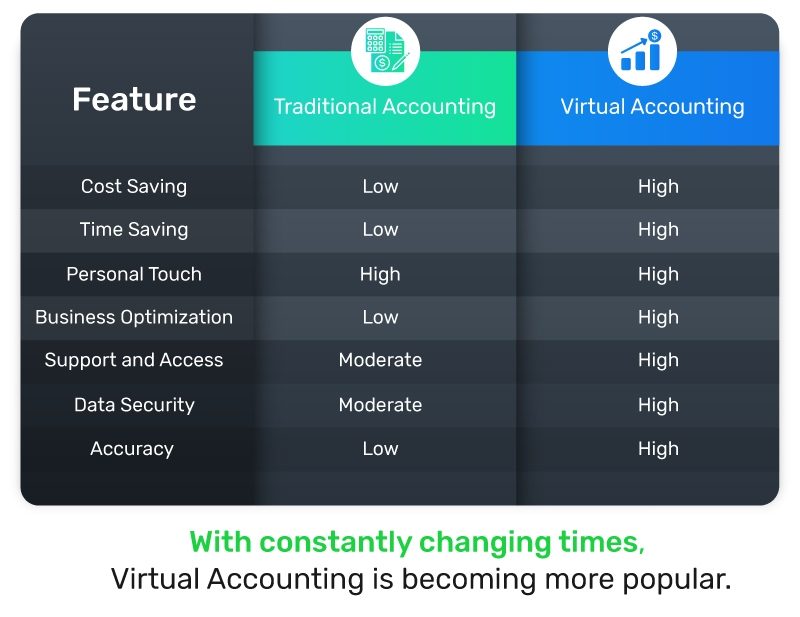
Virtual accounting uses modern cloud technology to make financial information easier to access and manage.
Traditional accounting may rely more on:
- Paper documents
- Manual data entry
- Local files
Virtual accounting commonly uses:
- Cloud accounting software
- Digital document storage
- Automated transaction feeds
- Online reporting dashboards
Benefits include:
- Faster updates
- Easier collaboration
- Better visibility
- Reduced paperwork
Is Virtual Accounting Secure?
Virtual accounting can be secure when providers use proper data protection methods and strong security practices.
Financial information requires careful handling.
Professional providers may use:
- Secure client portals
- Encrypted connections
- Permission-based access
- Cloud security systems
- Backup procedures
Businesses should ask providers about:
- Data protection
- Access controls
- Security policies
- Software systems
Security should be a key factor when choosing a virtual accounting partner.
Can Virtual Accounting Handle Complex Businesses?
Yes, virtual accounting can support complex businesses when the provider has the right experience and systems.
Virtual accounting can support:
- Ecommerce businesses
- Multi-location companies
- Growing startups
- Service businesses
- Remote companies
Complex needs may include:
- Multiple bank accounts
- High transaction volume
- Financial reporting
- Tax compliance
- Business forecasting
The important factor is choosing a provider with experience in your industry.
How to Switch From Traditional Accounting to Virtual Accounting
Switching to virtual accounting requires a planned process to avoid disruption.
A smooth transition usually includes:
Step 1: Review Current Records
Check:
- Accounting software
- Financial reports
- Outstanding tasks
- Missing documents
Step 2: Select the Right Provider
Look for:
- Accounting experience
- Software knowledge
- Security practices
- Clear communication
Step 3: Move Documents Digitally
Transfer:
- Financial records
- Receipts
- Reports
- Contracts
Step 4: Set Communication Rules
Agree on:
- Reporting schedule
- Meeting frequency
- Required approvals
Step 5: Review Results
Monitor:
- Report accuracy
- Response times
- Financial improvements
When Should a Business Choose Traditional Accounting?
Traditional accounting may be suitable for businesses that need daily in-person support or prefer direct employee management.
It may work well for:
- Large companies with internal finance departments
- Businesses requiring physical office presence
- Companies with complex internal operations
The choice depends on business structure and priorities.
When Should a Business Choose Virtual Accounting?
Virtual accounting is often a good option for businesses that want professional expertise, lower costs, and flexible support.
It can be a strong fit for:
- Startups
- Small businesses
- Ecommerce companies
- Remote businesses
- Growing companies
Businesses that want to focus more on growth and less on managing accounting staff often consider virtual accounting.
How to Choose a Virtual Accounting Provider
The right virtual accounting provider should offer expertise, security, clear communication, and services that match your business needs.
Consider:
Accounting Experience
Check whether the provider understands your industry.
Technology Skills
Look for experience with:
- QuickBooks Online
- Xero
- Cloud accounting systems
Service Range
A strong provider may offer:
- Bookkeeping
- Reconciliation
- Reporting
- Tax support
- Advisory services
Communication Process
Clear updates and reporting schedules are important for remote collaboration.
Final Thoughts
Traditional and virtual accounting both help businesses manage finances, but they follow different models.
Traditional accounting gives businesses a dedicated employee, but it comes with higher costs and limited expertise from one person.
Virtual accounting provides access to professional accounting support through a flexible, technology-based approach.
For many startups, small businesses, and growing companies, virtual accounting offers a practical way to get expert financial support without the cost of building a full internal accounting team.
The best choice depends on your business size, financial needs, growth plans, and how much flexibility you need.
Frequently Asked Questions
What is the main difference between traditional and virtual accounting?
Traditional accounting uses in-house employees, while virtual accounting uses remote accounting professionals through digital platforms.
Is virtual accounting really cheaper than hiring an accountant?
Yes, virtual accounting can reduce costs because businesses avoid expenses like benefits, office space, payroll taxes, and recruitment.
Does virtual accounting provide CPA-level expertise?
Many virtual accounting providers offer access to qualified accountants and financial professionals, depending on the service package.
Is virtual accounting secure for financial data?
Professional virtual accounting providers use security measures such as encrypted systems, secure portals, and controlled access.
What businesses benefit most from virtual accounting?
Startups, small businesses, ecommerce companies, and growing businesses often benefit from flexible virtual accounting support.
Can virtual accounting handle high transaction volumes?
Yes, experienced virtual accounting providers can support businesses with large transaction volumes and complex financial needs.
What happens if my virtual accountant leaves?
Many virtual accounting firms provide team-based support, which reduces dependence on a single person.
How do I move from traditional accounting to virtual accounting?
The process usually involves reviewing records, selecting a provider, transferring documents, and setting communication workflows.