Many people hear about IRS Form 8606 when they make a nondeductible IRA contribution or complete a backdoor Roth IRA conversion. The form can seem confusing because it deals with tax rules, IRA balances, and calculations that are not always easy to understand.
However, the main purpose of Form 8606 is simple:
IRS Form 8606 tracks after-tax money in certain IRAs so you do not pay tax on the same money twice.
The form helps the IRS understand which part of your IRA money has already been taxed and which part may be taxable in the future.
Form 8606 is especially important for:
- People making nondeductible traditional IRA contributions
- High-income earners using a backdoor Roth IRA strategy
- Taxpayers converting traditional IRAs to Roth IRAs
- Individuals taking certain IRA distributions
- Tax professionals preparing accurate returns
Understanding Form 8606 can help you avoid mistakes, keep proper IRA basis records, and report retirement transactions correctly.
What Is IRS Form 8606?
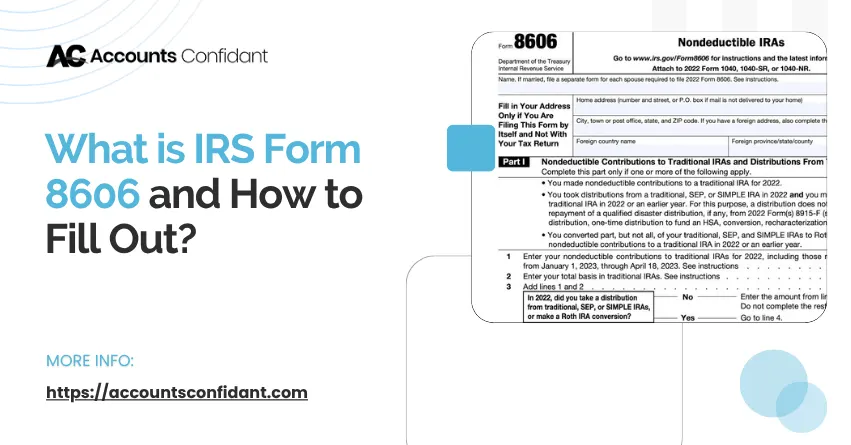
IRS Form 8606 is a tax form used to report nondeductible IRA contributions, track after-tax IRA basis, and report certain Roth conversions and IRA distributions.
Form 8606 is not a separate tax return. It is filed with your federal income tax return, such as:
- Form 1040
- Form 1040-SR
- Form 1040-NR
The main purpose of the form is to track money that has already been taxed.
For example:
You contribute $7,000 to a traditional IRA, but you cannot claim a tax deduction.
Because you did not receive a deduction, you have already paid income tax on that money.
That $7,000 becomes your after-tax basis.
Form 8606 records this basis so future withdrawals or conversions are calculated correctly.
Why Does Form 8606 Matter?
Form 8606 matters because it prevents double taxation on nondeductible IRA contributions.
Without proper basis tracking, the IRS may not know that part of your IRA money was already taxed.
Example:
You make a $10,000 nondeductible IRA contribution.
Years later, your IRA grows and you convert money to a Roth IRA.
If your after-tax basis was never reported, the IRS may treat the entire conversion as taxable.
This could cause you to pay tax on money that was already taxed before.
Form 8606 creates the record needed to separate:
- Taxable IRA money
- After-tax IRA money
Who Must File Form 8606?
You generally need to file Form 8606 if you have nondeductible IRA activity or certain IRA transactions that require basis tracking.
Common situations requiring Form 8606 include:
You Made a Nondeductible Traditional IRA Contribution
You must report contributions that were not deducted from your income.
Example:
You contribute to a traditional IRA but your income is too high to claim the deduction.
Form 8606 records the after-tax contribution.
You Converted a Traditional IRA to a Roth IRA
If you convert traditional IRA money to a Roth IRA, Form 8606 helps calculate the taxable and nontaxable portions.
This commonly applies to:
- Backdoor Roth IRA conversions
- Traditional IRA conversions
You Took Certain IRA Distributions
If you have after-tax IRA basis and withdraw money from your IRA, Form 8606 helps determine how much is taxable.
You Have Existing IRA Basis
If you previously made nondeductible contributions, you may need Form 8606 even if you did not make a new contribution this year.
IRA basis does not disappear. It carries forward until used.
What Are Nondeductible IRA Contributions?
A nondeductible IRA contribution is money placed into a traditional IRA that does not reduce your taxable income.
Traditional IRA contributions can be either:
Deductible Contributions
A deductible contribution reduces taxable income.
Example:
You contribute $5,000.
You qualify for the deduction.
Your taxable income may decrease.
Nondeductible Contributions
A nondeductible contribution does not provide a tax deduction.
Example:
You contribute $5,000.
You cannot deduct it because of income limits or other rules.
The contribution creates after-tax basis.
This is the money Form 8606 tracks.
How Does Form 8606 Track IRA Basis?
Form 8606 tracks your IRA basis by recording nondeductible contributions and carrying that amount forward over time.
Your IRA basis represents money that has already been taxed.
Think of it as a tax record showing:
“Some of the money inside this IRA has already been taxed.”
Important basis tracking points:
- Basis can continue across multiple years
- Basis is not the same as account value
- Investment growth is generally not basis
- Only after-tax contributions create basis
Example:
Year 1:
Nondeductible contribution: $6,000
Year 2:
Investment growth: $1,000
IRA value: $7,000
Your basis is still:
$6,000
The $1,000 growth is not after-tax basis.
Form 8606 and Backdoor Roth IRA Explained
Form 8606 is used to report a backdoor Roth IRA strategy because it tracks the nondeductible contribution and Roth conversion.
A backdoor Roth IRA generally involves two steps:
Step 1: Make a Nondeductible Traditional IRA Contribution
Example:
You contribute $7,000 to a traditional IRA.
Because the contribution is nondeductible, you report it on Form 8606.
Step 2: Convert the IRA to a Roth IRA
You move the money from the traditional IRA into a Roth IRA.
The conversion is reported using Form 8606.
The taxable amount depends on:
- Your IRA basis
- Total IRA balances
- The pro-rata rule
What Is the Form 8606 Pro-Rata Rule?
The Form 8606 pro-rata rule requires the IRS to treat all traditional, SEP, and SIMPLE IRAs as one combined account when calculating taxes on conversions.
This rule prevents taxpayers from choosing only after-tax money for conversion while leaving pre-tax money behind.
The IRS looks at:
- Traditional IRAs
- SEP IRAs
- SIMPLE IRAs
Employer plans like:
- 401(k)
- 403(b)
are generally not included in this calculation.
How Does the Pro-Rata Rule Work?
The pro-rata rule calculates the percentage of your IRA that is after-tax versus pre-tax and applies that percentage to your conversion.
The basic formula is:
After-tax IRA basis ÷ Total IRA value = Tax-free percentage
Example:
You have:
After-tax IRA basis:
$10,000
Traditional IRA balance:
$90,000
Total IRA value:
$100,000
Your after-tax percentage:
$10,000 ÷ $100,000 = 10%
If you convert $10,000 to a Roth IRA:
10% may be tax-free.
90% may be taxable.
This is why planning is important before completing a Roth conversion.
Why Does December 31 Matter for Form 8606?
The IRS uses your IRA balances on December 31 of the conversion year when applying the pro-rata rule.
Many taxpayers focus only on the day they make the conversion.
However, the IRS looks at the year-end picture.
Example:
January:
You make a nondeductible IRA contribution.
May:
You convert to Roth IRA.
December 31:
You still have pre-tax IRA money.
That year-end balance affects your tax calculation.
This is why some taxpayers move pre-tax IRA money into an employer plan, when available and appropriate, before year-end to change the calculation.
Understanding Form 8606 Parts I, II, and III
Form 8606 has three main sections that report different IRA activities.
Part I: Nondeductible Contributions and IRA Basis
Part I tracks nondeductible traditional IRA contributions and your total IRA basis.
It generally covers:
- Current-year nondeductible contributions
- Previous IRA basis
- Total basis calculation
Important information includes:
- Line 1: Nondeductible contributions
- Line 2: Existing basis
- Line 14: Remaining basis
This section helps maintain your after-tax IRA record.
Part II: Roth IRA Conversions
Part II reports traditional IRA conversions to Roth IRAs and calculates taxable amounts.
It helps determine:
- Total conversion amount
- Nontaxable portion
- Taxable portion
This section is commonly used for:
- Backdoor Roth IRA reporting
- Traditional IRA conversions
Part III: Roth IRA Distributions
Part III helps calculate taxable amounts for certain Roth IRA distributions.
It may apply when reviewing:
- Roth IRA withdrawals
- Basis recovery
- Taxable earnings
Roth IRA distribution rules can be complex, especially when considering:
- Age
- Five-year rule
- Qualified distributions
How Do You Fill Out Form 8606?
Filling out Form 8606 requires reporting your IRA contributions, basis, conversions, and distributions correctly.
A general process includes:
Step 1: Gather IRA Information
Collect:
- IRA contribution records
- Previous Form 8606 filings
- Form 1099-R
- IRA statements
Step 2: Determine Your IRA Basis
Review:
- Previous after-tax contributions
- Current nondeductible contributions
Step 3: Report Roth Conversions
Include:
- Conversion amount
- Taxable portion
- Basis calculation
Step 4: Review Before Filing
Check for:
- Correct contribution amounts
- Correct year
- Accurate IRA balances
Because IRA rules can be complicated, many taxpayers use tax software or work with a tax professional.
What Happens If You Forget to File Form 8606?
If you forget to file Form 8606, your IRA basis records may become incorrect and you may face unnecessary taxes later.
Possible problems include:
- Missing basis history
- Incorrect taxable conversion calculations
- Paying tax twice on after-tax money
If you discover a missing Form 8606:
Possible steps include:
- Filing the missing form
- Correcting previous tax records
- Providing an explanation if required
There is no simple “erase and restart” process because IRA basis can affect future years.
What Is the Penalty for Not Filing Form 8606?
The IRS penalty for failing to file Form 8606 is generally $50, unless reasonable cause applies.
Another possible penalty is:
- $100 for overstating nondeductible contributions
However, the bigger financial risk is incorrect basis tracking.
A missed Form 8606 can create a situation where you pay tax on money that should have been treated as already taxed.
Common Form 8606 Mistakes
Most Form 8606 mistakes happen because taxpayers misunderstand IRA basis rules or forget reporting requirements.
Common errors include:
Mistake 1: Assuming Roth Conversions Are Always Tax-Free
A Roth conversion may create taxable income depending on your IRA situation.
Mistake 2: Forgetting Old IRA Basis
Previous nondeductible contributions must continue to be tracked.
Mistake 3: Ignoring the Pro-Rata Rule
All eligible IRAs are considered together.
Mistake 4: Not Filing Form 8606 After a Nondeductible Contribution
A contribution without proper reporting can create future tax problems.
Mistake 5: Losing Previous Form 8606 Records
Keeping old forms helps prove your IRA basis history.
How Should You Keep Form 8606 Records?
You should keep Form 8606 records with your tax documents for as long as your IRA basis exists.
Important records include:
- Filed Form 8606 copies
- IRA contribution confirmations
- Tax returns
- Conversion records
- Form 1099-R
Good recordkeeping helps prevent problems years later.
Final Thoughts: Why Form 8606 Matters
IRS Form 8606 may look complicated, but its purpose is straightforward:
It helps track after-tax IRA money so you are not taxed twice.
For people making nondeductible IRA contributions, using a backdoor Roth IRA strategy, or converting retirement funds, accurate basis tracking is essential.
The most important steps are:
- Understand when Form 8606 is required
- Keep accurate IRA basis records
- Report Roth conversions correctly
- Avoid common filing mistakes
Because retirement tax rules can be complex, taxpayers with unique situations should consider working with a qualified tax professional who understands IRA rules.
Frequently Asked Questions
What is IRS Form 8606 used for?
IRS Form 8606 is used to report nondeductible IRA contributions, track after-tax IRA basis, and report certain Roth conversions and distributions.
Can I file Form 8606 by itself?
Form 8606 is generally filed with your federal tax return, not as a completely separate tax return.
Does Form 8606 apply to Roth IRA contributions?
No, Form 8606 mainly applies to certain traditional IRA activity, Roth conversions, and Roth distributions.
How do I fix a missed Form 8606 from a previous year?
You may need to file the missing form and correct your IRA basis records. The exact process depends on your situation.
Does Form 8606 affect backdoor Roth IRA taxes?
Yes, Form 8606 calculates the taxable and nontaxable portions of a backdoor Roth conversion.
What records should I keep for IRA basis?
Keep previous Form 8606 filings, IRA contribution records, conversion documents, and tax returns.
Is Form 8606 difficult to complete?
The form can be complex because it involves IRA tax rules, especially for Roth conversions and the pro-rata rule. Many taxpayers use tax software or professional help.