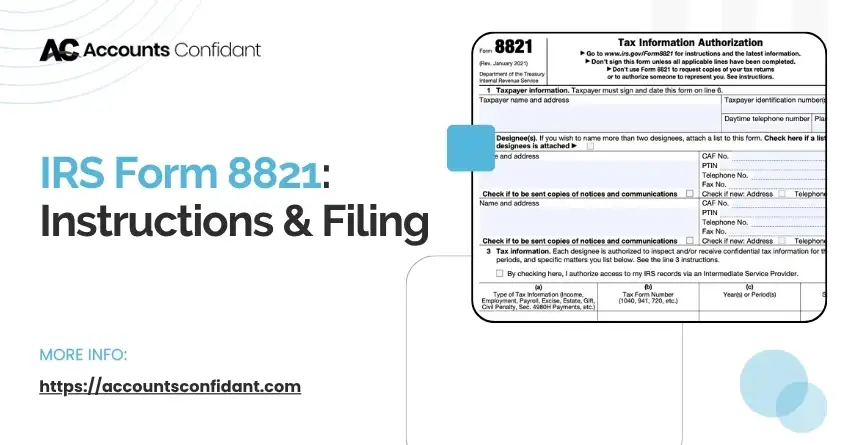
If you need to let a CPA, tax preparer, attorney, lender, or another third party access your federal tax information, IRS Form 8821 may be the form you need.
Form 8821 is called Tax Information Authorization. It allows a taxpayer to authorize a person or organization to inspect or receive confidential tax information for the tax types and years or periods listed on the form. It does not give that person general authority to represent the taxpayer before the IRS.
That distinction is important because Form 8821 and Form 2848, Power of Attorney and Declaration of Representative, serve different purposes.
This guide explains the current Form 8821 filing process, how to complete the form, electronic filing options, mailing and fax information, processing time, and the difference between Form 8821 and Form 2848.
Important: IRS forms and submission procedures can change. Always check the current IRS Form 8821 page and instructions before submitting an authorization.
What Is IRS Form 8821?
IRS Form 8821 is a Tax Information Authorization that lets a taxpayer authorize a designated person or organization to inspect or receive specified confidential tax information.
The authorization applies to the tax type and tax years or periods that you identify on the form.
For example, you might use Form 8821 to authorize a CPA to receive information about:
- Your individual income tax return
- Specific business tax information
- A particular tax year
- A specific tax matter
- IRS notices and communications, when properly authorized
The form can also be used to delete or revoke previous tax information authorizations.
Form 8821 is therefore an IRS third-party authorization, not a tax return and not a power of attorney.
For related information about another IRS authorization form, see our guide to IRS Form 2848.
What Is the Purpose of Form 8821?
The purpose of Form 8821 is to give another person or organization permission to inspect or receive specified confidential tax information from the IRS.
This can be useful when you need someone to access IRS information but do not need that person to represent you before the IRS.
Common situations include:
- A taxpayer wants a CPA to obtain IRS tax information.
- A tax professional needs access to specific IRS records.
- A lender needs tax information for income verification.
- A taxpayer wants another person to receive IRS notices or communications.
- A business owner wants an authorized third party to review specific tax information.
The authorization is limited to the tax matters and periods listed on the form.
Who Can File IRS Form 8821?
A taxpayer can use Form 8821 when they want to authorize a third party to inspect or receive specified confidential tax information. The designated recipient does not have to be a tax professional.
The person completing the form must have the authority to sign for the taxpayer.
For an individual taxpayer, the taxpayer generally signs the authorization. For certain businesses and entities, an authorized officer or other person with the required authority must sign.
A joint return requires each spouse to execute a separate Form 8821 if both taxpayers want to authorize a designee.
Who Can Be Designated on Form 8821?
Form 8821 allows you to designate an individual, corporation, firm, organization, or partnership to receive or inspect the specified tax information.
For example, the designee could be:
- A CPA
- An enrolled tax professional
- A tax preparer
- An attorney
- A bookkeeping or accounting firm
- A lender
- Another individual
- A business or organization
However, the authorization does not give the designee the right to represent you before the IRS.
What Information Does Form 8821 Authorize?
Form 8821 only covers the tax information, tax forms, years, periods, and specific matters that you identify on the authorization.
This is one of the most important parts of the form.
For example, you should not use a vague description such as:
All years, all taxes
The IRS instructions state that general references such as “All years,” “All periods,” or “All taxes” are not acceptable. You need to identify the relevant tax information and periods.
Example
If you want to authorize someone to access information related to a Form 1040 for 2024, the authorization should identify the appropriate tax type, form number, and year or period rather than simply giving unrestricted access.
Being specific helps prevent delays and makes the scope of the authorization clear.
IRS Form 8821 Instructions: How to Fill It Out
The main parts of Form 8821 ask for taxpayer information, designee information, tax information, the type of authorization, and the taxpayer’s signature. Always use the current IRS form and instructions when completing it.
Line 1: Enter the Taxpayer Information
Line 1 identifies the taxpayer whose confidential tax information will be disclosed.
Depending on the taxpayer, this can include:
- Legal name
- Address
- SSN
- ITIN
- EIN
- Telephone number
- Plan number, when applicable
Use the taxpayer information that matches the IRS records.
An incorrect taxpayer identification number can cause problems when the IRS processes the authorization.
Line 2: Enter the Designee Information
Line 2 identifies the person or organization that will receive or inspect the authorized tax information.
The form requests information such as:
- Name
- Address
- CAF number, if applicable
- PTIN, if applicable
- Telephone number
- Fax number
You can designate more than two people by attaching the additional information as instructed by the IRS.
If you want the designee to receive copies of IRS notices and communications, select the applicable option on the form.
Line 3: Specify the Tax Information
Line 3 defines exactly which tax information the designee can inspect or receive.
This section asks for:
- Type of tax
- Tax form number
- Years or periods
- Specific tax matters
For example, a taxpayer may authorize access to information associated with income tax and a particular Form 1040 for specified tax years.
Do not leave the scope unnecessarily broad or use general terms that the IRS instructions do not accept.
Line 4: Specific Use
Line 4 is used when the authorization is for a specific use that is not recorded on the IRS Centralized Authorization File (CAF).
If you check the specific-use box, the form generally needs to be sent to the IRS office handling the particular matter rather than being handled as a standard CAF authorization.
This section is important because checking the box changes how the authorization is submitted and handled.
Line 5: Retain or Revoke Prior Authorizations
Line 5 deals with whether earlier tax information authorizations should remain in effect or be revoked.
The IRS instructions state that, in certain standard submissions, a new Form 8821 can automatically revoke prior tax information authorizations unless you take the required steps to retain them.
If you need an older authorization to remain active, carefully follow the Form 8821 instructions and provide the required copy or information.
Sign and Date Form 8821 Correctly
The taxpayer must sign and date Form 8821 before submission.
For paper forms submitted by mail or fax, the IRS instructions require a handwritten signature. Forms using an electronic signature method must be submitted through the IRS online process that accepts electronic signatures.
Do not sign a blank or incomplete authorization.
Form 8821 PDF: Where Can You Get It?
The safest place to get the Form 8821 PDF is the official IRS website.
The IRS Form 8821 page provides the current form and instructions. The IRS currently lists Form 8821 as the January 2021 revision, while the instructions are dated September 2021.
Avoid relying on an old Form 8821 PDF saved on your computer or downloaded from an unrelated website.
The IRS also maintains a page containing prior-year forms, which can help distinguish current forms from older versions.
Can You File Form 8821 Electronically?
Yes, the IRS currently provides online submission options for Form 8821.
There are two important online routes.
Tax Pro Account
Tax professionals can use the IRS Tax Pro Account to submit a Tax Information Authorization request to an individual taxpayer’s online account. The taxpayer can then review, electronically sign, and manage the authorization. The IRS describes this option as providing real-time processing for eligible requests.
IRS Online Form Submission
The IRS also provides a secure online upload option for Forms 2848 and 8821.
The process generally involves:
- Signing in or creating an account.
- Answering questions about the form.
- Uploading Form 8821.
- Receiving confirmation that the form was received.
- Checking the processing status.
The IRS says not to submit another online copy if you have already faxed or mailed the same form.
Where Do You Mail Form 8821?
If you submit Form 8821 by mail, use the IRS address assigned to your state or situation in the current Form 8821 instructions.
For standard CAF processing, the IRS instructions group states into regional addresses. The current instructions list Memphis, Tennessee; Ogden, Utah; and Philadelphia, Pennsylvania for international and certain other addresses.
States in the Memphis Group
The instructions list states including Pennsylvania, New York, New Jersey, Florida, Georgia, Maryland, Massachusetts, Virginia, Ohio, and several others in this group.
Mail to:
Internal Revenue Service
5333 Getwell Road, Stop 8423
Memphis, TN 38118
Fax: 855-214-7519
States in the Ogden Group
The instructions list states including California, Texas, Arizona, Colorado, Washington, Oregon, Utah, Wisconsin, and several others in this group.
Mail to:
Internal Revenue Service
1973 Rulon White Blvd., MS 6737
Ogden, UT 84201
Fax: 855-214-7522
International and Certain U.S. Territories
For foreign addresses, APO/FPO addresses, Puerto Rico, Guam, U.S. Virgin Islands, American Samoa, and certain other locations, the instructions list:
Internal Revenue Service
International CAF Team
2970 Market Street
MS 4-H14.123
Philadelphia, PA 19104
Fax: 855-772-3156
Outside the United States: 304-707-9785
Important: IRS fax numbers can change. Check the current IRS Form 8821 instructions immediately before sending the form.
Can You Fax Form 8821 to the IRS?
Yes, The IRS currently accepts Form 8821 by fax when the applicable filing instructions permit fax submission.
The correct fax number depends on where you live or where the specific IRS matter is being handled.
If Line 4 is checked for a specific-use authorization, the form should be mailed or faxed to the IRS office handling that matter rather than automatically using the standard CAF address.
Keep proof of transmission for your records.
Form 8821 vs. Form 2848: What’s the Difference?
Form 8821 gives someone permission to inspect or receive specified tax information, while Form 2848 gives an eligible representative authority to represent the taxpayer before the IRS for specified tax matters.
| Feature | Form 8821 | Form 2848 |
| Main purpose | Receive or inspect tax information | Represent taxpayer before IRS |
| Receive tax information | Yes, within authorization | Yes, within authorization |
| Represent taxpayer before IRS | No | Yes, within granted authority |
| Advocate taxpayer’s position | No | Yes, subject to representative eligibility and authority |
| Can authorize a general individual? | Yes, subject to IRS rules | Representative must be eligible to practice before IRS |
| Can be used for specific tax years/periods? | Yes | Yes |
| Power of attorney | No | Yes |
The IRS specifically states that Form 8821 does not authorize the designee to advocate the taxpayer’s position, execute certain agreements or waivers, or otherwise represent the taxpayer before the IRS.
Simple Example
Suppose you want your CPA to receive your IRS tax transcripts and review your tax information.
Form 8821 may be appropriate.
If you want your CPA, attorney, or another eligible representative to act on your behalf in an IRS examination or other tax matter, Form 2848 may be required instead.
The exact form depends on what authority you need to give.
Does Form 8821 Allow a Tax Preparer or CPA to Speak to the IRS?
Form 8821 allows the designated person to receive or inspect the tax information covered by the authorization, but it does not give that person authority to represent you before the IRS.
This is an important difference.
If the tax preparer only needs access to information, Form 8821 may meet the need.
If the tax professional needs authority to represent you in an IRS matter, you generally need to consider Form 2848.
The IRS also recognizes limited oral authorization for certain conversations. Oral authorization generally applies only to the conversation in which you provide the authorization unless otherwise stated.
Does Form 8821 Allow My CPA to Receive IRS Transcripts?
Yes, Form 8821 can authorize a designated person to receive or inspect confidential tax information within the tax matters and periods listed on the form.
However, Form 8821 itself is not the same as ordering a transcript.
If you need an IRS transcript, make sure the correct transcript or tax information is being requested and that the authorization covers the relevant tax year and matter.
The IRS also provides separate transcript request tools and forms, including Form 4506-T.
For related information, you can read our guide to IRS Form 4506-T.
How Long Does Form 8821 Take to Process?
The IRS currently lists Form 8821 as being processed about 7 business days after receipt, but processing can vary and delays can occur.
The IRS provides different submission methods:
- Tax Pro Account for eligible requests
- Online form submission
- Fax
Tax Pro Account offers real-time processing for eligible individual taxpayer POA and TIA requests.
The IRS also advises taxpayers not to submit duplicate Forms 8821 when one has already been submitted.
Before assuming the authorization has failed, check the IRS processing status if available.
Common Form 8821 Mistakes to Avoid
Most Form 8821 problems can be reduced by checking the taxpayer information, authorization scope, designee information, signature, and submission method before sending the form.
Using an Old Form
Always download the form from the current IRS Form 8821 page.
Listing “All Years” or “All Taxes”
The IRS instructions do not allow general references such as “All years,” “All periods,” or “All taxes.” Specify the appropriate tax information and periods.
Using Form 8821 When Representation Is Needed
Form 8821 does not give the designee power to represent the taxpayer before the IRS.
If representation is needed, review the requirements for Form 2848.
Missing the Signature
An unsigned authorization cannot establish the intended authorization.
For paper submissions, follow the IRS signature requirements carefully.
Sending It to the Wrong Fax Number
Use the current IRS instructions to identify the correct CAF fax number or the IRS office handling a specific matter.
Submitting Duplicate Forms
If you already mailed or faxed the authorization, do not automatically upload another copy online. The IRS specifically advises against submitting duplicate forms.
Case Study: Choosing Between Form 8821 and Form 2848
This is an illustrative example designed to show how the two authorization forms differ; it is not a reported client case.
A small business owner is working with a CPA during a tax review.
The CPA needs to:
- Review the business’s IRS tax information.
- Obtain information about specific tax periods.
- Review IRS correspondence.
The owner does not want the CPA to represent the business before the IRS.
In this situation, a Form 8821-type authorization may provide the information access the CPA needs.
Now change the situation.
The CPA needs to communicate with the IRS and act on the taxpayer’s behalf during an examination.
That is a different type of authority. The taxpayer should review the requirements for Form 2848, because Form 8821 does not authorize representation before the IRS.
The key question is therefore not simply, “Which form is easier?”
The question is:
Does the third party only need tax information, or does the third party need authority to represent the taxpayer?
When Should You Use IRS Form 8821?
Form 8821 is generally appropriate when another person or organization needs access to specified IRS tax information but does not need authority to represent you before the IRS.
It can be useful for:
- Tax information requests
- Transcript-related needs
- Income verification
- Tax professional access
- Specific IRS correspondence
- Certain business tax information requests
- Other situations where disclosure authorization is needed
Before signing, confirm that the tax years, forms, and specific matters listed are the ones you actually want to authorize.
Final Takeaway
IRS Form 8821 is designed for information access, not IRS representation. It can be useful when you want a CPA, tax preparer, lender, or another authorized party to inspect or receive specific tax information.
Before submitting the form:
- Use the current IRS Form 8821 PDF.
- Enter accurate taxpayer and designee information.
- Clearly identify the tax type, form, years, and specific matters.
- Check whether prior authorizations need to be retained or revoked.
- Sign the form correctly.
- Choose the correct online, fax, or mail submission method.
- Keep a copy of the completed form and submission confirmation.
If you need someone to represent you before the IRS, do not assume Form 8821 provides that authority. Review the requirements for Form 2848 instead.
Frequently Asked Questions About IRS Form 8821
What is IRS Form 8821?
IRS Form 8821 is a Tax Information Authorization that lets a taxpayer authorize a person or organization to inspect or receive specified confidential tax information.
What is the purpose of Form 8821?
It gives a designated third party permission to access the tax information, tax matters, and periods identified on the form.
Who needs to file Form 8821?
A taxpayer files Form 8821 when they want to authorize another person or organization to inspect or receive specified IRS tax information.
Who can be designated on Form 8821?
You can designate an individual, corporation, firm, organization, or partnership, subject to the IRS requirements.
Can I file Form 8821 electronically?
Yes, The IRS currently offers online submission options, including Tax Pro Account and secure online form upload.
How do I fill out IRS Form 8821?
Enter the taxpayer information, designee information, specific tax information and periods, applicable authorization choices, and the required taxpayer signature.
Where do I mail Form 8821?
Use the address in the current IRS Form 8821 instructions based on your state or situation. The standard CAF addresses include Memphis, Ogden, and Philadelphia.
Can I fax Form 8821 to the IRS?
Yes, the IRS accepts Form 8821 by fax when applicable. Use the current fax number in the IRS instructions.
How long does Form 8821 take to process?
The IRS currently lists approximately 7 business days after receipt for Form 8821, although actual processing can vary.
Is Form 8821 the same as a power of attorney?
No, Form 8821 authorizes access to tax information. Form 2848 is the IRS power-of-attorney form used to authorize eligible representatives to act on behalf of a taxpayer before the IRS.
What is the difference between Form 8821 and Form 2848?
Form 8821 provides information access. Form 2848 provides representation authority for the tax matters and periods covered by the authorization.
Can Form 8821 be used to represent a taxpayer before the IRS?
No, Form 8821 does not authorize the designee to represent the taxpayer before the IRS.
Does Form 8821 allow my tax preparer to speak to the IRS?
It allows the preparer to receive or inspect authorized tax information, but it does not give the preparer general authority to represent you before the IRS.
Does Form 8821 allow my CPA to receive IRS transcripts?
It can authorize your CPA to receive or inspect the specified confidential tax information covered by the authorization. The relevant tax matters and periods must be properly identified.