
Many businesses know they should reconcile their accounts, but they often delay the process until the end of the quarter or even the end of the year.
This can create serious problems.
Small mistakes can become bigger issues. Missing transactions can affect financial reports. Fraud may go unnoticed. Tax preparation can become stressful because records are incomplete.
Monthly account reconciliation helps businesses keep financial records accurate, detect problems early, understand their real cash position, and make better financial decisions throughout the year.
Account reconciliation is not just a bookkeeping task. It is an important financial control that helps business owners, bookkeepers, and finance teams understand whether their accounting records match actual money movement.
For most small and growing businesses, monthly reconciliation is considered a best practice because it creates a regular process for checking financial accuracy.
What Is Account Reconciliation?
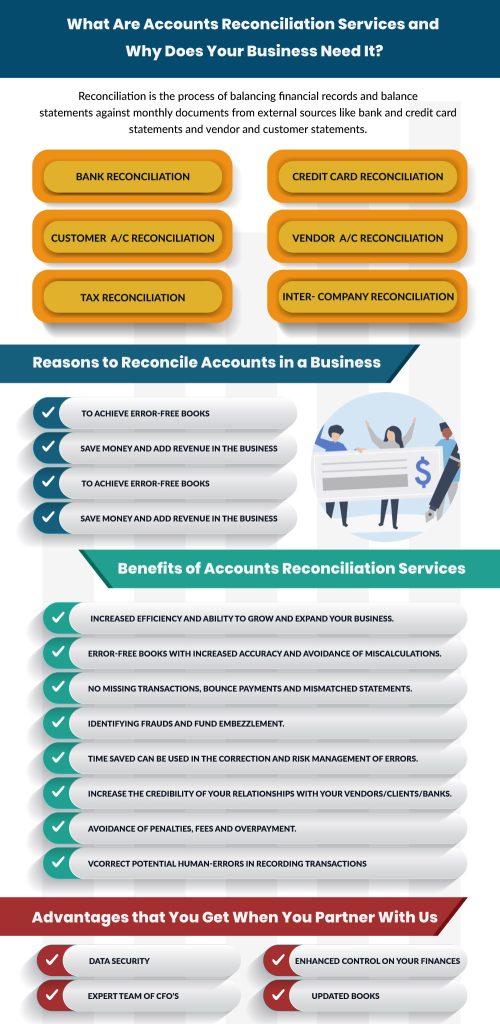
Account reconciliation is the process of comparing a company’s accounting records with external financial records to confirm that they match.
The goal is to find and explain differences between:
- Accounting software records
- Bank statements
- Credit card statements
- Payment processor reports
- Other financial records
Common types of reconciliation include:
Bank Reconciliation
Bank reconciliation compares the company’s cash records with the bank statement.
It helps identify:
- Missing deposits
- Outstanding checks
- Bank fees
- Incorrect entries
- Unauthorized transactions
Credit Card Reconciliation
Credit card reconciliation compares recorded expenses with credit card statements.
It helps find:
- Duplicate charges
- Missing expenses
- Incorrect amounts
- Unapproved purchases
General Ledger Reconciliation
General ledger reconciliation checks whether account balances in the accounting system are accurate.
It supports reliable:
- Financial statements
- Month-end close
- Tax reporting
Why Should Businesses Reconcile Accounts Monthly?
Businesses should reconcile accounts monthly because regular reviews catch errors, fraud, and cash flow problems before they become harder to fix.
Waiting too long creates several risks:
- More transactions to review
- Missing documents
- Harder error tracking
- Delayed financial decisions
A monthly reconciliation process creates a consistent financial routine.
Instead of asking:
“Why does our cash balance look wrong after six months?”
A business can identify the issue while the information is still easy to understand.
Monthly Reconciliation vs Quarterly Reconciliation vs Annual Reconciliation
Monthly reconciliation provides faster problem detection than quarterly or annual reconciliation because financial issues are reviewed closer to when they happen.
| Reconciliation Frequency | Benefits | Risks |
| Monthly | Early error detection, better cash visibility, cleaner records | Requires regular effort |
| Quarterly | Less frequent work | Problems may remain hidden for months |
| Annual | Simple for very small situations | Higher risk of errors and tax issues |
Monthly Reconciliation
Monthly reconciliation works well for most businesses.
It helps companies:
- Review transactions regularly
- Keep books updated
- Prepare accurate reports
- Monitor cash flow
Quarterly Reconciliation
Quarterly reconciliation may work for businesses with:
- Very low transaction volume
- Few financial accounts
- Simple operations
However, problems can continue for several months before being discovered.
Annual Reconciliation
Annual reconciliation creates the highest risk.
By year-end:
- Employees may forget transactions
- Documents may be missing
- Errors may be harder to trace
Annual reviews often become cleanup projects instead of normal financial maintenance.
Benefit 1: Monthly Reconciliation Helps Detect Fraud Early
Monthly reconciliation helps detect fraud by comparing recorded transactions with actual financial activity.
Fraud often becomes easier to identify when businesses regularly review their accounts.
Examples of suspicious activity include:
- Unauthorized bank withdrawals
- Fake vendor payments
- Duplicate payments
- Unusual credit card charges
- Missing deposits
According to the Association of Certified Fraud Examiners (ACFE), organizations lose a significant amount of revenue to fraud each year. Regular financial controls, including reconciliation, can help identify problems earlier.
Monthly reconciliation creates a simple question:
“Does every transaction in our records match what actually happened?”
Benefit 2: Monthly Reconciliation Prevents Small Errors From Growing
Monthly reconciliation prevents small accounting mistakes from becoming expensive financial problems.
Errors are easier to fix when they are discovered quickly.
Example:
A company accidentally records a $3,000 transaction incorrectly every month.
After one month:
- The issue is easy to identify.
After twelve months:
- The company must review a full year of records.
- Financial reports may be incorrect.
- Tax preparation becomes more difficult.
Common errors found during reconciliation include:
- Duplicate entries
- Incorrect transaction amounts
- Missing payments
- Wrong account categories
- Data entry mistakes
Monthly reviews keep these problems manageable.
Benefit 3: Monthly Reconciliation Improves Cash Flow Visibility
Monthly reconciliation gives businesses a more accurate view of their available cash.
A bank balance does not always show the real financial position.
Reasons include:
- Outstanding checks
- Pending deposits
- Credit card payments
- Bank fees
- Unrecorded transactions
Example:
A business account shows $50,000.
However:
- $5,000 in payments have not cleared.
- $3,000 in deposits are still pending.
The actual available cash position may be different.
Monthly reconciliation helps business owners understand:
- Real cash availability
- Working capital
- Upcoming payment needs
This improves financial planning.
Benefit 4: Monthly Reconciliation Improves Tax Accuracy
Monthly reconciliation helps businesses prepare more accurate tax returns by keeping financial records clean throughout the year.
Tax problems often happen because businesses have:
- Incorrect income records
- Missing expenses
- Poor transaction categories
- Unreconciled accounts
A monthly reconciliation process helps ensure:
- Revenue is recorded correctly
- Expenses are supported by documents
- Financial reports match actual transactions
When tax season arrives, businesses are less likely to face:
- Last-minute bookkeeping cleanup
- Missing information
- Incorrect filings
Benefit 5: Monthly Reconciliation Improves Audit Readiness
Monthly reconciliation creates an audit trail that helps businesses respond quickly to financial reviews.
During an audit, businesses may need to provide:
- Bank statements
- Accounting records
- Supporting documents
- Reconciliation reports
Businesses with monthly reconciliation already have organized financial records.
This helps build trust with:
- Auditors
- Lenders
- Investors
- Financial partners
Clean records show that a company has strong internal controls.
Benefit 6: Monthly Reconciliation Helps Business Owners Make Better Decisions
Monthly reconciliation provides reliable financial information for better business decisions.
Business owners need accurate numbers before deciding:
- Whether to hire employees
- Whether to invest in equipment
- Whether to expand operations
- Whether they have enough cash reserves
Without accurate records, decisions are based on assumptions.
Monthly reconciliation provides a clearer picture of:
- Revenue
- Expenses
- Cash position
- Financial performance
How Does Monthly Reconciliation Help Small Businesses?
Monthly reconciliation helps small businesses maintain financial control without needing a large finance department.
Small businesses often have limited resources.
A monthly reconciliation process helps them:
- Catch mistakes early
- Maintain clean books
- Prepare taxes easier
- Understand profitability
Even businesses with fewer transactions benefit because small errors can still affect financial decisions.
How Often Should Different Businesses Reconcile Accounts?
The ideal reconciliation frequency depends on transaction volume, business complexity, and financial risk.
Small Businesses With Low Transactions
Monthly reconciliation is usually sufficient.
Examples:
- Consultants
- Small service businesses
- Freelancers
Ecommerce Businesses
Ecommerce companies may need more frequent reconciliation because they manage:
- Shopify payments
- Amazon transactions
- Stripe payments
- PayPal deposits
- Refunds
- Processing fees
Some businesses reconcile weekly.
Retail and Hospitality Businesses
Businesses with daily transactions may benefit from:
- Daily reconciliation
- Weekly reconciliation
Examples:
- Restaurants
- Stores
- Hotels
Monthly Reconciliation Process: Step-by-Step
A monthly reconciliation process follows a simple routine of comparing records, finding differences, and correcting errors.
Step 1: Collect Financial Statements
Gather:
- Bank statements
- Credit card statements
- Payment processor reports
Step 2: Compare Transactions
Match accounting records with external statements.
Review:
- Deposits
- Payments
- Fees
- Transfers
Step 3: Investigate Differences
Review unmatched items such as:
- Missing transactions
- Duplicate entries
- Incorrect amounts
Step 4: Update Accounting Records
Make corrections in accounting software.
Common platforms include:
- QuickBooks
- Xero
Step 5: Complete Reconciliation Report
Document:
- Account balance
- Differences found
- Corrections made
This creates a clear audit trail.
Can Accounting Software Automate Monthly Reconciliation?
Accounting software can automate parts of monthly reconciliation, but human review is still important.
Modern tools can help with:
- Bank feed synchronization
- Transaction matching
- Categorization suggestions
- Reconciliation reports
However, automation may not understand every business situation.
A professional review helps identify:
- Incorrect classifications
- Suspicious activity
- Unusual transactions
What Happens If You Do Not Reconcile Accounts Monthly?
Failing to reconcile accounts monthly can lead to inaccurate financial reports, missed fraud, and poor business decisions.
Possible problems include:
- Incorrect cash balances
- Missing expenses
- Tax mistakes
- Unnoticed unauthorized transactions
- Difficult year-end cleanup
The longer businesses wait, the harder it becomes to identify the original problem.
Common Monthly Reconciliation Mistakes
Many reconciliation problems happen because businesses do not follow a consistent process.
Common mistakes include:
Ignoring Small Differences
Small errors can become larger problems.
Reconciling Only at Tax Time
Tax preparation should not be the first time accounts are reviewed.
Not Keeping Supporting Documents
Receipts, invoices, and statements help explain transactions.
Depending Only on Automation
Software helps, but financial review is still necessary.
How Outsourced Bookkeeping Can Help With Monthly Reconciliation
Outsourced bookkeeping services can help businesses maintain consistent monthly reconciliation without adding internal staff.
A bookkeeping provider can manage:
- Bank reconciliation
- Credit card reconciliation
- Transaction matching
- Financial reports
- Month-end close support
This can be useful for businesses that:
- Lack accounting staff
- Have growing transaction volume
- Need cleaner financial records
Final Thoughts: Why Monthly Account Reconciliation Matters
Monthly account reconciliation is more than checking numbers.
It helps businesses:
- Detect fraud earlier
- Correct errors faster
- Maintain accurate tax records
- Understand real cash flow
- Prepare for audits
- Make better financial decisions
Quarterly and annual reconciliation may work in limited situations, but monthly reconciliation provides a stronger financial control system for most businesses.
The earlier a problem is found, the easier and less expensive it is to fix.
A monthly reconciliation habit gives business owners confidence that their financial records reflect what is actually happening inside their company.
Frequently Asked Questions
What are the benefits of monthly account reconciliation?
Monthly account reconciliation improves financial accuracy, detects fraud earlier, supports tax preparation, and provides better cash flow visibility.
Why is monthly reconciliation better than quarterly reconciliation?
Monthly reconciliation identifies errors closer to when they happen, making problems easier to fix and reducing financial risk.
How often should a small business reconcile accounts?
Most small businesses should reconcile accounts monthly. Businesses with high transaction volume may need weekly or daily reconciliation.
How does monthly reconciliation help detect fraud?
It compares accounting records with bank and credit card statements, making unauthorized transactions and unusual activity easier to identify.
Is monthly reconciliation necessary for small businesses?
Yes, Even small businesses benefit because accurate records support better decisions and reduce tax problems.
Can accounting software automate monthly reconciliation?
Yes, Software can automate transaction matching and bank feeds, but human review is still needed for accuracy.
How long does monthly reconciliation take?
The time depends on account numbers, transaction volume, and record organization. Regular reconciliation is usually faster than fixing old problems later.
What is the difference between bank reconciliation and credit card reconciliation?
Bank reconciliation checks cash accounts against bank statements. Credit card reconciliation checks business expenses against credit card statements.
What happens if a business only reconciles accounts once a year?
Annual reconciliation increases the chance that errors, fraud, and missing records remain hidden for a long time and become harder to correct.