You need to file a U.S. federal tax return, but you don’t have a Social Security number (SSN) and aren’t eligible to get one. Then you find Form W-7, and suddenly a simple tax requirement turns into a page full of boxes, document rules, and exceptions.
Form W-7 is the IRS form used to apply for an Individual Taxpayer Identification Number (ITIN). You can also use it to renew an existing ITIN when you need to use it on a U.S. federal tax return. An ITIN is a nine-digit number issued to people who need a U.S. taxpayer identification number for federal tax purposes but don’t have and aren’t eligible for an SSN.
The good news is that you don’t need to figure out every W-7 rule at once. Start with three questions:
- Why do you need an ITIN?
- Which documents can prove your identity and foreign status?
- Are you applying for a new ITIN or renewing an existing one?
Once you answer those questions, the rest of the application becomes much easier to follow.
What is Form W-7?
Form W-7 is the application you use to request an ITIN from the IRS.
An ITIN is intended for federal tax purposes. For example, you may use it when filing a federal tax return to report income or claim a refund. It isn’t a replacement for an SSN, and having an ITIN doesn’t give you Social Security benefits, change your immigration status, or give you the right to work in the United States.
The IRS also says you shouldn’t complete Form W-7 if you already have an SSN or are eligible to obtain one. If you’ve applied for an SSN and the application is still pending, you generally need to wait for the Social Security Administration to determine whether you’re eligible. If the SSA determines that you’re not eligible, you’ll need its denial letter with your Form W-7. Before submitting your application, check the latest W-7 form instructions because the IRS may update its requirements and procedures.
That distinction matters because an ITIN isn’t simply an alternative number you can choose when you don’t want to use an SSN.
Knowing what Form W-7 does is the first step. The next question is whether your situation actually requires an ITIN.
Who needs an ITIN?
You may need an ITIN when you have a U.S. federal tax requirement but aren’t eligible for an SSN.
The IRS lists several situations, including:
- A nonresident alien who needs to file a U.S. federal tax return.
- A nonresident alien filing a return to claim a tax treaty benefit
- A nonresident alien who elects to file a joint federal return with a U.S. citizen or resident alien spouse.
- A U.S. resident alien who meets the applicable presence test but isn’t eligible for an SSN.
- Certain nonresident alien students, professors, or researchers.
- Certain spouses and dependents who meet the applicable requirements.
If one of these situations applies to you, the next step is making sure you have the right documents to support your application.
What documents do you need for a W-7 form?
Your documents need to establish your identity and foreign status. Applicants who are claimed as dependents may also need to prove U.S. residency, depending on their circumstances.
The IRS lists 13 acceptable document types, including:
- Passport
- USCIS photo identification
- U.S. Department of State visa
- U.S. driver’s license
- U.S. military identification card
- Foreign driver’s license
- Foreign military identification card
- National identification card
- U.S. state identification card
- Foreign voter registration card
- Civil birth certificate
- Medical records for qualifying dependents
- School records for qualifying dependents
A valid passport is the only document that can generally establish both identity and foreign status by itself. If you submit an original valid passport or a certified copy from the issuing agency, you generally don’t need another document from the supporting-documentation list. If you don’t submit a passport, you generally need at least two acceptable documents that establish the required identity and foreign status and meet the applicable photograph requirement. Dependents may also need additional documents to prove U.S. residency.
Once you know which documents you need and how you want to submit them, you can move on to completing Form W-7 itself.
How to apply for an ITIN using Form W-7
For a first-time ITIN application, the IRS requires a completed Form W-7, the applicable U.S. federal tax return unless you qualify for an exception, and the required supporting documentation.
Before submitting your application, review the IRS instructions for applying for an ITIN to confirm the current documentation and submission requirements.
Form W-7 checklist before you apply
- You aren’t eligible for an SSN.
- You have a valid reason for requesting an ITIN.
- You’ve selected the correct application type.
- You’ve selected the correct reason for submitting Form W-7.
- Your name and date of birth match your supporting documents.
- Your supporting documents are current.
- Your documents establish identity and foreign status.
- You’ve included proof of U.S. residency if required.
- You’ve attached the federal tax return if required.
- You’ve included the required documentation if you’re claiming an exception.
- You’ve provided the correct mailing address.
- You’ve kept a copy of your application.
Here’s what the process looks like.
1. Complete Form W-7
Use the current Form W-7 and complete the information requested on the form.
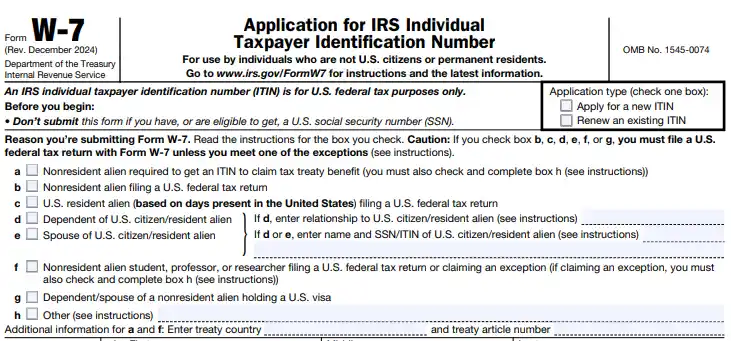
You’ll provide details such as your legal name, mailing address, foreign address, date of birth, citizenship information, and identification-document information.
One field deserves particular attention: the reason you’re submitting Form W-7.
You must select a reason even when you’re renewing an existing ITIN. The IRS says that if more than one reason applies, you should select the box that best explains why you’re submitting the form.
2. Gather your supporting documents
Check that your documents are current and that the information matches your Form W-7.
For example, the name, date of birth, and country or countries of citizenship shown in your documents should match the information you provide on the form.
This is also where small inconsistencies can create trouble. If your legal name has changed, don’t ignore the difference. The IRS requires documentation supporting a legal name change when renewing an ITIN, such as a marriage certificate or court order.
3. Attach your federal tax return when required
For a standard first-time application, attach Form W-7 to the front of the federal tax return for which you’re requesting the ITIN.
If you’re applying for several ITINs on the same return, such as for a spouse or dependents, attach all the Forms W-7 to that same tax return. The SSN field should remain blank for each person applying for an ITIN.
There are exceptions to the tax-return requirement. If you’re applying under one of those exceptions, you submit the documentation required for that exception instead of the tax return.
4. Submit the application
You can submit Form W-7 in several ways:
By mail: Send Form W-7, the tax return when applicable, and the required documentation to the IRS ITIN Operation.
In person: Visit a designated IRS Taxpayer Assistance Center that offers ITIN document authentication.
Through an Acceptance Agent or Certifying Acceptance Agent: Both Acceptance Agents (AAs) and Certifying Acceptance Agents (CAAs) can help with ITIN applications.
Both types of agents are available in the United States and abroad. If you’re looking for a certified acceptance agent ITIN service, make sure the agent is authorized under the IRS Acceptance Agent Program.
Important: If you’re mailing your application yourself, use the separate IRS mailing address for ITIN applications rather than the address provided for mailing your tax return.
Once these steps are complete, your application is ready to submit. Before sending it, take a moment to check who needs to sign the form and whether any additional authorization is required.
Who Can Sign Form W-7?
The applicant should sign Form W-7 themselves unless a specific exception allows someone else to sign on their behalf. The signature must be original.
Here’s how the signing rules work depending on the applicant’s situation.
Applicant Is Under 18
If the applicant is a dependent under 18 and cannot sign the form, their parent or court-appointed guardian can sign for them.
The parent or guardian must:
- Print or type their name in the designated space.
- Check the box showing their relationship to the applicant.
- Attach court-appointment documents if signing as a court-appointed guardian.
Another adult can sign for the child only when a parent or court-appointed guardian has authorized that person through Form 2848, Power of Attorney and Declaration of Representative.
Applicant Is 18 or Older
An applicant who is 18 or older can sign Form W-7 themselves. A court-appointed guardian can also sign.
The applicant can authorize a parent or another individual to sign on their behalf. That person must provide their name and relationship to the applicant. If the person signing is not the applicant or court-appointed guardian, Form 2848 must be attached to authorize the signature.
A spouse cannot sign Form W-7 for their spouse unless the appropriate Power of Attorney box is checked and Form 2848 is attached.
Applicant Cannot Sign Their Name
If the applicant cannot sign their name, they can use a mark, such as an “X” or thumbprint, instead. The mark must be made in the presence of a witness, and the witness must also sign the form and identify themselves as the witness.
If a Power of Attorney is being used, the IRS requires the POA to be in English. A POA written in another language must include a certified English translation. It must also clearly state the purpose for which the authorization is being provided.
Practical tip: Before submitting Form W-7, check who is signing it and whether that person needs to provide Form 2848 or guardianship documentation. A signature from the wrong person can create an avoidable problem with the application.
What happens after you submit Form W-7?
The IRS reviews the application, supporting documents, and tax return or exception documentation.
If everything meets the requirements, the IRS can assign the ITIN and process the associated return.
If something is missing or doesn’t meet the requirements, the application may require additional action. That’s why keeping a copy of your completed Form W-7 and the documents you submitted is a good idea. The IRS itself recommends keeping a copy of the application for your records.
Also, make sure your mailing address is correct. The IRS uses the address on Form W-7 to send notices about your application and return original supporting documents.
Keep a copy of everything you submit so you have the details available if the IRS requests additional information or you need to follow up.
ITIN Processing and Expiration
The IRS says to allow 7 weeks for notification about your ITIN application. The timeframe can increase to 9 to 11 weeks when you apply between January 15 and April 30 or from outside the United States. If you don’t receive your ITIN or IRS correspondence within the applicable timeframe, you can contact the IRS.
An ITIN expires if it hasn’t been included on at least one U.S. federal tax return for three consecutive tax years. You don’t need to renew it immediately if you only use it on information returns filed by third parties, but you must renew it before using it to file a federal tax return.
If you’re wondering how to renew an ITIN, you’ll need to submit Form W-7, the federal tax return on which the ITIN will be used unless an exception applies, and the required supporting documents. If you’re renewing an ITIN for a spouse or dependent claimed for an allowable tax benefit, include that person on the federal tax return with the applicable schedule, form, or checkbox.
Conclusion
Form W-7 looks complicated because the IRS uses one form to handle several different ITIN situations. The process becomes more manageable when you first determine why you’re applying, then gather the documents that support that specific reason.
The rest of the process is seemingly straightforward, but if you still need further assistance regarding how to fill out the form, we are here to walk you through the entire process.
Frequently Asked Questions
Do I need an ITIN if I’m married to someone without a Social Security number?
Not automatically. Your need for an ITIN depends on your federal tax situation and whether you’re eligible for an SSN. A spouse who isn’t eligible for an SSN may qualify for an ITIN in certain circumstances, such as when filing a joint federal tax return with a U.S. citizen or resident alien spouse. Also remember that a spouse isn’t considered your dependent for Form W-7 purposes.
How do I renew my ITIN if it expired?
Complete Form W-7, select the renewal option, and submit the required federal tax return and supporting documentation unless an exception applies. If you file a federal tax return using an expired ITIN without renewing it, the IRS says processing may be delayed.
Can I apply for an ITIN without mailing my passport to the IRS?
Yes, you can use a designated IRS Taxpayer Assistance Center that provides ITIN document authentication or work with an IRS-authorized Certifying Acceptance Agent. Eligible documents can be verified and returned through these options.
What documents do I need for a W-7 form?
You need documentation to establish your identity and foreign status. A valid passport can generally satisfy both requirements on its own. If you don’t submit a passport, you’ll generally need at least two acceptable documents that meet the IRS requirements. Dependents may have additional U.S. residency documentation requirements.
Does having an ITIN affect my immigration status?
No, an ITIN is issued for federal tax purposes and doesn’t change your immigration status or give you work authorization.
Why was my ITIN application rejected?
Check whether your Form W-7 information matches your supporting documents and whether you’ve provided all documentation required for your particular reason for applying. The IRS requires supporting documents to be consistent with the information reported on Form W-7.
Can we submit the W-7 form online?
No, the IRS currently does not offer a way to submit Form W-7 completely online. You can complete the fillable W-7 PDF electronically, but you must print and sign it and submit the application package by mail or through an approved in-person option, such as an IRS Taxpayer Assistance Center or an Acceptance Agent/Certifying Acceptance Agent.