Bookkeeping is the lifeline of any small business, but it’s not the only thing on your to-do list. Running a business, dealing with customers and their needs, working with staff and hiring, and managing growth can keep you very busy, leaving little time for keeping your finances up to date and organized.
A business can get busier down the road and bookkeeping can become more challenging. There are more transactions, longer reconciliation time and when you fall behind, it can be harder to see how the business is doing financially. The ability to outsource bookkeeping tasks can allow small businesses to receive professional bookkeeping assistance, while relieving much of the daily recordkeeping from the hands of the business owner.
This guide looks at how the process works, when it makes sense, what tasks can be handled externally, and what small businesses should consider before making the switch.
What Is Outsourced Bookkeeping?
Outsourced bookkeeping is when you hire an external bookkeeping professional or company to deal with some or all of your day-to-day bookkeeping duties.
This may be in the form of:
- Recording and categorizing transactions
- Bank and balance sheet reconciliation
- Accounts payable and accounts receivable
- Maintaining financial records
- Preparing financial reports
- Catching up on overdue bookkeeping
- Providing ongoing bookkeeping support
Outsourced bookkeeping usually means entrusting the financial information and accounting systems that are necessary for accounting and financial reporting to an external bookkeeper who is granted access to the business.
You don’t have to relinquish control of your finances by outsourcing. You continue to review your financial information and make the business decisions.
How Does Outsourced Bookkeeping Work?
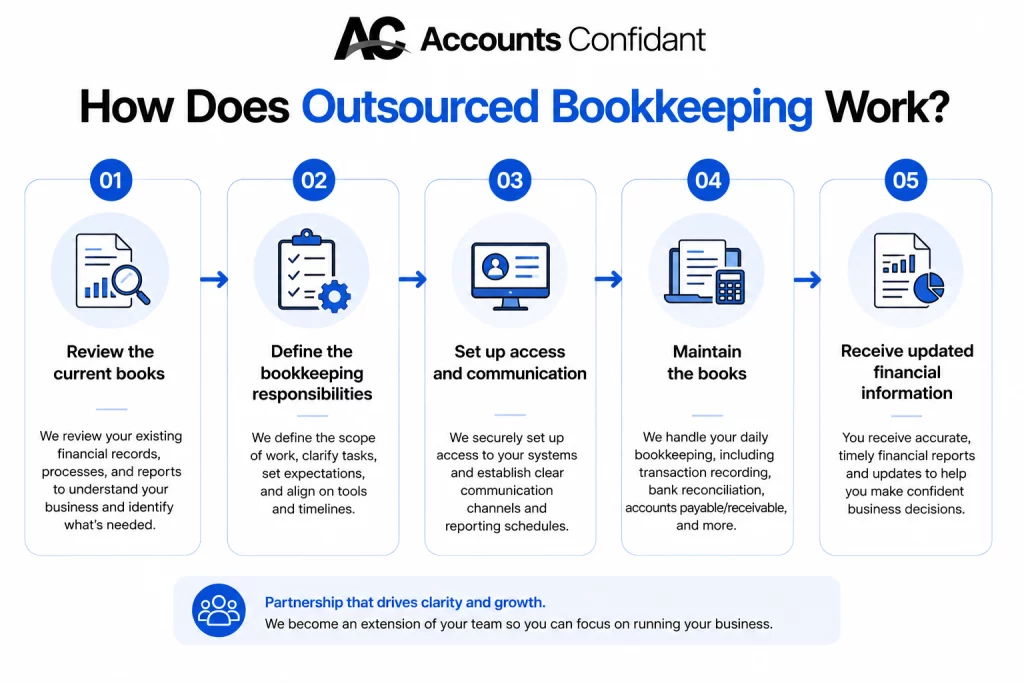
The process is usually straightforward:
- Review the current books– The provider determines whether your records are current, incomplete, or behind.
- Define the bookkeeping responsibilities– You agree on which tasks need to be handled and how often.
- Set up access and communication– The provider receives the necessary access to financial information and establishes a workflow for communication.
- Maintain the books– Transactions are recorded, accounts are reconciled, and other agreed bookkeeping tasks are completed.
- Receive updated financial information– Financial reports and updates are provided according to the agreed schedule.
If your books are already current, the provider can move directly into ongoing bookkeeping. If you have months or years of incomplete records, the first priority may be cleaning up the backlog.
Intuit also recommends establishing clear expectations around communication, access, oversight, security, and responsibilities when working with an external bookkeeping provider.
Benefits of Outsourcing Bookkeeping For Businesses
The advantages of bookkeeping outsourcing are more than just getting rid of bookkeeping tasks from your personal list.
1. Save Time
Routine bookkeeping can take hours away from managing customers, employees, operations, and growth. Outsourcing these responsibilities gives business owners more time to focus on higher-priority work.
2. Keep Your Books Updated
If bookkeeping is continually delayed, bookkeeping transactions and bookkeeping reconciliations can accumulate very rapidly. By having regular external support, there will be more consistency in keeping records up-to-date.
3. Get Access to Bookkeeping Expertise
An outsourced provider can bring experience with financial recordkeeping, reconciliations, reporting, and bookkeeping cleanup without requiring the business owner to handle every issue personally.
4. Make Financial Information Easier to Access
Current bookkeeping makes it easier to review financial reports and understand where the business stands. Businesses can keep financial information all year round rather than tidying it up near the end of the year.
5. Handle Changing Bookkeeping Needs
Your bookkeeping requirements can change as the business grows. Outsourcing can provide additional support when transaction volume, accounts, or financial responsibilities increase.
Support a Virtual Accounting Process
A virtual bookkeeping arrangement can allow businesses to work with an external team without requiring an on-site bookkeeping function.
For instance, Accounts Confidant’s virtual accounting platform enables companies in various time zones to operate and offers bookkeeping and accounting technology, organization, and advisory services.
When Should You Outsource Your Bookkeeping?
There is no single business size or revenue level that determines when you should outsource. Instead, look at whether your current bookkeeping process is actually working.
You may want to consider outsourcing if:
- Your books regularly fall behind
- Bank accounts aren’t reconciled consistently
- You struggle to produce current financial reports
- Bookkeeping takes too much of your time
- You have a growing backlog of transactions
- You need bookkeeping expertise that isn’t available internally
- Your business has grown beyond your existing bookkeeping process
- You want ongoing support without managing every bookkeeping task yourself
If your books are already accurate, current, and easy to maintain, there may be little reason to change your existing arrangement.
The better question is: Is your current bookkeeping process giving you reliable financial information without taking attention away from running your business?
In-House vs. Outsourced Bookkeeping
The choice between in-house vs. outsourced bookkeeping depends on how your business wants to manage its bookkeeping function.
| Factor | In-House Bookkeeping | Outsourced Bookkeeping |
| Bookkeeper | Internal employee | External provider |
| Management | Directly managed by business | Managed through agreed workflow |
| Work arrangement | Internal | Often virtual or remote |
| Expertise | Depends on employee | May provide access to a bookkeeping team |
| Flexibility | Based on internal staffing | Can be structured around business needs |
| Oversight | Direct supervision | Regular communication and reporting |
| Business involvement | More direct involvement | Owner reviews information and results |
An in-house bookkeeper may be appropriate when bookkeeping is a substantial internal function, and the business wants someone closely integrated with its daily operations.
Outsourced bookkeeping may be a better fit when the business needs regular bookkeeping support but doesn’t want the owner or internal employees spending their time managing the work.
The important point is that neither model is automatically right for every company. Your transaction volume, bookkeeping complexity, internal resources, and preferred level of involvement should guide the decision.
Is Outsourcing Bookkeeping Worth It?
Outsourcing bookkeeping can be worth it when it solves a real problem for the business.
If bookkeeping is consistently falling behind, you’re spending too much time on financial administration, or you don’t have reliable financial information when you need it, bringing in outside support can help establish a more consistent process.
It can also be useful when the business has reached a point where its bookkeeping needs have become more complicated than the existing internal process can comfortably handle.
However, outsourcing isn’t simply about handing your books to someone else. You still need to understand your financial position, review reports, maintain appropriate access controls, and communicate with the provider.
Intuit recommends considering factors such as bookkeeping workload, complexity, required support, communication, security, and oversight before deciding whether outsourcing is appropriate.
What Can Outsourced Bookkeeping Help With?
Outsourced bookkeeping can help with both ongoing bookkeeping and backlog or cleanup work.
| Bookkeeping issue | How an outsourced provider can help |
| Outdated books | Bring financial records up to date |
| Unreconciled accounts | Review and reconcile accounts |
| Missing transactions | Identify and record missing activity |
| Vendor bill backlogs | Organize and post outstanding bills |
| Financial reporting | Maintain and provide updated reports |
| Ongoing bookkeeping | Handle recurring bookkeeping responsibilities |
| Growing workload | Provide additional bookkeeping support |
How to Choose the Right Outsourced Bookkeeping Provider
Choosing an outsourced bookkeeping provider is about more than finding someone who can record transactions. The provider should fit your business’s bookkeeping needs, communication style, financial systems, and expectations for ongoing support.
Before making a decision, look at these areas:
- Services you actually need: Confirm that the provider handles the work your business requires, whether that’s routine bookkeeping, bank reconciliation, accounts payable, accounts receivable, financial reporting, or catching up on overdue books.
- Relevant experience: Look for experience with businesses of a similar size or complexity. A provider familiar with your type of bookkeeping challenges may require less time to understand your processes.
- Clear communication: Find out who will be responsible for your account, how often you’ll receive updates, and how questions or discrepancies will be handled.
- Data security: Your bookkeeper will work with sensitive financial information. Ask how access is managed, who can access your records, and what safeguards are used to protect your information.
- Reporting process: Understand what financial reports you’ll receive, how frequently they’ll be delivered, and whether the reports can be explained when you have questions.
- Accounting software compatibility: Make sure the provider can work with the accounting system your business already uses rather than assuming you’ll need to change your existing setup.
- Ability to handle growth: Your bookkeeping needs may change as your business grows. Choose a provider that can accommodate additional transactions or bookkeeping responsibilities when required.
- Coordination with your accountant: If you already work with a CPA or tax professional, ask how the bookkeeping provider will share or organize financial information for tax preparation and other accounting work.
Before signing an agreement, ask what happens if your books are already behind. A provider that can handle bookkeeping cleanup as well as ongoing maintenance may be more useful if you have unreconciled accounts, missing transactions, or several months of incomplete records.
The goal isn’t simply to find an outsourced bookkeeper. It’s to find a provider that can establish a reliable bookkeeping process, keep your records current, communicate clearly, and give you the financial information you need without creating another system for you to manage.
How We Help Small Businesses Get Their Books Back on Track
A Five-Year Bookkeeping Backlog Cleared in Three Months
One client came to us with five years of bookkeeping left incomplete. During that period, financial records had not been regularly reconciled, vendor payments had been missed, and invoices had not been consistently generated.
We worked through the backlog and brought five years of bookkeeping up to date within three months.
Two Years of Bank Reconciliation Completed in 45 Days
Another client had two years of bank reconciliation that needed to be completed. Rather than allowing the backlog to continue growing, we worked through the outstanding records and completed the two years of reconciliation in 45 days.
A Quarter of Missing Vendor Bills Addressed
Missing vendor bill postings can leave gaps in financial records and create additional problems when financial or tax deadlines approach. One client came to us with a quarter’s worth of missing vendor bills.
We worked through the missing postings to help bring the client’s records into order.
From In-House to Virtual Bookkeeping
Moving from an in-house bookkeeping setup to a virtual model can raise questions about how the work will be managed and whether the business will still have access to the support it needs.
We have helped businesses make that transition by providing virtual bookkeeping and accounting support while keeping financial information accessible and organized.
Conclusion
So, is outsourcing bookkeeping worth it? For businesses struggling with outdated records, growing bookkeeping workloads, or limited internal support, outsourcing can be a practical way to maintain accurate and organized financial records.
Understanding the difference between in-house vs outsourced bookkeeping can help you determine which approach fits your business. With the right outsourced bookkeeping services, you can keep your books current, access the financial information you need, and spend more time focusing on your business.
Frequently Asked Questions
Is it worth outsourcing bookkeeping for a small business?
Yes, outsourcing can be a practical option when bookkeeping takes time away from running your business or your financial records are difficult to keep up with. We help you keep your books updated, maintain your financial records, and provide the financial information you need while you focus on your core business.
How much does outsourced bookkeeping cost vs. hiring someone in-house?
The answer depends on the bookkeeping support your business needs. Instead of maintaining an on-site accounting function, you can use our virtual bookkeeping support for the services your business requires. The right option depends on your workload, bookkeeping needs, and level of support.
Is it safe to let an outside company handle my financial data?
Protecting your financial information is important when you outsource bookkeeping. We use reliable systems to maintain your financial data and follow security practices designed to protect your information while our team manages your bookkeeping responsibilities.
How does outsourced bookkeeping actually work?
We start by understanding your bookkeeping needs and the condition of your existing records. Our team then handles the agreed bookkeeping responsibilities, which can include maintaining records, reconciling accounts, and providing updated financial information and reports. We work virtually, so you can receive bookkeeping support without needing an on-site accountant.
What are the signs I need to outsource my bookkeeping?
If your books are regularly behind, accounts aren’t being reconciled, transactions are being missed, or you’re spending too much time managing bookkeeping, it may be time to consider outsourcing. We can help you manage ongoing bookkeeping requirements as well as bring outdated records up to date.
Can outsourced bookkeepers work with QuickBooks or Xero?
Yes, Our bookkeepers have experience with financial software such as QuickBooks, Sage, and FreshBooks. If you use another accounting platform, you can contact us to discuss your requirements and confirm whether we can support your existing system.
What’s the difference between outsourcing bookkeeping and hiring a part-time bookkeeper?
When you hire a part-time bookkeeper, that person works directly for your business for a set amount of time. With our virtual bookkeeping model, you get access to external bookkeeping and accounting support without needing an on-site accountant. This allows us to structure our support around your business’s bookkeeping needs.
How much time does outsourcing bookkeeping actually save a business owner?
The amount of time you save depends on how much bookkeeping you currently handle yourself. By taking care of recurring bookkeeping responsibilities, we can reduce the administrative work involved in maintaining your financial records and give you more time to focus on running your business.
What should I look for in an outsourced bookkeeping provider?
Look for experience, clear communication, knowledge of your accounting software, secure handling of financial information, reliable reporting, and services that match your bookkeeping needs. We also provide dedicated project management and virtual accounting support, so you have a team available to help manage your financial records.
Will outsourcing my bookkeeping mean losing control over my finances?
No, you remain in control of your business and your financial decisions. We handle the bookkeeping and financial recordkeeping responsibilities while providing you with updated financial information and reports, allowing you to monitor your financial position and make informed decisions.