Hiring an in-house bookkeeper can seem like the obvious choice for a small business. You have someone on payroll who knows your accounts, handles reconciliations, records transactions, and keeps your books moving.
But the salary on the job offer is only one part of the in-house bookkeeper cost.
Once you add payroll taxes, benefits, paid time off, software, equipment, training, management time, and the cost of correcting errors, the true cost of an in-house bookkeeper can be substantially higher than the advertised salary.
That raises an important question: Is outsourcing bookkeeping cheaper than keeping the function entirely in-house?
The answer depends on your business, transaction volume, and bookkeeping needs. However, looking at the complete bookkeeper salary plus overhead gives you a much clearer picture of what you are actually paying.
What Is the Real Cost of an In-House Bookkeeper?
The easiest mistake is to compare an employee’s salary directly with an outsourced bookkeeping quote.
For example, suppose you hire a full-time bookkeeper for a $55,000 annual salary. It is tempting to conclude that your bookkeeping costs $55,000 per year.
It doesn’t.
Your actual cost can include:
| Cost | Example Annual Cost |
| Bookkeeper salary | $55,000 |
| Employer payroll taxes | $4,500 |
| Health and other benefits | $7,000 |
| Paid time off | $2,500 |
| Accounting/bookkeeping software | $1,500 |
| Computer and equipment | $1,000 |
| Training and professional development | $1,000 |
| Recruiting/onboarding costs | $2,000 |
| Management and supervision | $3,000 |
| Estimated total | $77,500 |
These figures are illustrative rather than fixed. Actual costs vary by location, compensation package, company size, and benefits.
The important point is that a $55,000 salary can become a $70,000-plus annual expense after overhead.
And that still doesn’t account for the cost of mistakes, employee turnover, or unused capacity.
In-House Bookkeeper Cost: Salary Is Only the Starting Point
Your in-house bookkeeper cost can be divided into three categories: direct compensation, operating overhead, and business impact.
Direct compensation
This includes:
- Base salary or hourly wages
- Employer payroll taxes
- Health insurance contributions
- Retirement contributions
- Bonuses or incentives
- Paid vacation and sick leave
Operating overhead
Your bookkeeper may also require:
- Accounting software
- Payroll software
- Computer hardware
- Office space
- Internet and other workplace resources
- Training
- Professional memberships
- Recruiting and onboarding
Business Impact
This category is harder to see on a payroll report but can be more expensive.
Consider the cost of:
- Correcting bookkeeping errors
- Recreating missing records
- Fixing reconciliation problems
- Delayed financial reporting
- Incorrectly categorized transactions
- Missed invoices or collections
- Management time spent reviewing the books
- Training a replacement after turnover
This is where the true cost of an in-house bookkeeper starts to become very different from the salary listed in a job posting.
The Hidden Cost of Underutilized Bookkeeping Staff
A full-time employee does not necessarily mean eight hours of bookkeeping work every day.
A small business may have periods when bookkeeping demand is high and other periods when there simply isn’t enough work to justify a full-time position.
For example, your bookkeeper might spend significant time during:
- Month-end close
- Payroll processing
- Tax preparation periods
- Year-end reporting
- Accounts receivable follow-up
But between these tasks, there may be relatively little bookkeeping activity.
You are still paying the full salary.
Outsourcing can allow a business to purchase the amount of bookkeeping capacity it actually needs, rather than maintaining a full-time position regardless of workload.
What Does “Bookkeeper Salary Plus Overhead” Really Mean?
The phrase bookkeeper salary plus overhead captures the difference between an employee’s wage and the employer’s total cost.
A simple calculation is:
Total employee cost = salary + payroll taxes + benefits + equipment + software + training + other overhead
You can also calculate the effective hourly cost.
Suppose your annual employee expense is $77,500 and the employee provides approximately 1,800 productive working hours per year.
$77,500 ÷ 1,800 = approximately $43 per productive hour
That does not mean an outsourced bookkeeper charging $43 per hour is automatically the better deal. Outsourcing prices can vary significantly depending on services, transaction volume, expertise, and provider.
It does mean that comparing an outsourced provider’s rate with the employee’s salary alone gives you an incomplete comparison.
Outsourced Bookkeeping Cost vs. In-House Cost
The next step is to compare the outsourced bookkeeping cost with the complete cost of employing someone internally.
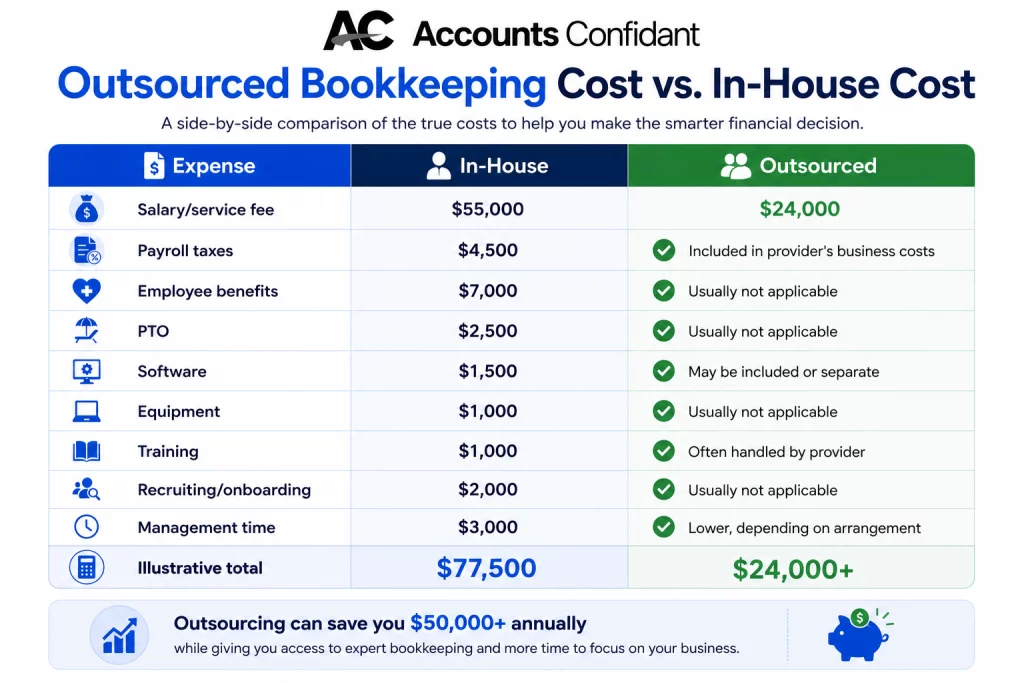
Outsourced bookkeeping pricing can be structured as a monthly fee, hourly rate, project-based fee, or customized package.
A simplified comparison might look like this:
| Expense | In-House | Outsourced |
| Salary/service fee | $55,000 | $24,000 |
| Payroll taxes | $4,500 | Included in provider’s business costs |
| Employee benefits | $7,000 | Usually not applicable |
| PTO | $2,500 | Usually not applicable |
| Software | $1,500 | May be included or separate |
| Equipment | $1,000 | Usually not applicable |
| Training | $1,000 | Often handled by provider |
| Recruiting/onboarding | $2,000 | Usually not applicable |
| Management time | $3,000 | Lower, depending on arrangement |
| Illustrative total | $77,500 | $24,000+ |
The outsourced figure is intentionally shown as an example, not a universal market rate. Your actual cost could be higher or lower.
The comparison becomes useful when you evaluate what each option delivers, not simply the price.
Is Outsourcing Bookkeeping Cheaper?
For many small businesses, outsourcing can be less expensive when bookkeeping needs do not justify a full-time employee.
But is outsourcing bookkeeping cheaper? That depends on several factors.
Outsourcing may make financial sense when:
- Your transaction volume is moderate
- You don’t need a full-time bookkeeper
- Your bookkeeping workload fluctuates
- You need access to experienced accounting professionals
- You want to reduce employee overhead
- You need bookkeeping plus reporting or cleanup
- Your business is growing faster than your current bookkeeping processes
Keeping bookkeeping in-house may make more sense when:
- You have high transaction volume
- Your accounting function is complex
- You need someone physically present every day
- Your business requires specialized internal knowledge
- The employee handles substantial finance-related responsibilities beyond bookkeeping
The right question isn’t simply, “Which costs less?”
It is: Which option gives the business the bookkeeping capacity, accuracy, controls, and financial visibility it needs at the lowest sustainable total cost?
How Errors Can Increase Your Bookkeeping Cost
Bookkeeping errors have a way of hiding until they become expensive.
A transaction entered into the wrong account might not look significant on its own. But repeated errors can distort financial reports and make it harder to understand the company’s actual performance.
Potential consequences include:
- Incorrect profit-and-loss reporting
- Unreconciled bank accounts
- Incorrect accounts receivable balances
- Duplicate transactions
- Missing expenses
- Incorrect tax information
- Delayed month-end closing
- Additional accountant fees for cleanup
Suppose a bookkeeper makes recurring classification errors that take an outside accountant 20 hours to correct at $150 per hour.
20 × $150 = $3,000
That $3,000 is an additional bookkeeping-related cost that will not appear in the employee’s salary.
This is why the true cost of an in-house bookkeeper should include the financial impact of errors and rework when those costs are material.
Bookkeeping Fraud Risk: Where Internal Controls Matter
Cost isn’t the only reason to evaluate your bookkeeping structure.
There is also bookkeeping fraud risk for small businesses.
Small companies can face greater internal-control challenges when one person has extensive access to financial records and controls multiple parts of the transaction process.
For example, consider an employee who can:
- Enter vendor bills
- Create or modify vendor records
- Record payments
- Reconcile the bank account
- Access financial reports
When too many responsibilities sit with one person, it can become harder for the business owner to identify unusual activity.
This does not mean that an in-house bookkeeper is inherently more likely to commit fraud. Most bookkeeping professionals are trustworthy. The issue is the control structure, not the employment arrangement.
Can Outsourcing Bookkeeping Reduce Fraud Risk?
Outsourcing can help reduce certain risks when it introduces separation of duties and independent review.
For example, a business owner could retain responsibility for approving payments while an outsourced bookkeeper handles transaction recording and reconciliations.
That creates an additional layer of oversight.
However, outsourcing does not automatically eliminate fraud risk. An outsourced provider still needs appropriate access controls, approval processes, user permissions, audit trails, and regular reviews.
A strong setup may look like this:
Owner approves payments → Bookkeeper records transactions → Bank accounts are reconciled → Owner reviews financial reports
The goal is to avoid giving one person unrestricted control over every stage of the financial process.
What If You Think Your Bookkeeper Is Costing You Money?
Don’t immediately assume the problem is the employee.
Instead, measure the bookkeeping function.
Start by reviewing:
Accuracy
Check whether:
- Bank accounts reconcile on time
- Credit card accounts reconcile correctly
- Accounts receivable is accurate
- Accounts payable is complete
- Transactions are consistently categorized
- Financial statements contain unusual fluctuations
Timeliness
Ask:
- Are monthly books closed on schedule?
- How quickly are reconciliations completed?
- Are financial reports available when management needs them?
- Are outstanding bookkeeping tasks accumulating?
Business value
Consider whether your bookkeeping helps you:
- Understand cash flow
- Track profitability
- Monitor receivables
- Control expenses
- Prepare for tax filings
- Make financial decisions
Total cost
Finally, calculate:
Salary + benefits + taxes + software + equipment + training + management time + corrections + other overhead
Then compare that number with the cost of an outsourced alternative that provides equivalent services.
That gives you a much more useful answer than simply comparing salaries.
What About Coverage When Your Bookkeeper Is Out?
An in-house bookkeeper can become a single point of failure.
If the employee is:
- On vacation
- Sick
- Taking parental leave
- Attending training
- Suddenly unavailable
- Leaving the company
Someone else still needs to maintain the books.
That could mean the owner, another employee, an accountant, or a temporary bookkeeper has to step in.
An outsourced firm may provide team-based coverage, depending on its service model. If one person is unavailable, another member of the provider’s team may be able to continue the work.
That doesn’t make outsourcing automatically better. It simply gives businesses another way to handle continuity.
What’s Included in Outsourced Bookkeeping Services?
Outsourced bookkeeping services vary by provider, so always check the scope before comparing prices.
A basic package may include:
- Transaction categorization
- Bank reconciliation
- Credit card reconciliation
- Accounts payable support
- Accounts receivable support
- Monthly financial statements
- Bookkeeping cleanup
- General ledger maintenance
More comprehensive packages may include:
- Cash-flow reporting
- Management reports
- Payroll coordination
- Accounts receivable follow-up
- Accounts payable management
- Month-end close
- Accounting software support
- Financial review meeting
If you’re comparing providers, make sure you’re comparing equivalent services.
Can You Keep Your Bookkeeper and Still Outsource Oversight?
Yes. Outsourcing does not have to mean replacing your employee.
A hybrid model can combine an internal bookkeeper with an external accounting professional.
For example:
In-house bookkeeper:
Handles daily transactions, invoices, bills, and routine bookkeeping.
External bookkeeping/accounting provider:
Performs monthly review, reconciliations, cleanup, financial reporting, and control checks.
Business owner:
Reviews reports and approves important financial transactions.
This approach can provide the business with internal knowledge while adding independent oversight.
It can be particularly useful when the company has an experienced bookkeeper but wants another set of eyes on the books.
How to Calculate Your Own Break-Even Point
Want to know whether outsourcing is financially attractive for your business?
Start with your current annual cost.
Step 1: Calculate employee cost
Add:
Salary + payroll taxes + benefits + PTO + software + equipment + training + recruiting + management
Step 2: Add rework and coverage costs
Estimate reasonable annual costs for:
- Cleanup
- Temporary coverage
- External review
- Correcting bookkeeping errors
- Additional accounting work caused by bookkeeping problems
Don’t inflate these figures. Use actual historical costs whenever possible.
Step 3: Calculate the outsourcing cost
Take the provider’s monthly fee and multiply it by 12.
Then add:
- Additional services
- Setup fees
- Cleanup fees
- Software not included
- Other applicable charges
Step 4: Compare equivalent services
Make sure both options cover the same responsibilities.
Step 5: Compare the business impact
Consider:
- Reporting speed
- Accuracy
- Coverage
- Internal controls
- Scalability
- Management time
Now you have a much more meaningful comparison than salary versus invoice.
When Outsourcing Becomes the Better Financial Choice
Outsourcing bookkeeping tends to become more attractive when the business has reached the point where bookkeeping is too important to be handled casually but not large enough to justify a full internal accounting team.
That middle ground is where many small businesses get stuck.
They may have:
- A full-time bookkeeper
- An external tax accountant
- Accounting software
- An owner reviewing the books
- Multiple subscriptions
- Recurring cleanup work
Yet nobody is looking at the entire system and asking whether the structure is efficient.
Outsourcing can consolidate some of those responsibilities and give the business access to bookkeeping expertise without taking on every cost associated with another employee.
Final Verdict: Look Beyond the Paycheck
An in-house bookkeeper isn’t necessarily expensive, and outsourcing isn’t automatically cheaper.
The mistake is comparing bookkeeper salary against an outsourced bookkeeping quote and calling that the answer.
The more accurate calculation considers the true cost of an in-house bookkeeper, including salary, payroll taxes, benefits, software, equipment, training, management time, errors, and other overhead.
Then compare that figure with the outsourced bookkeeping cost and the services you actually receive.
For some businesses, keeping bookkeeping internal will remain the smartest choice. For others, outsourcing can reduce overhead, provide greater flexibility, improve financial oversight, and potentially strengthen internal controls.
The best decision comes from doing the real math first.
Frequently Asked Questions
Is it cheaper to hire an in-house bookkeeper or outsource?
It depends on workload, transaction volume, compensation, benefits, software requirements, and the scope of outsourced services. Outsourcing can be less expensive when a business doesn’t have enough bookkeeping work to justify a full-time employee, while an in-house bookkeeper may be more economical for businesses with consistent, complex workloads.
What does an in-house bookkeeper really cost once you include benefits and taxes?
The total cost can be substantially higher than salary alone. Add employer payroll taxes, benefits, paid time off, software, equipment, training, recruiting, management time, and other overhead to calculate the full employer cost.
I think my bookkeeper is costing us money. How do I check?
Start with an objective review. Check reconciliations, transaction accuracy, reporting delays, accounts receivable and payable, recurring corrections, and the amount of management time required. Then calculate your total annual bookkeeping cost and compare it with equivalent outsourced services.
Should a small business with under $2M revenue outsource bookkeeping?
Revenue by itself shouldn’t determine the decision. Consider transaction volume, bookkeeping complexity, reporting requirements, internal controls, growth plans, and the total cost of maintaining an employee. Many smaller businesses can benefit from outsourcing when they don’t need a full-time bookkeeper.
What’s included in outsourced bookkeeping services?
Services vary, Common offerings include transaction categorization, bank and credit card reconciliations, accounts payable and receivable support, monthly close, financial statements, general ledger maintenance, and bookkeeping cleanup. More comprehensive packages may include reporting, cash-flow analysis, and ongoing accounting support.
How much should I budget for a full-time bookkeeper including overhead?
There is no universal figure because compensation and benefits vary by location and employer. A practical budget should include salary plus employer payroll taxes, benefits, paid time off, software, equipment, training, recruiting, management time, and other employee-related expenses.
Can outsourcing bookkeeping reduce fraud risk?
It can help reduce certain risks when outsourcing is combined with proper separation of duties, access controls, payment approvals, reconciliations, and independent review. Outsourcing alone does not eliminate fraud risk.
Is it possible to keep my bookkeeper but still outsource some oversight?
Yes. A hybrid model can work well. Your internal bookkeeper can handle routine transactions while an external provider or accounting professional performs reconciliations, monthly reviews, cleanup, reporting, or internal-control checks.
What are the hidden costs of hiring an employee vs. a contractor for bookkeeping?
Employee costs can include payroll taxes, benefits, PTO, equipment, training, recruiting, management, and other overhead. A contractor or outsourced provider may reduce some of those costs, but service fees, contract terms, additional services, and applicable tax and worker-classification requirements still need to be considered.