Managing a company’s financial records is not an easy task. But on the bright side, there are people who help you manage them so that you can save your time and energy and invest it in actually running the business. These professionals are called bookkeepers and accountants.
The two roles overlap, but they are not the same. A bookkeeper keeps your financial records organized and up to date, while an accountant uses those records to prepare financial reports, handle tax-related work, analyze business performance, and provide financial guidance.
In this guide, we’ll break down the responsibilities of bookkeepers and accountants, compare their roles, and help you decide which one is right for your business.
What Is a Bookkeeper?
A bookkeeper is responsible for recording and organizing your business’s day-to-day financial transactions. Think of a bookkeeper as the person who ensures your financial records remain accurate, complete, and up to date. Every sale, expense, invoice, payment, and bank transaction is recorded systematically so your financial information is always reliable.
Accurate bookkeeping forms the foundation of good financial management. Without organized records, preparing taxes, generating financial reports, or evaluating business performance becomes far more difficult. That’s why bookkeeping is often considered the first step in the accounting process.
Modern bookkeepers typically use cloud-based accounting software such as QuickBooks Online, Xero, or FreshBooks to automate many routine tasks. Features like bank feeds, invoice tracking, and automated transaction categorization make bookkeeping more efficient while reducing the likelihood of human error. However, software alone isn’t enough, someone still needs to review transactions, correct discrepancies, and ensure financial records accurately reflect your business activity.
Although bookkeeping doesn’t usually involve financial analysis or tax strategy, it plays a critical role in supporting those functions. Accountants rely on clean, accurate books to prepare financial statements, file tax returns, and provide strategic advice.
Types of Bookkeeping
Depending on the size and complexity of a business, bookkeeping generally follows one of two methods.
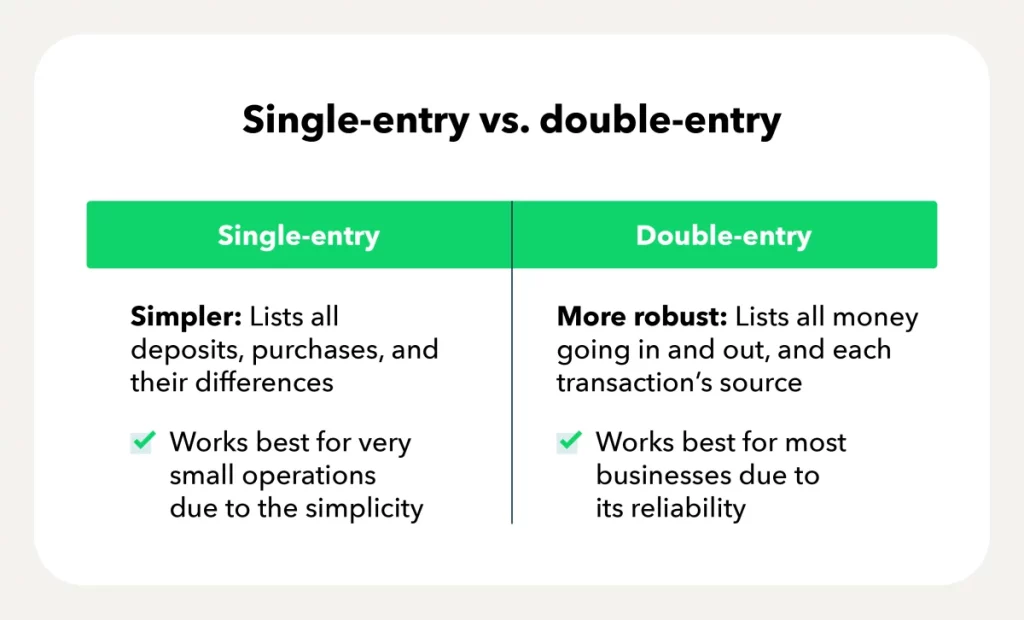
Single-Entry Bookkeeping
Single-entry bookkeeping is the simplest method and is commonly used by sole proprietors, freelancers, and businesses with relatively few financial transactions. Each transaction is recorded once, making it suitable for businesses with straightforward cash inflows and outflows.
While this method is easy to manage, it provides limited financial reporting and may not be sufficient as a business grows.
Double-Entry Bookkeeping
Most established businesses use double-entry bookkeeping. Every transaction affects at least two accounts, one debit and one credit, ensuring that the accounting equation remains balanced. This approach provides greater accuracy, reduces the risk of errors, and supports comprehensive financial reporting. It’s also the standard method used by modern accounting software, including QuickBooks.
For businesses with inventory, payroll, multiple revenue streams, or growing operational complexity, double-entry bookkeeping is generally the preferred approach.
What Does a Bookkeeper Do?
A bookkeeper is the one who handles day-to-day financial transactions and organizes them accordingly. The responsibilities are clerical in nature.
Some of the most common responsibilities of bookkeepers include:
- Keeping Records: They record daily transactions, such as payments, expenses, and inventory, to keep financial records accurate and up to date.
- Checking Accounts: They also compare financial records with bank statements to make sure the numbers match and identify missing or incorrect entries.
- Tracking Cash: Bookkeepers help monitor cash balances and upcoming payments to make sure the business has enough money for payroll, taxes, and other expenses.
- Handling Payroll: Also, they are proficient in calculating employee pay, including overtime, paid leave, and bonuses, along with processing payroll and keeping payroll records up to date.
- Tracking Payments: They monitor accounts receivable and accounts payable to track what customers owe and what the business needs to pay.
Why Bookkeeping Matters
Many business owners underestimate the importance of bookkeeping until they encounter problems like missing transactions, inaccurate tax filings, or cash flow issues. In reality, consistent bookkeeping supports nearly every financial aspect of running a business.
Effective bookkeeping helps businesses:
- Maintain accurate financial records
- Track income and expenses in real time
- Monitor cash flow
- Prepare for tax season with organized documentation
- Identify unusual spending patterns
- Support informed business decisions
- Reduce the risk of financial errors
- Simplify audits and compliance requirements
For example, imagine a small marketing agency that invoices dozens of clients each month. Without proper bookkeeping, missed payments, duplicate expenses, or unreconciled bank transactions could quickly create confusion. A bookkeeper ensures every transaction is recorded correctly, making it easier to understand the business’s financial performance and providing accountants with reliable data for tax preparation and strategic planning.
Bookkeeping also enables business owners to answer important questions such as:
- How much profit did the business earn this month?
- Which expenses have increased?
- Which customers still owe payments?
- Is there enough cash available to cover upcoming bills?
- Are operating costs staying within budget?
Having accurate answers to these questions helps business owners make confident financial decisions rather than relying on guesswork.
Skills Every Good Bookkeeper Should Have
While bookkeeping software has automated many routine processes, successful bookkeepers still require a strong combination of technical knowledge and attention to detail.
Some of the most valuable bookkeeping skills include:
- Excellent attention to detail
- Strong organizational abilities
- Knowledge of accounting principles
- Proficiency with accounting software such as QuickBooks Online
- Data entry accuracy
- Time management
- Problem-solving skills
- Communication skills for working with business owners and accountants
A skilled bookkeeper doesn’t just enter numbers, they help ensure your financial records remain accurate, consistent, and ready for analysis whenever needed.
What Is an Accountant?
While a bookkeeper focuses on recording financial transactions, an accountant takes that information and transforms it into meaningful financial insights. Accountants analyze financial data, prepare reports, ensure compliance with tax laws and accounting standards, and help business owners make informed decisions.
Think of it this way: if bookkeeping is about maintaining accurate financial records, accounting is about understanding what those records mean and using them to plan for the future.
Accountants don’t simply “do taxes”; they help businesses understand profitability, manage cash flow, identify growth opportunities, minimize tax liabilities within legal guidelines, and prepare for major financial decisions. Their work becomes increasingly valuable as a business grows and financial operations become more complex.
Most accountants work closely with business owners throughout the year rather than only during tax season. They review financial performance, recommend process improvements, assist with budgeting, and help ensure the business remains compliant with applicable regulations.
Moving forward, we will discuss the responsibilities of an accountant.
What Does an Accountant Do?
Although responsibilities vary depending on the size of the business and the accountant’s specialization, most accountants perform a combination of the following tasks.
Preparing Financial Statements
Accountants prepare common financial statements like:
- Profit and Loss (Income) Statement
- Balance Sheet
- Cash Flow Statement
- Statement of Changes in Equity
These help track the financial performance of the company.
2. Taxes and Filing
Taxes are one of the biggest reasons businesses hire accountants.
An accountant takes care of the tax returns and eligible deductions that may apply, ensures the statements are compliant with the tax regulations, and also meets important filing deadlines.
You need a qualified accountant to protect your business as the tax rules change all year round.
3. Financial Analysis
Recording transactions is only the beginning. Accountants analyze financial information to answer important business questions such as:
- Is the business profitable?
- Are expenses increasing faster than revenue?
- Which products or services generate the highest profit?
- Is cash flow sufficient to support expansion?
- What financial risks should management address?
By addressing these questions, business owners can make informed decisions instead of relying on assumptions.
4. Budgeting and Forecasting
Accountants help businesses create realistic budgets and financial forecasts based on historical performance and future goals.
Forecasting allows business owners to estimate:
- Future revenue
- Expected expenses
- Cash flow requirements
- Hiring plans
- Investment opportunities
This proactive approach helps businesses prepare for growth while minimizing financial surprises.
5. Business Advisory Services
Modern accountants assist with decisions such as:
- Pricing strategies
- Business expansion
- Equipment purchases
- Hiring employees
- Choosing the right business structure
- Improving profitability
- Managing financial risk
They are considered trusted business advisors because of their expertise.
6. Compliance and Regulatory Support
Businesses must comply with various financial regulations, tax requirements, and accounting standards.
Accountants help ensure:
- Accurate financial reporting
- Proper tax compliance
- Payroll tax obligations are met
- Financial records support audits
- Required documentation is maintained
This reduces the risk of penalties and helps businesses operate with confidence.
Bookkeeper vs Accountant: Understanding the Key Differences
Many people assume bookkeeping and accounting are the same because both involve managing financial information. In reality, they complement each other while serving different purposes.
The difference between a bookkeeper and an accountant lies in the scope of their responsibilities.
A bookkeeper focuses on recording and organizing financial data. An accountant uses that data to analyze financial performance, prepare reports, ensure compliance, and provide strategic advice.
Bookkeeper vs Accountant: A Practical Example
The difference between a bookkeeper and an accountant lies in the scope of their responsibilities.
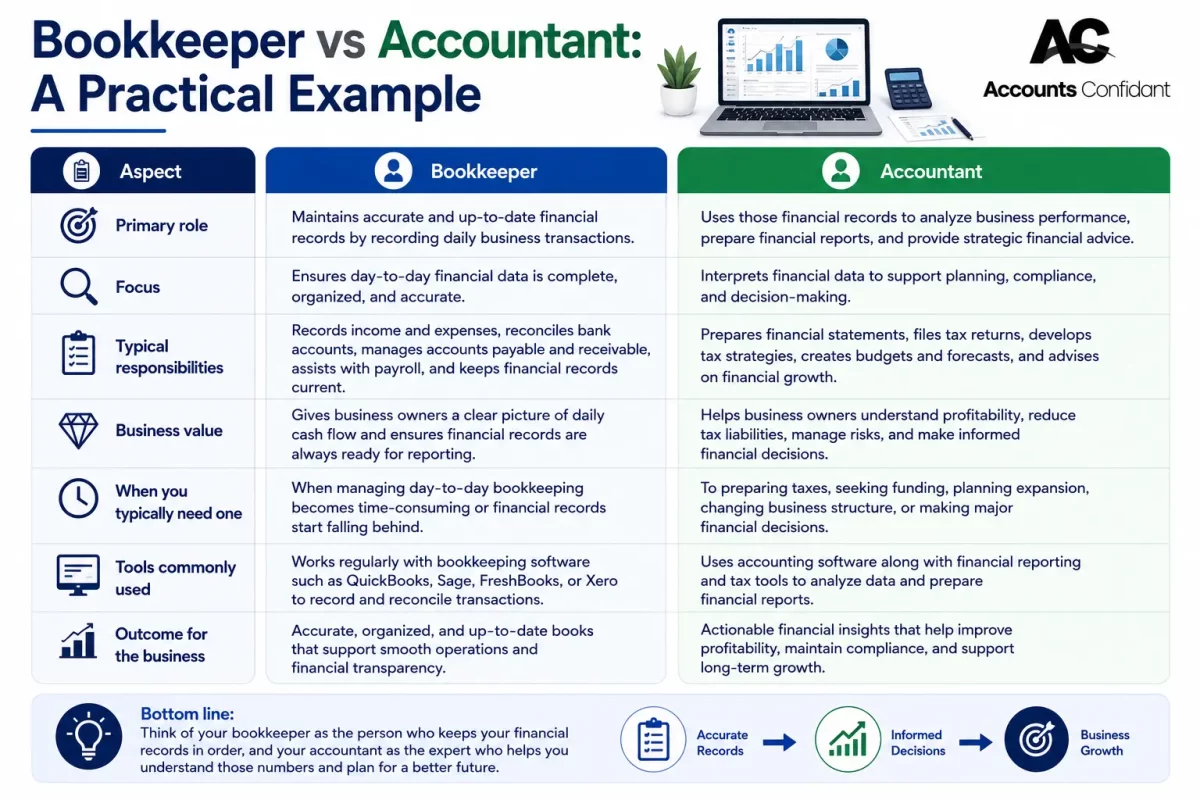
Imagine you own a growing digital marketing agency.
Throughout the month:
- Clients pay invoices.
- Employees receive salaries.
- Software subscriptions renew.
- Marketing expenses are incurred.
- Contractors submit bills.
- Business travel expenses are recorded.
A bookkeeper would:
- Record every transaction.
- Categorize income and expenses.
- Reconcile bank accounts.
- Track unpaid invoices.
- Maintain organized financial records.
- Produce monthly bookkeeping reports.
An accountant would then:
- Review those reports.
- Prepare financial statements.
- Calculate estimated taxes.
- Recommend tax-saving strategies.
- Analyze profitability.
- Help determine whether hiring another employee is financially sustainable.
- Advise on long-term business growth.
Without accurate bookkeeping, the accountant would spend valuable time correcting errors instead of providing meaningful financial guidance.
| Aspect | Bookkeeper | Accountant |
| Primary role | Maintains accurate and up-to-date financial records by recording daily business transactions. | Uses those financial records to analyze business performance, prepare financial reports, and provide strategic financial advice. |
| Focus | Ensures day-to-day financial data is complete, organized, and accurate. | Interprets financial data to support planning, compliance, and decision-making. |
| Typical responsibilities | Records income and expenses, reconciles bank accounts, manages accounts payable and receivable, assists with payroll, and keeps financial records current. | Prepares financial statements, files tax returns, develops tax strategies, creates budgets and forecasts, and advises on financial growth. |
| Business value | Gives business owners a clear picture of daily cash flow and ensures financial records are always ready for reporting. | Helps business owners understand profitability, reduce tax liabilities, manage risks, and make informed financial decisions. |
| When you typically need one | When managing day-to-day bookkeeping becomes time-consuming or financial records start falling behind. | To preparing taxes, seeking funding, planning expansion, changing business structure, or making major financial decisions. |
| Tools commonly used | Works regularly with bookkeeping software such as QuickBooks, Sage, FreshBooks, or Xero to record and reconcile transactions. | Uses accounting software along with financial reporting and tax tools to analyze data and prepare financial reports. |
| Outcome for the business | Accurate, organized, and up-to-date books that support smooth operations and financial transparency. | Actionable financial insights that help improve profitability, maintain compliance, and support long-term growth. |
The difference between a bookkeeper and an accountant isn’t about which role is more important; it’s about where they add value. A bookkeeper ensures your financial records are accurate every day, while an accountant uses those records to guide financial decisions, manage taxes, and help your business grow. For many businesses, these roles work best together rather than as substitutes for one another.
Now let’s see which one is the right pick for your business.
Accountant vs Bookkeeper For Small Business
One of the most common questions business owners ask is about the accountant vs bookkeeper for small business. The answer depends on your business’s size, transaction volume, and financial complexity.
Freelancers and Solopreneurs
If you’re a freelancer or independent consultant with relatively few monthly transactions, accounting software may handle much of your day-to-day bookkeeping. You may only need an accountant during tax season or when making major financial decisions.
Startups
Startups often benefit from routine bookkeeping support while consulting an accountant periodically for budgeting, tax planning, and choosing the right business structure.
Keeping financial records organized from the beginning also makes it easier to secure funding and measure business performance as the company grows.
Growing Small Businesses
As revenue increases, so does financial complexity.
Businesses managing payroll, inventory, recurring invoices, multiple bank accounts, or expanding teams often benefit from dedicated bookkeeping support combined with ongoing accounting advice.
This combination ensures daily financial records remain accurate while providing business owners with strategic financial guidance.
Established Businesses
Established businesses generally require both bookkeeping and accounting services.
Bookkeepers maintain accurate records throughout the year, while accountants focus on financial reporting, compliance, tax strategy, budgeting, and long-term planning.
Working together, they provide business owners with both operational efficiency and financial insight.
Not sure whether you need a bookkeeper, an accountant, or both? Accounts Confidant can help you manage your financial records and get the accounting support your business needs.
Why Accurate Bookkeeping Makes Your Accountant More Effective
Many business owners assume accountants spend most of their time analyzing financial performance or preparing tax returns. In reality, much of their time can be spent correcting incomplete bookkeeping records.
When financial transactions are missing, accounts haven’t been reconciled, or expenses are categorized incorrectly, accountants must first clean up the books before they can provide meaningful financial advice.
Accurate bookkeeping changes that.
When your financial records are consistently maintained throughout the year, your accountant can focus on higher-value activities, such as:
- Identifying tax-saving opportunities
- Preparing accurate financial statements
- Analyzing profitability and cash flow
- Developing budgets and financial forecasts
- Supporting business expansion plans
- Providing strategic financial guidance
Why Many Businesses Outsource Their Financial Management
While some businesses hire in-house staff, many choose to outsource bookkeeping and accounting services to access professional financial support without the overhead of building an internal finance team.
Outsourced financial services can include bookkeeping, bank reconciliations, accounts payable and receivable, financial reporting, payroll support, and accounting advisory. This allows business owners to spend less time on administrative tasks while ensuring their financial records remain accurate, organized, and ready for tax season.
The Bottom Line
The bookkeeper vs accountant debate isn’t about choosing one profession over the other, it’s about understanding the role each plays in your business. While both of them have distinct responsibilities, they are complementary to each other.
Many businesses start with bookkeeping support and later add accounting services to help with planning, compliance, and long-term growth. By understanding when to rely on each professional, you can build a stronger financial foundation and make more confident business decisions.
Frequently Asked Questions
Do I need a bookkeeper or an accountant for my small business?
It depends on your needs. If you need help recording daily transactions, reconciling bank accounts, managing invoices, and keeping financial records organized, a bookkeeper is the right choice. If you need tax planning, financial reporting, budgeting, or strategic advice, you’ll benefit from working with an accountant. Many growing businesses eventually use both services.
What’s the actual difference between a bookkeeper and an accountant?
The primary difference between a bookkeeper and an accountant is their role. Bookkeepers maintain accurate financial records by recording daily transactions, while accountants analyze those records to prepare financial statements, manage taxes, and provide business advice.
Can the same person be my bookkeeper and my accountant?
Yes, many professionals and accounting firms provide both bookkeeping and accounting services, particularly for small businesses. As a business grows, however, these responsibilities are often divided between dedicated bookkeeping and accounting specialists.
Is a CPA the same thing as an accountant?
No, a CPA is a licensed accountant who has met additional education, examination, and experience requirements. While every CPA is an accountant, not every accountant is a CPA.
How much does a bookkeeper cost vs. an accountant?
Bookkeeping Service is clerical in nature, so the cost is usually less than a highly skilled service like accounting. The pricing may also vary based on your business size, transaction volume, and service requirements.
When to hire an accountant instead of just a bookkeeper?
Consider hiring an accountant if you’re preparing taxes, applying for financing, expanding your business, changing your business structure, or making significant financial decisions that require professional guidance.
What does a bookkeeper actually do day to day?
A bookkeeper records financial transactions, manages accounts payable and receivable, reconciles bank accounts, processes payroll (where applicable), organizes financial records, and prepares routine financial reports that help business owners monitor performance.
Do I need an accountant if I already have QuickBooks?
Yes, QuickBooks is a powerful accounting software, but it doesn’t replace professional financial expertise. The software helps record and organize financial information, while an accountant interprets that information, provides tax guidance, and supports strategic decision-making.
What tasks should I hand to a bookkeeper vs an accountant?
Routine financial tasks such as recording transactions, reconciling accounts, invoicing, payroll support, and maintaining financial records are typically handled by a bookkeeper. Financial reporting, tax preparation, forecasting, budgeting, and business advisory services are generally handled by an accountant.
Is it worth paying for both a bookkeeper and an accountant as a small business?
For many businesses, yes. A bookkeeper keeps financial records accurate throughout the year, while an accountant uses those records to provide tax guidance and financial insights. Working with both professionals helps reduce errors, improve financial visibility, and support better business decisions.