A job can look profitable in your accounting records and still produce less profit than expected when the project is complete. Missing labor hours, incorrectly assigned materials, delayed subcontractor bills, and inconsistent overhead allocation can all distort project costs. This is why job costing accuracy matters.
Job costing helps businesses track the labor, materials, subcontractor expenses, and overhead associated with individual projects. When those costs are recorded correctly, you can compare actual spending with estimates, identify overruns, and understand whether a project is truly profitable.
But when the numbers do not line up, the important question is: why is my job costing wrong?
The answer is often found in the way costs are estimated, tracked, assigned, recorded, or reviewed throughout the project.
What Is Job Costing and Why Does Accuracy Matter?
Job costing is an accounting method used to track the revenue and costs associated with a specific project. Instead of looking only at the company’s overall expenses, it connects individual costs to the job that generated them.
Most job costs fall into three major categories:
| Cost Category | Examples |
| Labor | Employee wages, project hours, overtime, subcontracted labor |
| Materials | Supplies, raw materials, equipment-related materials |
| Overhead | Rent, utilities, administrative expenses, equipment, insurance |
The basic calculation is:
Total Job Cost = Labor + Materials + Overhead
Once the total cost is known, you can compare it with project revenue to determine profitability.
Job Profit = Project Revenue − Total Job Cost
Accurate job costing is important because it helps you:
- Measure the profitability of individual projects
- Compare actual costs with estimates
- Identify cost overruns early
- Improve future project estimates
- Set more realistic prices
- Find inefficient spending
- Understand which projects generate the strongest margins
For example, if a project generates $100,000 in revenue and the accounting records show $75,000 in costs, the reported profit is $25,000.
But if $8,000 in labor and material costs have not yet been assigned to that project, the actual profit is only $17,000.
The business did not necessarily make a calculation error. It may simply have incomplete job-costing data.
Why Is My Job Costing Wrong?
When job costing repeatedly produces unexpected results, the problem usually comes from how project information is entered and maintained.
Expenses Are Assigned to the Wrong Job
Every project-related expense needs to be connected to the correct customer or job.
If a $4,000 material purchase for Job A is accidentally assigned to Job B, the total business expense may still be correct. However, both project profitability reports will be wrong.
Job A will appear more profitable than it really is, while Job B will appear less profitable.
This is one reason accurate job costing requires more than simply recording every transaction. Each transaction must also be connected to the right project.
Labor Hours Are Missing or Incorrect
Labor is often one of the largest costs associated with a project.
Job costing can become inaccurate when employees:
- Forget to submit timesheets
- Record hours under the wrong project
- Enter incorrect hours
- Leave overtime unrecorded
- Use inconsistent job or service codes
- Submit project hours after the reporting period
For example, a project may appear to be under budget because 40 hours of employee labor have not yet been entered. Once those hours are recorded, the project’s profit margin may drop significantly.
Payroll errors can also affect job costing accuracy when employee wages, overtime, or labor expenses are recorded incorrectly, so it is important to identify and resolve QuickBooks payroll errors promptly.
Material Costs Are Recorded Late
Materials do not always appear in project records at the same time they are purchased.
Supplier invoices may arrive later, receipts may not be entered immediately, or purchases may be recorded as general business expenses instead of project expenses.
This creates a temporary gap between the actual cost of the job and the cost shown in your accounting records.
Subcontractor Costs Are Missing
Construction and other project-based businesses often rely on subcontractors.
A subcontractor may complete work in one accounting period but submit an invoice later. Until that cost is recorded and assigned to the correct project, the job may appear more profitable than it actually is.
Regularly reviewing outstanding subcontractor bills can help reduce this problem.
Overhead Is Allocated Incorrectly
Direct costs are usually easier to identify because they can be linked directly to a project.
Overhead is more difficult because it supports multiple jobs or the business as a whole.
Depending on the business, overhead may include:
- Office rent
- Utilities
- Insurance
- Administrative labor
- Equipment expenses
- Software
- Other operating costs
If overhead is included in your job-costing model, it needs to be allocated consistently. Otherwise, project margins may not accurately reflect the resources required to complete the work.
Estimates Are Outdated
Job costing is most useful when actual costs are compared with realistic estimates.
If your original estimate is based on outdated labor rates, material prices, or project assumptions, the variance may look worse than it actually is.
Estimates should be reviewed when significant changes occur, including:
- Material price increases
- Scope changes
- Additional labor requirements
- Schedule delays
- New subcontractor costs
- Customer-requested changes
Change Orders Are Not Updated
A project can change substantially after the original estimate is created.
If a customer approves additional work but the related revenue and costs are not properly recorded, your job-costing report will no longer represent the project’s current scope.
Every approved change order should be reflected in the appropriate project records.
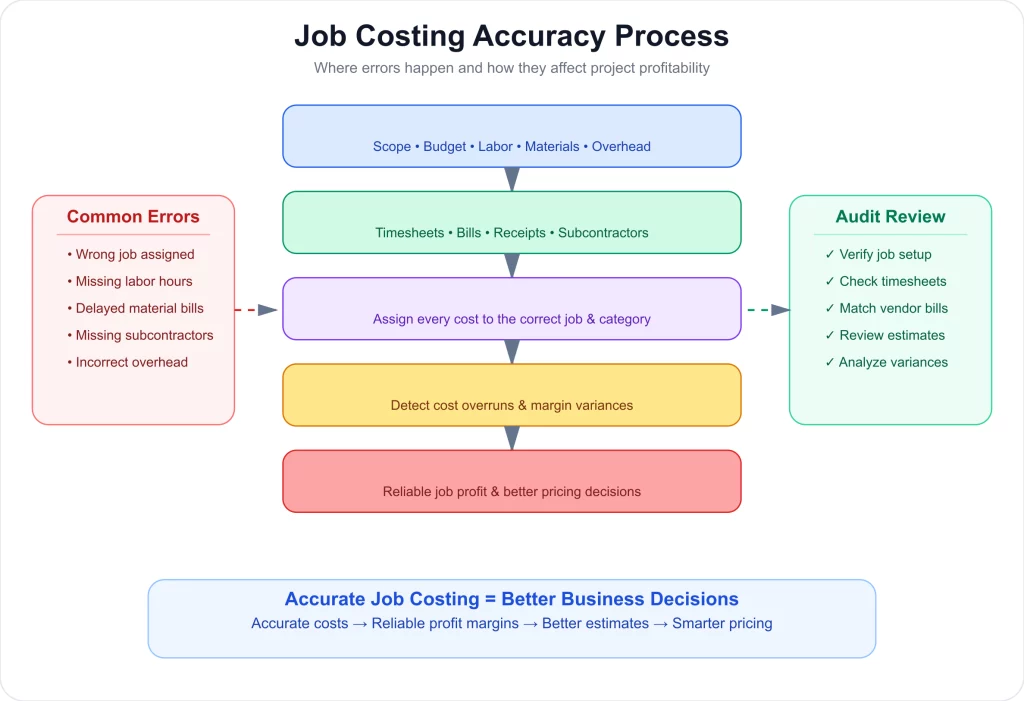
How the Job Costing Process Can Go Wrong
Job costing is not a single accounting entry. It is a process that begins before work starts and continues through project completion.
A reliable process generally includes these stages:
| Stage | What Happens | What Can Go Wrong |
| Identify | Set up the project | Wrong customer or job selected |
| Estimate | Forecast labor, materials, and overhead | Unrealistic estimates |
| Track | Record actual project costs | Missing hours or purchases |
| Allocate | Assign costs to categories and jobs | Incorrect cost allocation |
| Record | Enter costs into accounting records | Late or duplicate entries |
| Analyze | Compare actual vs. estimated costs | Variances ignored |
| Report | Review project profitability | Reports based on incomplete data |
This process explains why job costing accuracy is an ongoing responsibility rather than something you check only after a project is finished.
The earlier an error is identified, the easier it usually is to correct.
What Are the Signs Your Job Costing System Is Inaccurate?
You may have an inaccurate job-costing process if your reports regularly produce results that do not match what is happening on the project.
Look for these warning signs:
- Projects show unusually high profit margins
- Actual costs frequently exceed estimates
- Project margins change significantly after completion
- Labor costs appear unusually low
- Material purchases are sitting under general expenses
- Subcontractor costs appear weeks after the work
- Project reports require frequent manual adjustments
- Completed jobs have unexplained cost variances
- A project looks profitable until final bills arrive
- Reported project profit does not match operational expectations
One unusual variance does not necessarily indicate a problem. However, repeated discrepancies are worth investigating.
How Inaccurate Job Costing Affects Profit Margins
Inaccurate job costing profit margins can create a misleading picture of project performance.
Consider a project with $100,000 in revenue.
The business initially records:
- Labor: $30,000
- Materials: $25,000
- Subcontractors: $10,000
- Overhead: $5,000
Recorded job cost = $70,000
The project appears to generate:
$100,000 − $70,000 = $30,000 profit
But a later review reveals:
- $5,000 in unrecorded labor
- $3,000 in additional materials
- $2,000 in subcontractor costs
The actual project cost is $80,000.
The real profit is therefore:
$100,000 − $80,000 = $20,000
The project appeared to generate a $30,000 profit when it actually generated $20,000.
That $10,000 difference can affect pricing, future estimates, cash-flow planning, and decisions about which projects to accept.
This is why businesses should not judge project performance solely from an early profit report.
How to Audit Your Job Costing System
A job costing audit should examine the entire flow of project costs, from the original estimate through the final report.
Start by selecting active and recently completed projects. Then compare the accounting records with source documents such as timesheets, purchase receipts, vendor bills, subcontractor invoices, and project records.
Review the Job Setup
Confirm that:
- The correct customer is associated with the project
- The project has the appropriate job or project code
- Cost categories are being used consistently
- The original estimate is available
- Approved changes are documented
Check Labor Costs
Compare recorded labor hours with employee timesheets and project schedules.
Look for:
- Missing hours
- Duplicate entries
- Incorrect job assignments
- Unrecorded overtime
- Unusual labor variances
Review Material Purchases
Match project-related purchases with receipts, purchase orders, and vendor bills.
Check whether materials were:
- Assigned to the correct job
- Recorded in the correct period
- Accidentally classified as general expenses
- Returned or credited correctly
Review Subcontractor Costs
Compare subcontractor invoices with project records and contracts.
Pay particular attention to completed work that has not yet been billed or recorded.
Review Overhead
If your business includes overhead in job costing, confirm that the allocation method is consistent.
Avoid changing the allocation method from project to project without a clear reason.
Compare Actual Costs With Estimates
Break the variance down by category.
Instead of asking only:
“Why did this job go over budget?”
Ask:
- Did labor exceed the estimate?
- Did material prices increase?
- Were more hours required?
- Did subcontractor costs change?
- Was overhead underestimated?
- Did the project scope change?
This makes the audit much more useful.
Review the Final Job Report
After checking individual transactions, review the complete project report.
Confirm that project revenue, labor, materials, subcontractors, overhead, and other applicable costs are included.
How to Improve Job Costing Accuracy
Once you identify the source of the problem, the next step is creating a more consistent process.
Standardize Job and Cost Codes
Employees should know which project and cost category to use for each type of transaction.
Consistent coding reduces the chance of expenses being assigned incorrectly.
Record Costs Promptly
Avoid allowing project expenses to accumulate for weeks before entering them.
Timely recording gives managers a more current view of project performance.
Review Active Jobs Regularly
Do not wait until the project is complete to check profitability.
Regular reviews can reveal cost overruns while there is still time to adjust staffing, purchasing, scheduling, or project scope.
Compare Actual and Estimated Costs
Historical project data can improve future estimates.
If similar projects repeatedly exceed material or labor estimates, those patterns should be reflected in future bids and budgets.
Document Changes
Change orders, scope changes, additional work, and unexpected expenses should be documented and reflected in project records.
Reconcile Project Costs
Regular reconciliation helps identify missing, duplicated, or incorrectly assigned transactions before they distort project reports.
Consistent bookkeeping is essential for keeping labor, materials, subcontractor costs, and other project expenses properly recorded. Regular QuickBooks bookkeeping can make it easier to maintain accurate financial records and identify discrepancies early.
How Often Should You Review Your Job Costing Process?
Job costing should be reviewed throughout the project lifecycle rather than only after the job is completed.
A practical schedule might look like this:
| Review Frequency | What to Review |
| Weekly | Labor, materials, recent expenses, and major changes |
| Monthly | Actual vs. estimated costs and project margins |
| Project milestones | Budget, scope changes, and projected final costs |
| Project completion | Final costs, profitability, and variances |
The appropriate frequency depends on project size and complexity.
For a large construction project, weekly monitoring may be particularly valuable because labor, materials, and subcontractor costs can change quickly.
For smaller projects, a monthly review may be sufficient.
The key is consistency. A review process is useful only when it happens regularly enough to identify problems before they become expensive.
Conclusion
Job costing is only as reliable as the information behind it. If your project reports repeatedly show unexpected margins, start by looking at the fundamentals: Are labor hours complete? Are materials assigned correctly? Have subcontractor costs been recorded? Is overhead allocated consistently? Are estimates and change orders up to date?
A structured review can turn an unexplained profitability problem into a specific, fixable accounting issue. Whether you use QuickBooks job costing or another accounting system, accurate project reporting requires consistent cost tracking, timely entries, regular reconciliation, and ongoing comparison between estimated and actual costs.
When those pieces work together, job costing becomes more than a way to report past performance. It becomes a practical tool for improving pricing, controlling costs, and protecting project profit margins.
FAQs
Why does my job costing keep coming out wrong?
Job costing can be inaccurate when labor hours, materials, subcontractor expenses, or overhead are missing or assigned incorrectly. Outdated estimates, delayed invoices, incorrect project codes, and unrecorded change orders can also cause project profitability reports to differ from actual results.
How do I audit my job costing system?
Review the complete process from project setup and estimates through cost tracking and final reporting. Check labor, materials, subcontractor invoices, overhead, change orders, and project revenue. Then compare actual costs with estimates and investigate significant variances.
What are signs my job costing system is inaccurate?
Common signs include unusually high or changing profit margins, frequent manual adjustments, large differences between estimated and actual costs, missing project expenses, and jobs that appear profitable until final bills or labor costs are recorded.
How often should I review my job costing process?
Active projects should be reviewed regularly. Weekly reviews can help track current costs, while monthly reviews can provide a broader view of project profitability. Larger or more complex projects may require more frequent monitoring.
Why are my construction jobs profitable on paper but not in reality?
Construction jobs may appear profitable when labor, material, subcontractor, equipment, overhead, or change-order costs have not been fully recorded. Delayed invoices and expenses assigned to the wrong project can also make reported margins appear higher than the actual margin.
Is QuickBooks good enough for accurate job costing?
QuickBooks can support QuickBooks job costing by helping businesses track project-related income and expenses. However, accurate results depend on properly assigning labor, materials, subcontractor costs, and other expenses to the correct jobs. Regular reviews and reconciliations can help improve job costing accuracy and provide more reliable project profitability reports