If you’ve ever reviewed your financial reports and thoughts, “Something doesn’t look right,” you’re not alone. Many business owners become concerned when they notice that their balance sheet and income statement are incorrect. Perhaps your net income doesn’t match your balance sheet; retained earnings seem incorrect, or your accountant tells you that your books need reconciliation. Whatever the reason, these discrepancies can make it difficult to trust your financial reports and make informed business decisions.
The good news is that these issues are largely preventable when businesses follow consistent accounting practices and regularly review their financial records.
In most cases, mismatched financial statements are the result of incorrect bookkeeping, missing journal entries, reconciliation issues, or transactions posted to the wrong accounts. Identifying the root cause early can save you from inaccurate tax filings, cash flow surprises, and poor financial planning. In this guide, we’ll explain why your balance sheet and income statement are incorrect, what causes these differences, and how you can resolve them before they become larger accounting problems.
Understanding the Balance Sheet, Income Statement, and Their Differences
Before looking at why net income doesn’t match the balance sheet, it’s important to understand what each financial statement actually represents.
What Is a Balance Sheet?
A balance sheet provides a snapshot of your business’s financial position at a specific point in time. It summarizes three key components:
- Assets
- Liabilities
- Owner’s Equity
The balance sheet follows a simple accounting equation:
Assets = Liabilities + Owner’s Equity
Every transaction recorded in your accounting system eventually affects at least one of these categories. For example:
- Purchasing equipment increases assets.
- Taking out a business loan increases both assets and liabilities.
- Paying off debt decreases cash and liabilities.
Because every transaction has two sides, a properly maintained balance sheet should always remain balanced.
What Is an Income Statement?
An income statement, also called a Profit and Loss (P&L) statement, measures your business’s financial performance over a period of time. Instead of showing what your business owns, it reports:
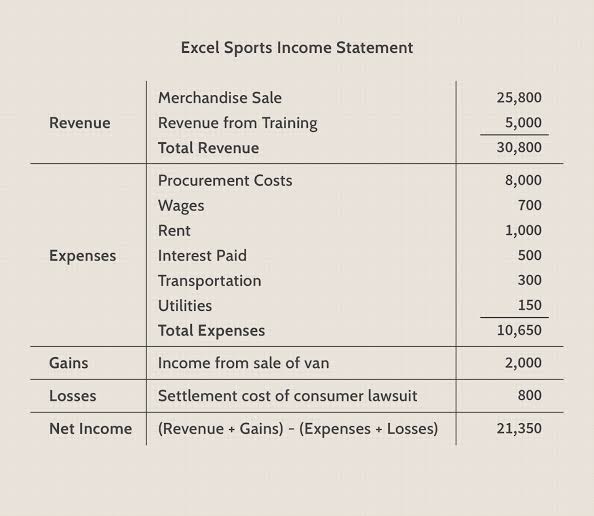
- Revenue
- Cost of Goods Sold (COGS)
- Operating Expenses
- Other Income and Expenses
- Net Profit or Net Loss
Unlike the balance sheet, which reflects a specific date, the income statement covers a timeframe, such as:
- Monthly
- Quarterly
- Annually
At the end of each accounting period, the net income from the income statement flows into retained earnings on the balance sheet. This relationship is one of the main reasons the two reports should complement each other.
Balance Sheet vs Income Statement Difference
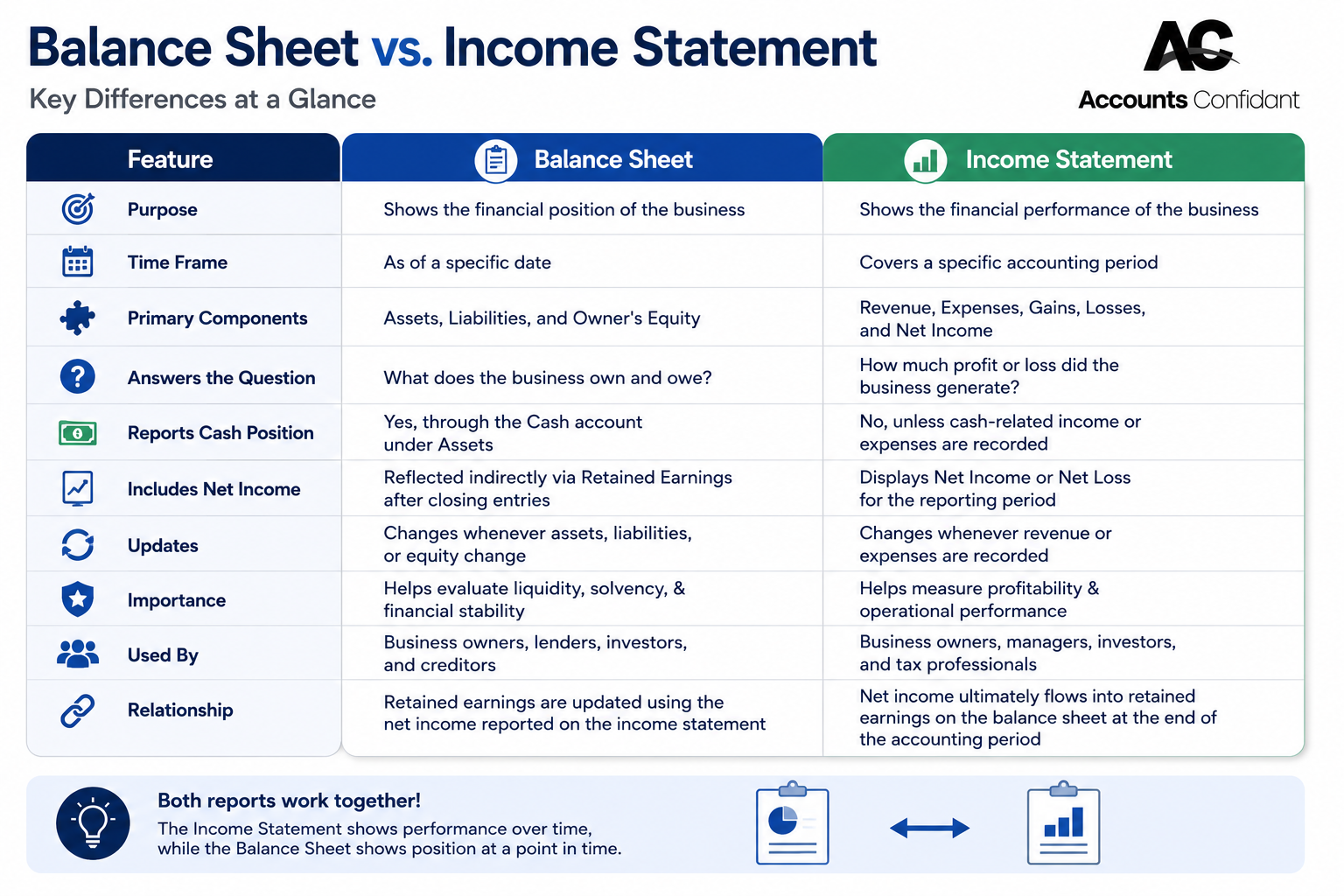
Understanding the balance sheet vs. income statement difference is essential because both statements work together to present a complete picture of your business. While the income statement explains how profitable your operations have been, the balance sheet shows how those profits have impacted your overall financial position.
| Feature | Balance Sheet | Income Statement |
| Purpose | Shows the financial position of the business | Shows the financial performance of the business |
| Time Frame | As of a specific date | Covers a specific accounting period |
| Primary Components | Assets, Liabilities, and Owner’s Equity | Revenue, Expenses, Gains, Losses, and Net Income |
| Answers the Question | What does the business own and owe? | How much profit or loss did the business generate? |
| Reports Cash Position | Yes, through the Cash account under Assets | No, unless cash-related income or expenses are recorded |
| Includes Net Income | Reflected indirectly via Retained Earnings after closing entries | Displays Net Income or Net Loss for the reporting period |
| Updates | Changes whenever assets, liabilities, or equity change | Changes whenever revenue or expenses are recorded |
| Importance | Helps evaluate liquidity, solvency, & financial stability | Helps measure profitability & operational performance |
| Used By | Business owners, lenders, investors, and creditors | Business owners, managers, investors, and tax professionals |
| Relationship | Retained earnings are updated using the net income reported on the income statement | Net income ultimately flows into retained earnings on the balance sheet at the end of the accounting period |
Although the balance sheet and income statement measure different aspects of your business, they don’t exist in isolation. They work together to present a complete picture of your company’s financial health.
Now that you understand the balance sheet vs income statement difference, let’s answer a question that often confuses business owners: Do these financial statements actually need to match?
Do the Balance Sheet and Income Statement Need to Match?
This is one of the most common questions business owners and even new bookkeepers ask. While these two financial statements are closely connected, they are designed to serve different purposes. As a result, they should not display the same numbers or be expected to match line by line.
Instead, they should be consistent and logically connected. When the relationship between the two breaks down, it often indicates an accounting error, missing transaction, or issue that needs further investigation.
For example:
- Suppose your business earns $50,000 in net profit during the year. That $50,000 will increase retained earnings on your balance sheet after the accounting period closes.
- If retained earnings fail to reflect that profit, something may be wrong with your accounting records.
- This is why many business owners search for answers about “retained earnings not matching net income.”
In short, your balance sheet and income statement are not supposed to contain identical figures, but they should accurately reflect the same financial story. If the connection between these reports is broken, it could indicate that your Balance Sheet and Income Statement Incorrect issue stems from underlying bookkeeping or accounting errors.
Understanding what causes these discrepancies is the first step toward restoring accurate financial reporting. In the next section, we’ll explore the most common reasons your balance sheet and income statement may be incorrect or appear not to match.
Why Your Net Income Doesn’t Match Your Balance Sheet?
There are several reasons why these reports become inconsistent. Some are simple bookkeeping mistakes, while others involve accounting procedures that haven’t been completed correctly. Let’s explore the most common causes that make business owners question, “Why aren’t my balance sheet and income statement accurate?”
1. Incorrect Journal Entries
Journal entries form the foundation of every accounting system. Even a single incorrect entry can affect multiple reports. Common examples include:
- Recording an expense as an asset
- Posting revenue to the wrong account
- Entering duplicate transactions
- Reversing debits and credits
- Using incorrect account classifications
For example, if office supplies worth $2,000 are mistakenly recorded as office equipment, your expenses decrease while your assets increase. As a result:
- The income statement reports higher profits.
- The balance sheet reports inflated assets.
Over time, these mistakes accumulate and create noticeable discrepancies between financial statements.
2. Expenses Recorded as Assets
One of the most common bookkeeping mistakes is capitalizing expenses that should have been expensed immediately. For example:
Instead of recording software subscriptions as operating expenses, they may accidentally be classified as intangible assets. This creates two problems.
- First, expenses on the income statement become understated.
- Second, assets on the balance sheet become overstated.
Eventually, business owners begin asking, “Why isn’t my balance sheet accurate?” The answer often lies in incorrect account classifications.
3. Missing Closing Entries
At the end of every accounting period, temporary accounts such as revenue and expenses should be closed into retained earnings. If closing entries are skipped or completed incorrectly:
- Net income stays in temporary accounts.
- Retained earnings are not updated.
- Equity balances become inaccurate.
This is one of the biggest reasons net income doesn’t match the balance sheet, especially at year-end. Businesses that close their books manually are particularly susceptible to this issue.
4. Bank Reconciliation Issues
Bank reconciliation is more than comparing your bank balance with your accounting software. It also verifies that every transaction has been recorded correctly. Problems arise when:
- Outstanding checks are ignored.
- Deposits are duplicated.
- Bank charges are missing.
- Automatic payments aren’t recorded.
- Interest income isn’t entered.
These omissions affect cash balances on the balance sheet while also influencing income or expenses on the income statement.
5. Changes Made Directly to the Balance Sheet
Sometimes users manually adjust balance sheet accounts without recording corresponding income or expense transactions. For example:
- Adjusting inventory
- Changing loan balances
- Editing fixed asset values
- Writing off receivables
While these changes may seem harmless, they often create inconsistencies because every accounting adjustment should maintain the double-entry accounting system. Manual corrections should always be documented with appropriate journal entries rather than editing balances directly.
These are the five most common issues that can cause a mismatch between your balance sheet and income statement.
Step-by-Step Process to Fix a Balance Sheet and Income Statement Incorrect or Mismatch Issue
When your balance sheet and income statement do not align, the first step is not to make random adjustments. Financial statement mismatches usually happen because of incorrect entries, missing transactions, reconciliation issues, or account classification errors. A structured review process can help you identify the cause and correct the problem without affecting other areas of your accounting records. These are some of the common practices you can follow to fix incorrect balance sheet and income statement issues:
1. Review Both Financial Statements Carefully
Start by comparing your balance sheet and income statement side by side. Look for unusual changes or inconsistencies, such as:
- Unexpected increases or decreases in revenue
- Large expense fluctuations
- Incorrect asset or liability balances
- Changes in retained earnings that do not align with reported profit
Understanding where the difference appears can help narrow down the potential source of the error. For example, if your income statement shows a profit increase but your retained earnings do not reflect that change, the issue may be related to closing entries or equity adjustments.
2. Verify the Accounting Periods
Before reviewing transactions, confirm that both financial statements are generated for the same reporting period. A common reason for mismatched reports is comparing:
- A monthly income statement with a year-to-date balance sheet
- A current-period report with previous-period balances
- Reports generated using different accounting methods
Ensure both statements use the same:
- Date range
- Accounting method (cash or accrual)
- Company file settings
- Reporting basis
This simple check can often explain why numbers appear inconsistent.
3. Check Retained Earnings and Closing Entries
Retained earnings are directly connected to your company’s net income. If your retained earnings balance appears incorrect, review:
- Previous year closing entries
- Current period net income
- Owner distributions or dividends
- Prior period adjustments
At the end of an accounting period, revenue and expense accounts should be closed into retained earnings. If this process is incomplete or incorrect, your balance sheet may not accurately reflect your company’s accumulated profits.
4. Correct Incorrect Account Classifications
Review whether transactions have been posted to the correct accounts. Common classification mistakes include:
- Recording expenses as assets
- Recording liabilities as expenses
- Posting personal transactions as business expenses
- Classifying short-term items as long-term assets
Correct classification ensures both financial statements accurately represent your business activity.
5. Consult a Professional Accountant if Needed
Some financial statement discrepancies require professional expertise, especially when they involve:
- Prior year adjustments
- Complex journal entries
- Tax-related corrections
- Inventory valuation
- Depreciation calculations
An experienced accountant or bookkeeping professional can identify hidden errors and ensure corrections are made properly without creating additional issues.
6. Use Reliable Accounting Software and Bookkeeping Tools
Manual bookkeeping using spreadsheets can work for very small businesses, but as your transactions increase, managing financial records manually becomes more challenging and increases the possibility of errors.
Using reliable accounting software such as QuickBooks can help automate many accounting processes, including transaction tracking, bank reconciliation, financial reporting, and account management.
- Modern accounting tools help businesses:
- Automatically import bank transactions
- Categorize income and expenses accurately
- Generate real-time financial reports
- Track invoices and payments
- Maintain organized records
- Reduce manual data entry errors
Accounting software does not replace professional bookkeeping, but it provides a structured system that makes it easier to maintain accurate books and identify potential issues early.
7. Maintain Proper Documentation for Every Transaction
Every financial transaction should have supporting documentation, such as invoices, receipts, purchase orders, or payment records. Proper documentation helps you:
- Verify transactions during reconciliation
- Explain financial changes
- Support tax reporting
- Identify mistakes quickly
Without proper records, correcting accounting errors becomes more complicated because there is no clear evidence explaining why a transaction was recorded.
8. Avoid Making Unverified Manual Adjustments
Manual journal entries are useful when used correctly, but unnecessary adjustments can create financial reporting issues. Before making changes to your accounts:
- Understand which accounts will be affected
- Verify the reason for the adjustment
- Maintain proper documentation
- Review the impact on financial statements
If adjustments are made without proper accounting knowledge, it can create situations where a Balance Sheet and Income Statement Incorrect issue appears and requires additional reconciliation.
9. Reconcile Your Accounts Regularly
Regular account reconciliation is one of the most effective ways to identify and fix accounting discrepancies before they become major problems. Review your:
- Bank accounts
- Credit card accounts
- Loan balances
- Accounts receivable
- Accounts payable
- Inventory records
Monthly reconciliations help confirm that every transaction has been recorded correctly and that your accounting records match your actual financial activity.
Preventing accounting errors is always easier than correcting them after they impact your financial reports. A consistent bookkeeping process, regular reviews, and accurate record-keeping can help ensure that your balance sheet and income statement remain reliable. By following these practices, you can minimize mismatch errors and maintain accurate financial records.
Conclusion
Your balance sheet and income statement are more than just accounting reports. They provide valuable insights into your business’s profitability, financial stability, and overall performance. When these reports do not align properly, the issue is usually caused by accounting errors such as incorrect journal entries, missing transactions, reconciliation problems, or classification mistakes. Understanding the connection between these statements helps business owners identify problems faster and maintain accurate financial records.
Issues like net income not matching the balance sheet are common, but they should not be ignored. If you are struggling to understand your financial statements or need professional assistance reviewing your books, we can help. Get in touch with Accounts Confidant today and ensure your financial statements accurately reflect your business performance.
Frequently Asked Questions
Why doesn’t my net income match my balance sheet?
Your net income does not directly appear as a separate line item on the balance sheet. Instead, it flows into retained earnings after the accounting period is closed. If your net income does not match the changes in retained earnings, it may be due to missing closing entries, incorrect journal entries, prior period adjustments, or accounting errors. Reviewing your financial records and reconciling accounts can help identify the cause.
Should my balance sheet and income statement always match?
No, your balance sheet and income statement should not have identical numbers because they serve different purposes. The income statement shows your business revenue, expenses, and profit or loss over a specific period. The balance sheet shows your assets, liabilities, and equity at a particular point in time. However, they should be connected through items such as net income and retained earnings.
My business shows a profit, but I have no cash. Why?
A business can be profitable but still have limited cash because profit and cash flow are different concepts. Your income statement may show profit from sales, but that money may not have been collected yet. Cash may also be tied up in inventory, used for loan payments, invested in equipment, or distributed to owners.
How do I fix a mismatch between retained earnings and net income?
Start by reviewing your closing entries, prior-year balances, and journal entries affecting equity accounts. Common fixes include:
– Correcting incorrect account postings
– Recording missing transactions
– Adjusting opening balances
A professional review can help identify the exact reason behind the mismatch.
What’s the difference between a balance sheet and an income statement? Explain simply!
A balance sheet shows what your business owns, owes, and the value remaining for owners at a specific point in time. An income statement shows how much money your business earned and spent during a specific period, resulting in either a profit or loss. Simply put, the balance sheet shows your financial position, while the income statement shows your financial performance.
I coded an expense as an asset by mistake; how does that affect my financial statements?
Recording an expense as an asset can make your business appear more profitable than it actually is. Your expenses will be understated on the income statement, while your assets will be overstated on the balance sheet. Correcting the classification through an appropriate journal entry can restore accuracy.
How often should a small business reconcile its balance sheet and income statement?
Most small businesses should review and reconcile their financial statements at least monthly. Regular reconciliation helps identify errors quickly, improves financial accuracy, and ensures business owners have reliable information for decision-making.
What causes a balance sheet to be out of balance?
A balance sheet can become unbalanced due to incorrect journal entries, missing transactions, duplicate entries, incorrect opening balances, or errors in account classification. Because accounting follows the equation Assets = Liabilities + Equity, any discrepancy usually indicates that one side of the accounting records has been affected incorrectly.
Is it normal for retained earnings to not equal net income this month?
Yes, this can be normal depending on the timing and accounting process. Retained earnings represent accumulated profits from previous periods, not just the current month’s net income. However, if retained earnings are significantly different from expected balances, the accounts should be reviewed for possible errors.
How do I know if my bookkeeper made an error on my financial statements?
Signs of possible bookkeeping errors include unusual account balances, unexpected changes in profits, incorrect expense classifications, missing transactions, or situations where net income doesn’t match balance sheet records. Regular financial reviews, reconciliations, and professional bookkeeping audits can help identify and correct these issues.