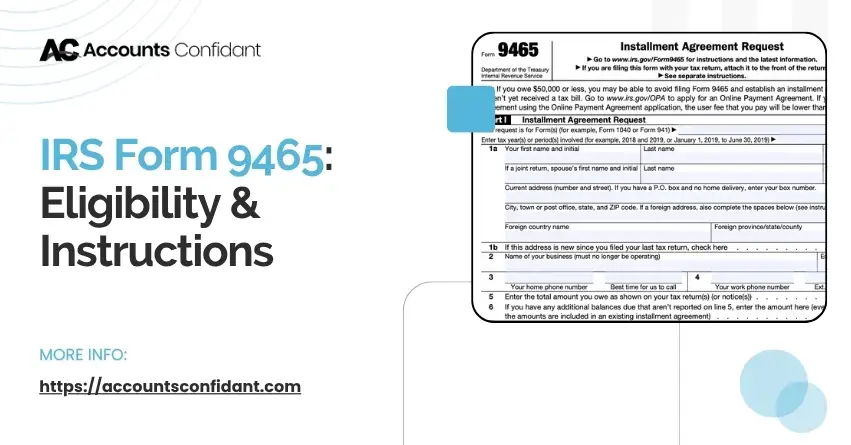
A tax balance does not always have to be paid in one lump sum. When you cannot pay the IRS in full, you may be able to request a monthly payment plan.
IRS Form 9465, Installment Agreement Request, is the paper form used to request an installment agreement. However, many individuals no longer need to file the form because the IRS allows eligible taxpayers to apply online through its Online Payment Agreement system. For individuals with a balance of $50,000 or less in combined tax, penalties, and interest who have filed all required returns, the IRS says the online application may be available.
Form 9465 still matters when you cannot use the online application, need to submit a paper request, or have a situation requiring additional financial information.
The most important point is this:
Form 9465 does not forgive your tax debt. It is a request to pay the amount you owe over time.
Interest and applicable penalties generally continue until the balance is paid in full.
What Is Form 9465?
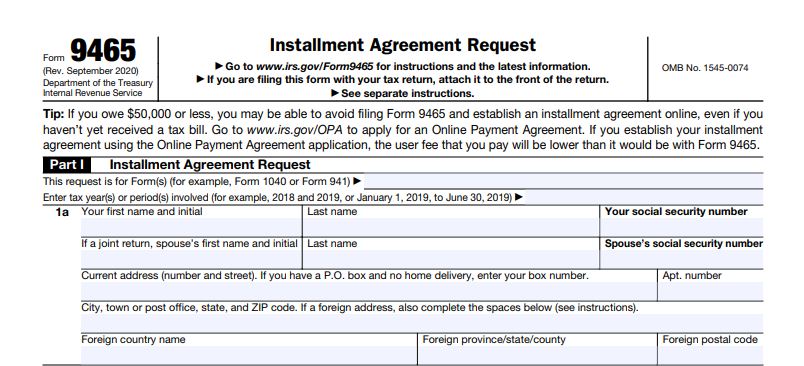
Form 9465 is the IRS Installment Agreement Request.
You use it to request monthly payments when you cannot immediately pay the full amount shown on your tax return or on an IRS notice. The IRS instructions say the form is primarily for individuals and certain individual liabilities, including some liabilities connected with a sole proprietor business that is no longer operating.
Form 9465 may be used for situations involving:
- Individual federal income tax
- Certain trust fund recovery penalty liabilities
- Certain employment or unemployment taxes connected with an out-of-business sole proprietorship
- Other individual liabilities covered by the IRS installment-agreement rules
An individual with an operating business that owes employment taxes generally should not assume Form 9465 is the correct solution. The IRS instructs businesses with ongoing employment-tax liabilities to contact the IRS about the appropriate payment arrangement.
For a broader explanation of federal tax balances and collection alternatives, see Accounts Confidant’s IRS tax debt relief and forgiveness guide.
Do You Still Need Form 9465?
Not always, the IRS now encourages eligible taxpayers to use its Online Payment Agreement system. According to the IRS, individuals may generally apply online for a long-term payment plan when they owe $50,000 or less in combined tax, penalties, and interest and have filed all required returns.
You may still use Form 9465 when:
- You are not eligible to apply online
- The online system directs you to use the form
- You need to provide additional financial information
- You are filing a paper request
- You prefer to submit the installment request by mail
The IRS says individuals who cannot use the online payment-plan application may complete Form 9465 and, when required, attach Form 433-F.
Form 9465 vs. Online Payment Agreement
| Feature | Form 9465 | Online Payment Agreement |
| Method | Paper request or through supported tax software | IRS online application |
| Typical individual threshold | Depends on circumstances | Generally $50,000 or less for long-term online plans |
| Decision | Usually later by IRS notice | Immediate online determination |
| Financial statement | May be required | Depends on eligibility |
| Setup fee | Generally higher when submitted by mail | Generally lower |
| Best use | Cases that cannot use online system | Eligible straightforward cases |
NerdWallet, TurboTax, H&R Block, and TaxAct all explain Form 9465 as an installment-agreement route, but current IRS guidance makes clear that online application is now an important alternative for eligible individuals.
IRS Form 9465 Eligibility
Your eligibility depends on more than the amount you owe.
Before a payment-plan request can generally be considered, individual taxpayers must be current with required filing and payment obligations. Taxpayers in an open bankruptcy proceeding generally are not eligible for an installment agreement.
Long-term payment plans
For an individual, the IRS currently says you may generally qualify to apply online for a long-term payment plan when your combined assessed tax, penalties, and interest are $50,000 or less and you have filed all required returns.
The amount is not limited to the original tax.
When checking the threshold, include:
- Tax
- Penalties
- Interest
The IRS also requires the proposed payments to satisfy the liability within the applicable collection period.
Guaranteed installment agreements
There is a separate rule for some individuals with smaller income-tax liabilities.
The IRS says a taxpayer may qualify for a guaranteed installment agreement when the tax owed is no more than $10,000, the taxpayer has met the required five-year filing and payment history, has not recently had an income-tax installment agreement, agrees to pay the amount in full within three years, and is financially unable to pay the liability when due.
The $10,000 rule should not be confused with an automatic approval for everyone who owes less than $10,000.
The other conditions still apply.
Streamlined installment agreements
The IRS instructions also describe streamlined arrangements.
Generally, taxpayers with assessed liabilities of $25,000 or less may qualify under streamlined procedures, while certain individual taxpayers or out-of-business sole proprietors with assessed liabilities from $25,001 to $50,000 can use streamlined procedures when they agree to pay by direct debit or payroll deduction.
For the streamlined rules described in Form 9465 instructions, proposed payments generally need to fully pay the liability within 72 months or by the Collection Statute Expiration Date, whichever comes first.
Current IRS payment-plan policy can offer broader terms in some situations, so the online IRS eligibility determination and the instructions for the applicable arrangement should control the actual payment term.
Can You Request a Payment Plan Before Receiving an IRS Bill?
Yes, in some circumstances.
The IRS says an individual can establish a pre-assessed payment agreement through the Online Payment Agreement system even if the IRS has not yet sent a bill, by entering the balance expected from the tax return.
This can be useful when you have filed a return showing a balance but want to arrange payments rather than wait for a collection notice.
The actual application depends on whether the balance has been assessed and whether you meet the online eligibility criteria.
Can You Request Monthly Payments After Filing Your Tax Return?
Yes, if you already filed your federal return and owe money, you can still request an installment agreement.
The IRS specifically states that Form 9465 may be used when you cannot pay the full amount shown on your tax return or an IRS notice.
You can also use the IRS Online Payment Agreement system when eligible.
Do not wait for multiple collection notices simply because you cannot pay the full balance today.
The IRS advises taxpayers who cannot pay in full to consider a payment plan or another payment option and to pay as much as they can as soon as possible to reduce additional interest and penalties.
How to Fill Out Form 9465
Knowing how to fill out Form 9465 is easier when you treat the form as a payment-plan request rather than another tax return.
Step 1: Identify yourself
Enter the taxpayer information requested on the form, including:
- Name
- Address
- Social Security number or other applicable taxpayer identification number
- Daytime telephone number
Use the information that agrees with your federal tax records.
Step 2: Identify the tax debt
Enter the tax form, tax year, and amount associated with the balance.
If the agreement involves multiple tax periods or liabilities, follow the Form 9465 instructions for listing them correctly.
Do not estimate the balance if you can obtain the current figure from your IRS Online Account or notice.
Step 3: Enter the amount you can pay immediately
The Form 9465 instructions encourage taxpayers to pay as much as possible when submitting the request because unpaid tax continues to generate applicable charges.
If you are filing Form 9465 with your tax return, you can generally make a payment with the return.
If you are filing it separately in response to a notice, follow the payment instructions that apply to the request.
Step 4: Enter your proposed monthly payment
Line 11a asks for the amount you can pay each month.
The IRS instructions say to make the monthly payment as large as possible to limit additional interest and penalty charges. If no amount is entered, the IRS instructions state that a payment may be determined by dividing the balance by 72 months.
That does not mean balance ÷ 72 is a universal required payment.
Your actual payment may depend on:
- Total balance
- Applicable payment-plan type
- Collection period
- Financial information
- Whether the payment will fully satisfy the balance
- Direct-debit requirements
- IRS review
For taxpayers who owe more than $25,000 but no more than $50,000 and need streamlined treatment, direct debit or payroll deduction requirements can apply.
Step 5: Choose your payment date
The IRS allows you to choose the monthly payment date.
Under the Form 9465 instructions, the date can be any day from the 1st through the 28th of the month.
Choose a date that gives you enough time after receiving income to keep the payment available.
Step 6: Consider direct debit
Direct debit can make payments automatic and can reduce the risk of missing a monthly payment.
It can also result in a lower installment-agreement setup fee. The IRS currently charges less for direct-debit arrangements than for some other long-term payment methods.
Step 7: Review the form
Before submitting, check:
- Taxpayer identification number
- Tax years
- Balance
- Proposed payment
- Payment date
- Bank information, if direct debit is selected
- Required financial forms
- Signature
A payment-plan request can be delayed when information is incomplete or inconsistent.
How Much to Pay Monthly on Form 9465
There is no single monthly payment amount that applies to every taxpayer.
The practical goal is to propose an amount that is:
- Affordable enough for you to maintain every month.
- Large enough to satisfy the IRS rules for the payment plan.
- High enough to reduce the amount of interest and penalties that accumulate over time.
For example, a $12,000 balance divided evenly over 72 months would be approximately $166.67 per month before considering continuing interest and penalties.
But that does not mean $166.67 will always be an acceptable final payment.
The IRS’s Form 9465 instructions specifically say to pay as much as possible, and current payment-plan rules require the liability to be paid within the applicable collection period for many arrangements.
A payment that is too low can create another problem
Suppose your balance is $30,000 and you propose $150 per month.
Even without considering future charges, $150 × 72 months equals only $10,800.
That payment would not fully pay the balance within 72 months.
In a case like this, the IRS may require a different payment amount, additional financial information, direct debit, or another collection arrangement.
The correct monthly amount should therefore be based on the actual debt and your realistic ability to pay, not an arbitrary number.
Do You Need Form 433-F With Form 9465?
Not always, the IRS may require Form 433-F, Collection Information Statement, when the standard payment-plan criteria do not apply or when your proposed payment requires additional financial review.
The Form 9465 instructions specifically require additional financial information in several situations, including certain requests involving balances above $50,000 and situations where the taxpayer cannot increase the proposed payment to the required amount.
For example, the instructions say that when the amount owed is more than $50,000, Form 433-F must be completed and attached.
The IRS may also request financial records after receiving a payment-plan request.
What If You Owe More Than $50,000?
Being above $50,000 does not necessarily mean you cannot get a payment plan.
It does mean you may not qualify for the simpler online arrangement available to many individual taxpayers.
The IRS says taxpayers who do not qualify for an online payment plan may still be able to pay in installments. Additional financial information may be required, and a Notice of Federal Tax Lien can be considered depending on the circumstances.
For an individual requesting an arrangement through Form 9465, the IRS instructions generally require Form 433-F when the amount owed exceeds $50,000.
A larger balance should not be ignored simply because the online tool does not approve the request.
How Much Does an IRS Payment Plan Cost?
The IRS updated installment-agreement user fees in 2026.
For a long-term payment plan, the current IRS fee schedule includes:
| Application/payment method | Setup fee |
| Apply online + direct debit | $29 |
| Apply by phone, mail, or in person + direct debit | $107 |
| Apply online + payments not through direct debit | $69 |
| Apply by phone, mail, or in person + other payment method | $178 |
| Low-income taxpayer + direct debit | $0 |
| Low-income taxpayer + other applicable method | $43, potentially reimbursable |
The IRS states that qualifying low-income taxpayers who use direct debit can have the setup fee waived. Those who qualify as low-income taxpayers but cannot use direct debit may have the applicable fee reimbursed after completing the agreement, subject to IRS rules.
Credit- and debit-card payments can also carry separate processing fees charged by the payment processor.
What about a short-term payment plan?
If you can pay your balance within 180 days, a short-term payment plan may be available to individuals with less than $100,000 in combined tax, penalties, and interest.
There is no setup fee for the short-term plan, although interest and applicable penalties continue until the balance is paid.
This can make a short-term arrangement worth considering before choosing a long-term installment agreement.
Can You File Form 9465 Online?
You can apply for an IRS payment plan online, but you may not need to submit Form 9465 itself.
For eligible individuals, the IRS Online Payment Agreement system is usually the more direct method. The IRS says eligible individuals can apply online when they meet the applicable balance and filing requirements.
The online application can provide an immediate determination.
By contrast, the IRS says a paper Form 9465 request will generally receive a response within about 30 days, although processing may take longer during filing season.
Can tax software file Form 9465?
Some tax software products support Form 9465.
TaxAct, for example, says Form 9465 can be completed through its software and can be filed even after an individual return has already been filed. H&R Block also supports Form 9465 through its tax software.
This is different from applying directly through the IRS Online Payment Agreement tool.
Form 9465 Mailing Address
There is not one universal Form 9465 mailing address.
The correct address depends on:
- Whether Form 9465 is filed with the tax return or separately
- Your state
- Whether your return includes Schedule C, E, or F
- Other filing circumstances
The IRS says that if Form 9465 is filed with your tax return, attach it to the front of the return. If you are filing it separately, use the IRS’s Form 9465 state-specific mailing table.
Example: taxpayers in Massachusetts without Schedule C, E, or F
For individual taxpayers in Massachusetts filing Form 9465 separately and not filing Form 1040 with Schedule C, E, or F, the current IRS table lists:
Department of the Treasury
Internal Revenue Service
310 Lowell St. Stop 830
Andover, MA 01810
Example: Massachusetts taxpayer with Schedule C, E, or F
If the individual is filing Form 1040 with Schedule C, E, or F for any tax year involved in the installment request, the IRS currently lists:
Department of the Treasury
Internal Revenue Service
P.O. Box 480 Stop 660
Holtsville, NY 11742-0480
Because IRS addresses can change, verify the current address on the IRS Where to File Form 9465 page immediately before mailing.
What Happens While the IRS Reviews Form 9465?
The IRS generally reviews the request and determines whether the proposed installment agreement meets the applicable criteria.
For a paper request, the IRS says you will generally receive a response within about 30 days, although processing may take longer during filing season. An IRS employee may also contact you for additional financial information.
While an installment-agreement request is pending, the IRS is generally restricted from taking levy action, subject to exceptions.
The IRS also says that the collection period can be suspended or otherwise affected while an installment-agreement request is pending, including certain rejection, termination, and appeal periods.
A pending request is therefore not something to ignore after filing. Watch your IRS notices and respond promptly if the agency asks for additional information.
Do Interest and Penalties Stop When a Payment Plan Is Approved?
No, interest and applicable penalties generally continue to accrue until the balance is paid in full.
However, the failure-to-pay penalty can generally be lower while an approved installment agreement is in effect than it would be without an agreement, subject to the applicable IRS rules.
This means the total amount ultimately paid can be higher than the original tax balance.
The longer repayment takes, the more time there is for additional charges to accumulate.
Can You Choose Your Monthly Payment Date?
Yes, Form 9465 allows you to choose a monthly payment date from the 1st through the 28th.
For example, if you normally receive your salary on the 15th, you could select a payment date after that date rather than choosing the first of the month.
The IRS must receive the payment by the selected due date.
Can You Lower the Monthly Payment if Your Income Drops?
Potentially, yes.
The IRS currently allows taxpayers to revise an existing payment plan through their Online Account in many cases.
Available changes can include:
- Monthly payment amount
- Payment due date
- Direct-debit conversion
- Bank information
- Reinstatement after default
If the revised amount does not meet the applicable requirements, the IRS may direct you to provide additional financial information through forms such as Form 433-F or Form 433-H.
Do not simply reduce the payment on your own.
Contact the IRS or use the online revision system before changing the amount.
What Happens if You Miss an Installment?
Missing a payment can put the agreement into default.
The IRS says an installment agreement may be terminated if you fail to make payments on time or fail to pay a later tax balance as required. If the agreement is terminated, the IRS can resume enforcement actions such as filing a tax lien or issuing a levy.
A reinstatement fee may also apply in some situations. The IRS currently allows certain existing agreements to be revised or reinstated online.
If you know you cannot make a scheduled payment, contact the IRS before the account goes into default rather than waiting for a termination notice.
Will the IRS Keep Your Tax Refund While You Are on a Payment Plan?
Generally, yes.
The IRS states that refunds or overpayments are automatically applied to outstanding federal tax liabilities covered by the agreement.
The refund does not replace your required monthly installment.
So if the IRS applies a $2,000 refund to your tax debt, you generally still need to make your scheduled monthly payments.
If the refund exceeds all applicable federal balances, other federal or state offsets can still affect the amount you receive.
Can the IRS File a Tax Lien While You Have a Payment Plan?
Yes, depending on the circumstances.
A payment plan does not automatically prevent the IRS from filing a Notice of Federal Tax Lien.
The IRS says liens can be used to protect the government’s interest until the debt is paid, although guaranteed and streamlined installment agreements generally have more favorable lien rules and are not normally subject to lien filing under ordinary circumstances. Exceptions can apply.
A payment plan also does not permanently prevent every type of collection action if the agreement is later defaulted or terminated.
Alternatives to Form 9465
Form 9465 is not always the best option.
Pay in full
If you can pay the balance without creating a financial problem, paying in full generally stops additional interest and penalties sooner.
Short-term payment plan
If you can pay the full balance within 180 days, an individual may qualify for the short-term plan with no setup fee.
Online long-term payment plan
For eligible individuals with $50,000 or less in combined tax, penalties, and interest, the online payment-plan system may be simpler than mailing Form 9465.
Offer in Compromise
An Offer in Compromise may allow an eligible taxpayer to settle a tax debt for less than the full amount owed when the IRS determines the offer is appropriate under its rules.
See Accounts Confidant’s IRS tax debt forgiveness guide for a broader explanation of payment plans, Offers in Compromise, penalty relief, and Currently Not Collectible status.
Currently Not Collectible
If even an installment payment would prevent you from meeting basic living expenses, you may be able to request a temporary collection delay instead of an installment agreement.
CNC status does not erase the debt.
Common Form 9465 Mistakes
Filing Form 9465 when you can use the online system
For many individual taxpayers, the IRS’s online payment-plan application is faster and cheaper than submitting the paper form.
Choosing an unrealistically low payment
A payment that cannot satisfy the IRS’s applicable requirements may lead to additional financial review or rejection.
Forgetting continued interest and penalties
Your original tax balance is not necessarily the final amount you will pay under a long-term agreement.
Using the wrong mailing address
Form 9465 addresses vary depending on the taxpayer’s state and whether Schedules C, E, or F are involved.
Assuming approval is automatic
Submitting Form 9465 is a request, not an approval.
TaxAct likewise notes that filing Form 9465 does not guarantee that the IRS will approve the installment agreement.
Ignoring new tax liabilities
An installment agreement requires you to remain current with future filing and payment obligations. Failing to do so can put the existing agreement at risk.
A Practical Form 9465 Checklist
Before submitting a payment-plan request, confirm:
Tax records
- All required federal returns have been filed
- IRS balance is current
- Tax years are correct
- Penalties and interest are included
Form 9465
- Name and taxpayer ID are correct
- Proposed monthly payment is realistic
- Payment date is between the 1st and 28th
- Direct-debit information is correct, if used
- Required signature is included
Supporting information
- Form 433-F attached if required
- Financial records available if requested
- Payment evidence retained
After submission
- Save a copy of the request
- Monitor IRS notices
- Continue making payments as instructed
- File future returns on time
- Pay future taxes on time
Keeping accurate financial records can make this process easier, especially when the IRS requires detailed financial information.
Accounts Confidant’s Online Bookkeeping Services include account reconciliation, financial reporting, payroll processing, and tax-preparation support, which can help keep the financial records behind tax obligations organized.
Final Takeaway
IRS Form 9465 is a way for eligible individuals to request monthly payments when they cannot pay a federal tax balance in full.
But Form 9465 is not always the first step.
For many individuals who owe $50,000 or less in combined tax, penalties, and interest and have filed all required returns, the IRS’s online payment-plan system may be faster and less expensive than mailing Form 9465.
When a paper Form 9465 is appropriate, complete it carefully. Pay particular attention to the proposed monthly payment, payment date, taxpayer information, required financial forms, and mailing address.
Also remember that a payment plan does not freeze the balance. Interest and applicable penalties generally continue until the tax debt is paid in full.
If you cannot afford the proposed monthly payment, do not simply choose an amount that will obviously fail to satisfy the applicable rules. The IRS has other options, including different installment arrangements, temporary collection delay, and Offers in Compromise for taxpayers who meet the requirements.
Accounts Confidant can assist with organizing financial records, bookkeeping, reconciliations, and tax-related documentation. Its Virtual Bookkeeping Services include account reconciliation, financial statement preparation, payroll processing, and tax-preparation support.
Frequently Asked Questions
Do I need Form 9465, or can I apply for an IRS payment plan online?
You may not need Form 9465. Eligible individuals can often apply through the IRS Online Payment Agreement system. Form 9465 remains useful when you cannot apply online, or the IRS requires additional paperwork.
I already filed my tax return. Can I still request monthly payments?
Yes, you can request an installment agreement after filing your return through the IRS online system, by phone, or with Form 9465 when appropriate.
Can I request a payment plan before the IRS sends me a bill?
Yes, the IRS allows some taxpayers to establish a pre-assessed payment agreement online using the balance expected from their return.
What monthly payment should I enter on Form 9465?
Enter an amount you can realistically pay each month that also satisfies the applicable IRS payment-plan rules. The Form 9465 instructions tell taxpayers to make the payment as large as possible to reduce continuing interest and penalties.
What if I owe more than $50,000?
You may still qualify for an installment agreement, but additional financial information may be required. Form 9465 instructions generally require Form 433-F when the amount owed exceeds $50,000.
Does the IRS automatically approve balances under $10,000?
No, the guaranteed installment-agreement rule has additional requirements, including a qualifying filing and payment history, a three-year payoff period, and financial inability to pay in full when due.
Do interest and penalties stop after my payment plan is approved?
No, interest and applicable penalties generally continue until the balance is fully paid.
How much does an IRS payment plan cost?
For 2026, long-term setup fees generally range from $29 to $178, depending on how you apply and how you pay. Qualifying low-income taxpayers may have the fee waived or reduced and reimbursed under certain conditions.
Can I get the setup fee waived?
Yes, qualifying low-income taxpayers can generally have the setup fee waived when they agree to direct debit. Other qualifying low-income taxpayers may receive a reduced fee that can be reimbursed under the IRS rules.
Do I need Form 433-F with Form 9465?
Not always, the IRS may require Form 433-F when the balance or proposed payment falls outside simpler installment-agreement rules. It is generally required when the balance exceeds $50,000.
Can I choose my monthly payment date?
Yes, Form 9465 lets you choose a payment date from the 1st through the 28th of the month.
What happens while the IRS reviews my request?
The IRS reviews the proposed agreement and may ask for additional financial information. A paper request generally receives a response in about 30 days, although processing can take longer. Certain collection actions are generally restricted while an installment request is pending, subject to exceptions.
Can I lower my payment if my income drops?
Potentially, the IRS allows many taxpayers to revise their payment amount through their Online Account. A lower payment may require additional financial information if it does not meet the applicable plan requirements.
What happens if I miss an installment?
The agreement can go into default and may eventually be terminated. The IRS can then resume collection action, and a reinstatement fee may apply in some situations.
Will the IRS keep my refund while I am on a payment plan?
Generally, yes. The IRS automatically applies refunds and overpayments to outstanding federal tax debt, and you must continue making scheduled installment payments.