Payroll is a critical part of running a business, but managing it internally can quickly become time-consuming as a company grows. Calculating wages, processing deductions, managing payroll taxes, maintaining employee records, and meeting filing deadlines all require accuracy and consistency.
For many small businesses, outsourced payroll services provide a practical way to manage these responsibilities without adding a dedicated internal payroll team. A payroll provider can handle routine processing, tax administration, reporting, and other payroll functions while business owners retain control over approvals, employee information, and financial decisions.
The question is not simply whether payroll can be outsourced. The more important question is whether outsourcing can give your business a more efficient, reliable, and scalable way to manage payroll.
This guide explains how payroll outsourcing works, its benefits, potential considerations, costs, and how to decide between in-house payroll and an outsourced solution.
What Are Outsourced Payroll Services?
Outsourced payroll services involve hiring an external provider to manage some or all of a business’s payroll responsibilities. The provider becomes responsible for agreed-upon administrative tasks, allowing the business to reduce the amount of payroll work handled internally.
Depending on the service package, an outsourced payroll provider manages:
- Employee wage calculations
- Payroll processing
- Payroll tax calculations
- Tax deposits and filings
- Employee deductions
- Direct deposits
- Payroll reports
- Payroll recordkeeping
- Year-end payroll documents
- Wage garnishments
- Payroll-related administrative support
Businesses can outsource their entire payroll process or select only the functions they need.
For example, a business may want to retain control over payroll approvals but outsource calculations and tax administration. Another company may prefer full-service payroll outsourcing, where the provider manages most recurring payroll activities.
This flexibility makes payroll outsourcing suitable for businesses at different stages of growth.
What Do Payroll Management Services Include?
Professional payroll management services typically cover the repetitive activities required to process employee compensation accurately and on schedule.
Payroll Processing
Payroll processing includes calculating employee pay based on salary, hourly wages, overtime, bonuses, deductions, and other applicable compensation.
Tax Administration
Payroll providers can calculate applicable payroll taxes and handle designated tax deposits and filings based on the service arrangement.
Employee Payments
Payroll services can support direct deposits or other employee payment methods and help maintain payment records.
Payroll Reporting
Businesses may receive reports covering payroll expenses, taxes, deductions, employee compensation, and other payroll information needed for accounting and management.
Year-End Payroll Support
Year-end payroll activities may include preparing employee tax documents and providing payroll information needed for annual reporting.
Recordkeeping
Maintaining accurate payroll records is an ongoing responsibility. Outsourcing can help businesses maintain an organized payroll history while reducing the amount of administrative work performed internally.
The key is to understand exactly what your service agreement includes before choosing a provider.
Benefits of Outsourcing Payroll
The benefits of outsourcing payroll extend beyond simply saving time. For a growing business, professional payroll support can improve how the entire payroll function is managed.
Save Time Every Pay Period
Payroll is a recurring responsibility. Even when a business has only a few employees, every pay period requires calculations, reviews, approvals, payments, and recordkeeping.
As employee numbers increase, the workload increases with them.
Outsourcing allows businesses to transfer many of these repetitive responsibilities to a dedicated payroll team. Owners, bookkeepers, HR personnel, and administrative employees can spend less time processing payroll and more time handling responsibilities that directly contribute to business operations and growth.
Access Payroll Expertise
Payroll requires specialized knowledge. Employees may have different compensation structures, deductions, benefits, work locations, and tax requirements.
Maintaining that knowledge internally can be difficult when payroll is only one responsibility among many.
An outsourced payroll provider specializes in payroll administration and can provide processes and expertise that may not be available within a small business.
This can be especially valuable for companies that do not have a dedicated payroll specialist.
Reduce Payroll Tax Administration
Payroll taxes are an important part of every employer’s payroll process.
Payroll tax outsourcing allows businesses to delegate designated tax-related responsibilities, such as calculations, deposits, and filings, depending on the services provided.
This can significantly reduce the administrative burden associated with tracking payroll tax obligations and completing recurring filings.
However, outsourcing does not mean that a business should stop monitoring its payroll tax activity. Employers should understand which responsibilities remain with them and maintain appropriate access to payroll reports and tax documentation.
Improve Payroll Accuracy
Payroll errors can affect both employees and the business.
An incorrect paycheck can create employee frustration, while incorrect tax calculations or filings can create additional administrative work.
Professional payroll providers use structured payroll processes designed to handle recurring calculations and deadlines. Businesses can also establish review and approval procedures to ensure payroll information is checked before processing.
The goal is not merely to automate payroll. It is to create a consistent payroll process with appropriate checks and oversight.
Make Payroll Easier to Scale
A payroll process that works for five employees may not work as efficiently for 30 employees.
Growth can introduce:
- More employees
- Multiple pay rates
- Additional benefits
- More deductions
- Increased payroll frequency
- Multiple work locations
- Employees in different states
- Greater reporting requirements
An outsourced payroll provider can help businesses scale payroll without requiring them to immediately build a larger internal payroll department.
For a growing company, that scalability can become one of the strongest reasons to outsource.
In-House Payroll vs Outsourced Payroll
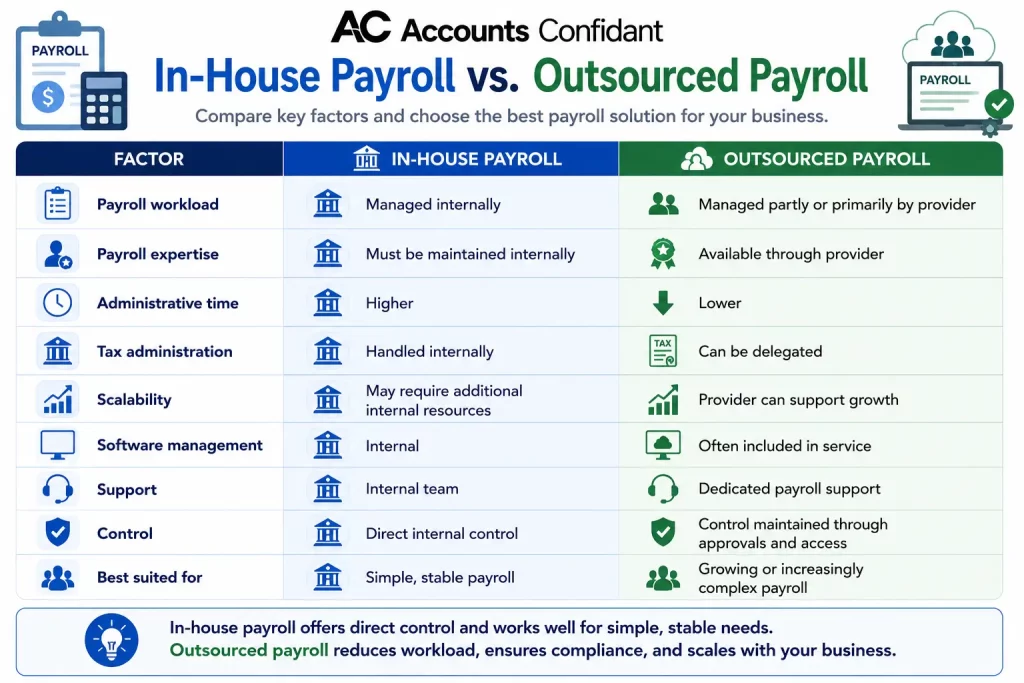
When comparing in-house payroll vs outsourced payroll, businesses often focus on cost and control. Both are important, but they should not be the only considerations.
| Factor | In-House Payroll | Outsourced Payroll |
| Payroll workload | Managed internally | Managed partly or primarily by provider |
| Payroll expertise | Must be maintained internally | Available through provider |
| Administrative time | Higher | Lower |
| Tax administration | Handled internally | Can be delegated |
| Scalability | May require additional internal resources | Provider can support growth |
| Software management | Internal | Often included in service |
| Support | Internal team | Dedicated payroll support |
| Control | Direct internal control | Control maintained through approvals and access |
| Best suited for | Simple, stable payroll | Growing or increasingly complex payroll |
In-house payroll can work well when a company has a simple payroll structure and sufficient internal expertise.
However, outsourcing becomes increasingly attractive when payroll starts consuming valuable employee time or becomes too complex for a small administrative team to manage efficiently.
The decision should therefore consider the total cost and operational impact, not simply the payroll provider’s monthly fee.
When Should a Small Business Outsource Payroll?
There is no universal employee-count threshold for outsourcing payroll.
A company does not suddenly need an outsourced payroll provider when it reaches a particular number of employees. Instead, the decision should be based on workload, complexity, internal expertise, and growth.
A small business should consider outsourcing when:
- Payroll takes significant time every pay period.
- Employees responsible for payroll have other important responsibilities.
- Payroll tax administration is becoming difficult.
- Payroll errors are occurring more frequently.
- The business is hiring rapidly.
- Employees receive different benefits or deductions.
- The company operates in multiple states.
- There is no dedicated payroll specialist.
- Management wants to reduce administrative work.
- The business expects continued growth.
In many cases, outsourcing payroll before the process becomes overwhelming is more efficient than waiting until payroll problems start affecting employees or management.
Is Outsourcing Payroll Cheaper Than Managing It Internally?
The answer depends on how much it costs your business to manage payroll internally.
A business may not have a dedicated payroll employee. Instead, payroll might be handled by an owner, bookkeeper, office manager, HR employee, or accounting staff member.
That can make in-house payroll appear inexpensive.
However, the real internal cost can include:
- Employee time
- Payroll software
- Training
- Payroll tax administration
- Compliance research
- Error correction
- Recordkeeping
- Reporting
- System maintenance
- Administrative overhead
When these costs are considered, outsourcing may offer better overall value.
The goal should not be to find the lowest payroll price. It should be to determine whether the business can reduce administrative workload while gaining reliable payroll expertise at a reasonable cost.
What Should You Look for in an Outsourced Payroll Provider?
Choosing the right outsourced payroll provider can make the difference between simply purchasing payroll processing and building a reliable payroll function.
Transparent Pricing
Ask for a detailed breakdown of all fees, including:
- Base charges
- Per-employee charges
- Payroll processing fees
- Tax filing fees
- Year-end fees
- Setup fees
- Additional-state fees
- Optional services
Payroll Expertise
Choose a provider with experience managing payroll for businesses similar to yours.
Tax Support
Understand which payroll tax calculations, deposits, filings, and reports are included.
Customer Support
Payroll issues are time-sensitive. Make sure you know how to reach the provider and how urgent issues are handled.
Security
Ask about data protection, access controls, authentication, and other security practices.
Scalability
Your provider should be able to support you as you add employees, expand into new states, or introduce additional benefits.
Integrations
If your company already uses accounting, HR, benefits, or time-tracking systems, confirm that the payroll service can work with your existing tools.
Reporting
You should have access to the payroll information and reports needed to review payroll activity and maintain your business records.
Final Takeaway
For growing small businesses, outsourced payroll services can provide access to payroll expertise while reducing repetitive administrative work. From payroll processing and tax administration to employee payments and reporting, the right provider can take on the day-to-day responsibilities that increasingly consume internal resources.
The decision between in-house payroll and outsourcing ultimately comes down to your business’s complexity, resources, growth plans, and need for professional support.
With the right outsourced payroll provider, your business can maintain oversight of important decisions while relying on dedicated professionals to manage the recurring work behind every successful payroll run.
Frequently Asked Questions
How much does it cost to outsource payroll?
The cost varies according to employee count, payroll frequency, service scope, location, and provider. Businesses should compare complete pricing, including processing, tax services, year-end forms, additional states, and optional features.
When should a small business outsource payroll?
A business should consider outsourcing when payroll takes too much time, becomes increasingly complex, requires specialized knowledge, or begins distracting employees from their primary responsibilities.
Should I outsource payroll for my small business or keep it in-house?
If your payroll is simple and your team has the expertise and time to manage it efficiently, in-house processing may work. If payroll is consuming significant resources or becoming more complex, outsourcing can provide professional support and reduce administrative workload.
How do I know if my business has grown enough to outsource payroll?
Look beyond employee count. Consider payroll complexity, time spent processing payroll, number of states, benefits, deductions, tax administration, error frequency, and the payroll expertise available internally.
Is outsourcing payroll cheaper than hiring someone to manage it internally?
It can be, depending on your internal payroll costs. Compare the provider’s complete fee with employee time, software, training, compliance work, corrections, and other internal administrative expenses.
What are the biggest risks of outsourcing payroll to a third-party provider?
The main considerations are provider reliability, data security, communication, pricing transparency, and understanding which responsibilities remain with the employer. Choosing a reputable provider and reviewing the service agreement carefully can help address these concerns.
Can a small business outsource payroll and still stay responsible for payroll taxes?
Yes. Outsourcing payroll does not automatically eliminate employer responsibilities. Businesses should understand their specific obligations and the responsibilities assigned to their payroll provider.
What payroll tasks should I outsource and what should I keep under my control?
You can outsource recurring tasks such as payroll processing, tax administration, direct deposits, reporting, and recordkeeping while keeping employee changes, compensation decisions, approvals, and financial oversight internally.
How much does it typically cost to outsource payroll for a business with 10 employees?
There is no universal price for a 10-employee business. Pricing depends on payroll frequency, services required, locations, tax support, and provider pricing. Request a detailed quote that includes all required services before comparing providers.
What should I look for when comparing payroll outsourcing companies?
Compare pricing, payroll expertise, tax support, security, customer service, integrations, reporting, scalability, service scope, and error-resolution procedures. The best provider should offer reliable service that can grow with your business.
Is outsourced payroll worth it for a small business with employees in multiple states?
Outsourcing can be particularly valuable for multi-state businesses because payroll administration becomes more complex as the number of locations increases. Professional payroll support can help centralize processing and reduce the administrative burden on internal teams.
Can you help me decide whether payroll software or a fully managed payroll service is better for my business?
Choose payroll software if your team has the knowledge and time to manage payroll but wants automation. Consider full-service payroll outsourcing if you want to reduce internal payroll administration and gain professional support for processing, tax administration, reporting, and other payroll functions.