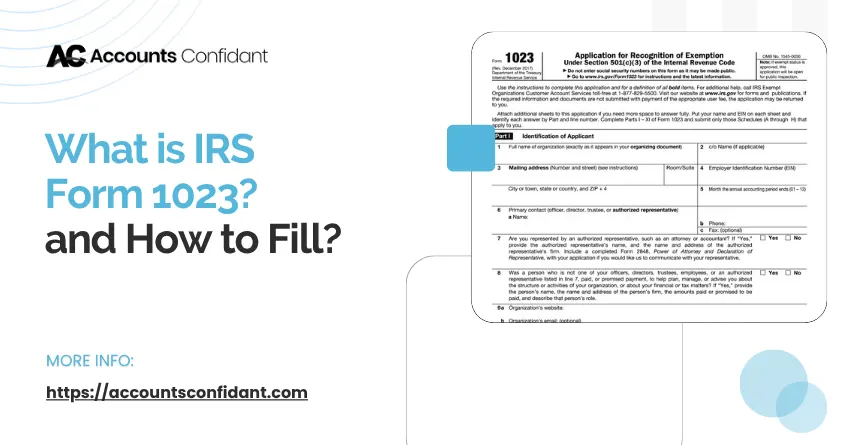
Starting a nonprofit does not automatically make your organization tax-exempt. To receive official recognition from the IRS as a 501(c)(3) organization, most charitable organizations must submit IRS Form 1023 — Application for Recognition of Exemption Under Section 501(c)(3) of the Internal Revenue Code.
The application helps the IRS review your organization’s purpose, activities, governance structure, financial information, and compliance with nonprofit rules. A properly prepared Form 1023 can help avoid unnecessary questions, delays, or rejection.
Many nonprofit founders struggle with deciding whether they need the full Form 1023 or the shorter Form 1023-EZ, understanding the filing requirements, preparing the activity narrative, and knowing what information the IRS expects.
This guide explains the complete Form 1023 process, including eligibility, filing steps, costs, timelines, schedules, and common mistakes.
You May Also Read About: IRS Form 8832?
What Is IRS Form 1023?
IRS Form 1023 is the application nonprofit organizations use to request official recognition of tax exemption under Section 501(c)(3) of the Internal Revenue Code.
When the IRS approves Form 1023, the organization receives a determination letter confirming its federal tax-exempt status. This allows qualifying organizations to avoid federal income tax on related activities and provides a foundation for accepting tax-deductible charitable contributions.
Organizations that typically use Form 1023 include:
- Charitable organizations
- Religious organizations
- Educational nonprofits
- Scientific organizations
- Foundations
- Public benefit organizations
Form 1023 does not create a nonprofit organization. The organization must usually be legally formed first, such as through incorporation, trust formation, or another recognized structure.
For example, if a group creates a nonprofit corporation to provide free educational programs, the corporation exists after state formation. However, it still needs IRS approval through Form 1023 to receive official 501(c)(3) recognition.
Who Must File Form 1023?
Most organizations seeking recognition as a 501(c)(3) nonprofit must file Form 1023 or Form 1023-EZ with the IRS.
The IRS requires organizations that want formal recognition of exemption to complete the application process unless they fall under specific exceptions.
Organizations commonly required to file include:
- New charitable nonprofits
- Community service organizations
- Educational institutions
- Public charities
- Private foundations
Some organizations may not need to submit Form 1023, including:
- Churches and certain religious organizations
- Organizations with annual gross receipts below certain limits that qualify for automatic exemption
- Certain government entities
However, even when filing is not mandatory, some organizations choose to apply because an IRS determination letter can provide credibility when applying for grants, opening bank accounts, or working with donors.
You May Also Read About: IRS Form 8821?
What Is the Difference Between Form 1023 and Form 1023-EZ?
The main difference is that Form 1023 is the full application with detailed information, while Form 1023-EZ is a shorter application available only to eligible smaller organizations.
Many nonprofit founders choose the wrong form because Form 1023-EZ looks simpler. However, eligibility rules are strict, and submitting Form 1023-EZ when an organization does not qualify can create problems.
| Feature | Form 1023 | Form 1023-EZ |
| Application length | Detailed application | Short online form |
| User fee | $600 | $275 |
| Filing method | Electronic through Pay.gov | Electronic through Pay.gov |
| Processing time | Usually several months | Usually faster |
| Financial information | Detailed projections and history | Limited information |
| Eligibility | Available to most eligible nonprofits | Only qualifying small organizations |
Form 1023-EZ Eligibility Requirements
An organization generally must meet requirements such as:
- Expected annual gross receipts of $50,000 or less for the current year and the next two years
- Gross receipts of $50,000 or less in previous applicable years
- Total assets of $250,000 or less
Certain organizations cannot use Form 1023-EZ, including many:
- Churches
- Schools
- Hospitals
- Foreign organizations
- Private foundations
- Supporting organizations
- LLCs seeking exemption
Before choosing the EZ form, nonprofit founders should review the IRS Form 1023-EZ Eligibility Worksheet carefully.
Do You Need an EIN Before Filing Form 1023?
Yes, an organization must obtain an Employer Identification Number (EIN) before submitting Form 1023.
The IRS uses the EIN to identify your organization during the exemption application process.
The normal order is:
- Create your nonprofit entity under state law
- Obtain an EIN using Form SS-4
- Prepare organizational documents
- File Form 1023 through Pay.gov
A common mistake is trying to submit the 501(c)(3) application before obtaining an EIN. The IRS cannot process the application without this identification number.
How to Fill Out Form 1023 Step by Step
Form 1023 requires detailed information about your nonprofit’s structure, purpose, activities, finances, and governance.
The application is divided into multiple parts. Each section helps the IRS determine whether your organization meets 501(c)(3) requirements.
Part I: Identification of Applicant
Part I collects basic information about your nonprofit organization.
You provide:
- Legal name of the organization
- Mailing address
- EIN
- Contact information
- Organization type
You must ensure the information matches your formation documents and IRS records.
A mismatch between your legal name, EIN records, and state filing documents can slow down processing.
Part II: Organizational Structure
Part II explains how your nonprofit was legally created.
The IRS reviews whether your organizing documents contain the required nonprofit provisions.
Depending on your structure, you may provide:
- Articles of incorporation
- Trust documents
- Association documents
Your organizing document generally needs:
- A charitable purpose clause
- A dissolution clause explaining that remaining assets go to another charitable purpose if the organization closes
Missing these provisions is one of the common reasons applications require correction.
Part III: Required Provisions in Your Organizing Document
This section confirms that your organization meets IRS requirements for nonprofit operation.
The IRS looks for restrictions related to:
Private Inurement
Nonprofit assets cannot improperly benefit private individuals such as founders, directors, or insiders.
Private Benefit
Activities must primarily serve the public benefit rather than private interests.
Political Campaign Activity
501(c)(3) organizations cannot participate in political campaign activities supporting or opposing candidates.
Lobbying
Some lobbying activities are allowed, but they cannot become a substantial part of the organization’s activities.
Part IV: Describe Your Activities
Part IV is one of the most important sections because the IRS uses it to understand what your organization actually does.
You must describe:
- Current activities
- Planned activities
- Who benefits
- How programs operate
- Where activities take place
- How activities are funded
A weak activity description is one of the most common causes of IRS questions.
For example:
Weak description:
“We help children in need.”
Better description:
“The organization provides free after-school tutoring programs for low-income students between ages 8 and 16. Volunteer teachers provide weekly mathematics and reading sessions at community centers. The program is funded through individual donations and foundation grants.”
The IRS wants specific operational details, not only a mission statement.
Part V: Compensation and Financial Arrangements
Part V explains relationships between the nonprofit and people involved with the organization.
The IRS reviews:
- Officer compensation
- Director relationships
- Family relationships
- Business transactions
- Potential conflicts of interest
You should disclose arrangements honestly. Trying to hide compensation or related-party transactions can create larger issues later.
Part VI: Financial Data
Financial information helps the IRS understand how your organization will operate financially.
New organizations usually provide projected financial information.
The IRS reviews:
- Revenue sources
- Expenses
- Program costs
- Fundraising income
- Administrative expenses
Typical information includes:
- Donations
- Grants
- Program income
- Salaries
- Rent
- Operating expenses
Your projections should be realistic and connected to your activity description.
Part VII: Foundation Classification
This section determines whether your organization will be classified as a public charity or private foundation.
Most operating charities seek public charity status because they receive broad public support.
The classification affects:
- IRS reporting requirements
- Donor rules
- Financial limitations
Choosing the correct classification helps avoid future compliance problems.
Part VIII: Effective Date of Exemption
This section determines when your tax-exempt status becomes effective.
If you file within the IRS 27-month filing window, your exemption may generally be recognized retroactively back to your legal formation date.
If you file late, your exemption usually begins from the filing date unless special relief applies.
Part IX: Annual Filing Requirement
This section explains your ongoing IRS reporting obligations after approval.
Most nonprofits must file one of these annual returns:
- Form 990
- Form 990-EZ
- Form 990-N
Failing to file required returns for three consecutive years can result in automatic revocation of tax-exempt status.
Part X: Signature
The authorized officer must sign Form 1023 before submission.
The signer confirms that the information provided is accurate and complete.
Paid preparers may also need to include their:
- Name
- Preparer Tax Identification Number (PTIN)
What Are the Required Form 1023 Schedules?
Schedules are additional sections required only for certain types of organizations.
The IRS uses schedules to collect information about specific activities.
Common schedules include:
| Schedule | Applies To |
| Schedule A | Churches |
| Schedule B | Schools |
| Schedule C | Hospitals and medical organizations |
| Schedule D | Supporting organizations |
| Schedule E | Organizations requesting certain effective date treatment |
| Schedule F | Low-income housing organizations |
| Schedule G | Successor organizations |
| Schedule H | Scholarship organizations |
Not every nonprofit completes every schedule. Only include schedules that apply to your organization.
Can You File Form 1023 Electronically?
Yes, Form 1023 must generally be filed electronically through Pay.gov.
The IRS no longer accepts traditional paper submissions for Form 1023.
The electronic filing process includes:
- Creating a Pay.gov account
- Completing the online application
- Uploading supporting documents
- Paying the user fee
- Submitting the application
Before submitting, review every section carefully because corrections after filing may require IRS communication.
How Much Does Form 1023 Cost in 2026?
The Form 1023 user fee is $600, while Form 1023-EZ costs $275.
The fee is paid electronically through Pay.gov when submitting the application.
The fee is separate from professional costs if you hire a CPA, attorney, or nonprofit consultant to assist with preparation.
How Long Does Form 1023 Take to Process?
Full Form 1023 applications commonly take several months, while Form 1023-EZ applications are generally processed faster.
Processing time depends on:
- Application completeness
- IRS workload
- Whether additional information is requested
- Complexity of nonprofit activities
A detailed application involving unusual activities, international programs, or complex financial arrangements may take longer.
The IRS provides status tools for applicants who need updates on pending applications.
Common Form 1023 Mistakes That Cause Delays
Most Form 1023 delays happen because organizations provide incomplete, unclear, or inconsistent information.
Common mistakes include:
Choosing Form 1023-EZ without checking eligibility
Some organizations assume they qualify because they are small. Size alone does not determine eligibility.
Writing a vague activity description
The IRS needs operational details, not only your mission statement.
Missing required organizing document language
Articles of incorporation must include appropriate nonprofit provisions.
Incorrect financial projections
Numbers should match your planned activities.
Forgetting required schedules
Not including applicable schedules can delay review.
Filing after the 27-month deadline
Late filing can affect the effective date of exemption.
Case Study: Why a Clear Form 1023 Application Matters
A nonprofit application becomes easier to review when activities, finances, and governance documents tell the same story.
Consider a community education nonprofit planning free tutoring programs.
The organization described its mission as “helping students succeed,” but its Form 1023 application did not explain:
- Number of students served
- Program locations
- Volunteer roles
- Funding sources
- Educational materials used
The IRS requested additional information.
After updating the application with specific program details and financial explanations, the organization provided a clearer picture of its operations.
The lesson is simple: Form 1023 is not only a form-filling exercise. It is a detailed explanation of how your nonprofit operates and serves the public.
What Happens After IRS Approves Form 1023?
Approval gives your organization official recognition of 501(c)(3) tax-exempt status, but ongoing compliance is still required.
After approval, nonprofits should:
- Maintain accurate financial records
- File required annual IRS returns
- Follow nonprofit governance rules
- Track charitable activities
- Maintain board meeting records
Approved organizations may appear in the IRS Tax Exempt Organization Search (TEOS) database.
Final Thoughts
IRS Form 1023 requires careful preparation because the IRS reviews more than your nonprofit’s mission. It examines your structure, activities, finances, governance, and compliance with 501(c)(3) rules.
Choosing the correct application, preparing a detailed activity narrative, and submitting accurate financial information can reduce delays and improve the chance of a smooth review process.
For nonprofit founders, the goal is not just completing a form. The goal is creating a clear record that shows how your organization serves the public and operates within IRS requirements.
Frequently Asked Questions
What is IRS Form 1023?
IRS Form 1023 is the application nonprofit organizations file to request recognition of exemption under Section 501(c)(3) of the Internal Revenue Code.
Who must file Form 1023?
Most nonprofit organizations seeking official 501(c)(3) recognition must file Form 1023 or Form 1023-EZ unless they qualify for an exception.
How much does Form 1023 cost?
The full Form 1023 filing fee is $600. Form 1023-EZ costs $275.
How long does Form 1023 processing take?
Processing times vary, but full Form 1023 applications often take several months depending on complexity and IRS workload.
Can I file Form 1023 without an EIN?
No, Organizations need an EIN before submitting Form 1023.
What is the 27-month filing window?
The 27-month filing window allows eligible organizations to request recognition of exemption back to their legal formation date if they file within the required period.
What happens if I miss the 27-month deadline?
Late filing generally means exemption begins from the filing date unless the organization qualifies for special relief.
Where can I check my Form 1023 status?
Applicants can use IRS application status tools such as “Where’s My Application” to check pending submissions.