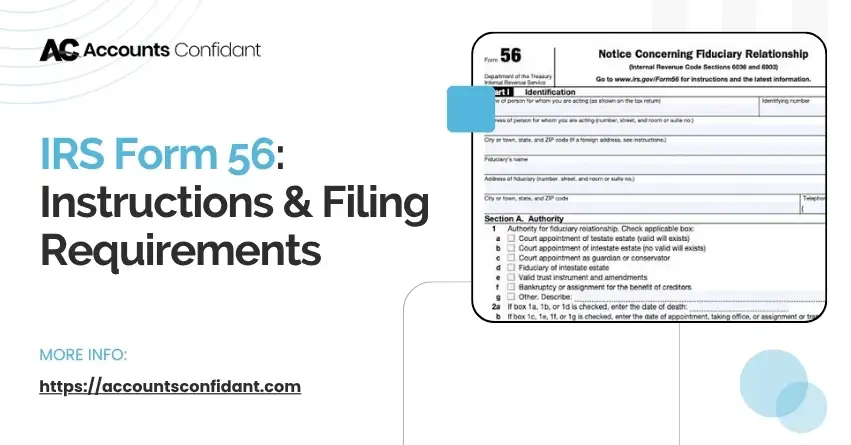
When you become responsible for another person’s or entity’s tax affairs, the IRS needs to know that you are acting in a fiduciary capacity. This is where IRS Form 56, officially called Notice Concerning Fiduciary Relationship, comes in.
Form 56 is used to notify the IRS when a fiduciary relationship is created or terminated. Common examples include an executor or administrator handling a deceased person’s tax matters, a trustee managing a trust, or a guardian or conservator acting for another person. The current IRS Form 56 was revised in June 2026.
For someone handling a deceased parent’s taxes, one of the most important points is that Form 56 is about notifying the IRS of your fiduciary status; it is not the same as a power of attorney. A fiduciary steps into the taxpayer’s position for the matters covered by the relationship, while an authorized representative acts only under authority granted through Form 2848.
What Is Form 56?
Form 56 is the IRS notice used to establish or terminate a fiduciary relationship for federal tax purposes.
The IRS uses it primarily to:
- Notify the IRS that a fiduciary relationship has been created
- Notify the IRS that a fiduciary relationship has ended
- Give notice of qualification in certain receivership and assignment situations
A fiduciary can include an executor, administrator, trustee, guardian, conservator, receiver, or another person acting in a qualifying fiduciary capacity.
A fiduciary is treated differently from an ordinary tax representative. The IRS explains that a fiduciary is treated as though the fiduciary is the taxpayer and assumes the taxpayer’s powers, rights, duties, and privileges.
When Should Form 56 Be Filed?
There is no single annual Form 56 filing deadline like April 15 for an individual income tax return.
Generally, Form 56 should be filed when the fiduciary relationship is created and again when it is terminated.
For a deceased taxpayer, IRS Publication 559 says to file Form 56 as soon as all necessary information is available, including the estate’s EIN when applicable.
There is a more specific rule for certain receivers and assignees. A fiduciary appointed as a receiver in a nonbankruptcy receivership or as an assignee for the benefit of creditors generally must file Form 56 on or within 10 days of the appointment.
So, for most estates and trusts, think of Form 56 as a status notification, not a once-a-year tax form.
Who Uses IRS Form 56?
Form 56 can apply to several fiduciary situations.
Executors and administrators
An executor or administrator handling a deceased person’s tax affairs may use Form 56 to notify the IRS of the fiduciary relationship.
Trustees
A trustee named under a valid trust instrument may use Form 56 to notify the IRS of the trustee relationship.
Guardians and conservators
A court-appointed guardian, custodian, or conservator can use Form 56 when acting for another person’s interests.
Receivers and assignees
Certain court-appointed receivers, fiduciaries, and assignees for the benefit of creditors also use Form 56. The June 2026 revision specifically expanded the form’s treatment of receivers and fiduciaries in these proceedings.
Bankruptcy fiduciaries
The Form 56 instructions contain a special rule: a bankruptcy trustee, debtor-in-possession, or similar bankruptcy fiduciary generally does not use Form 56 for the section 6036 notice of qualification because bankruptcy proceedings are subject to separate bankruptcy-law notice requirements.
How to Fill Out Form 56
The current IRS Form 56 instructions divide the form into four main parts.
Part I — Identification
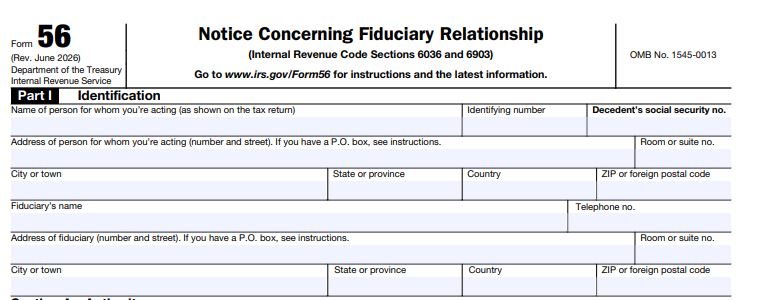
The first section identifies both the person or entity for whom you are acting and you, the fiduciary.
You generally enter:
- Name of the person or entity for whom you are acting
- Identifying number
- Decedent’s Social Security number, when applicable
- Address of the person or entity
- Fiduciary’s name
- Fiduciary’s telephone number
- Fiduciary’s address
The current form specifically asks for the name of the person for whom you’re acting as shown on the tax return.
Form 56 SSN or EIN: Which number should you use?
The correct identifying number depends on whom you are representing.
If you are acting for an individual, use that individual’s SSN or ITIN.
If you are acting for a person other than an individual, such as an estate or other entity, the identifying number is generally the entity’s EIN.
When acting for a decedent, the current Form 56 also has a separate field for the decedent’s Social Security number.
This distinction is important because the decedent’s final individual return and the estate’s tax return can belong to two different taxpayer accounts.
How to Fill Out Form 56 for a Deceased Parent
A death in the family creates a particularly common Form 56 situation.
Suppose your parent, Jane Smith, dies and you become responsible for handling her federal tax matters.
The IRS instructions provide an important example: when an executor or administrator will file the decedent’s final Form 1040 and also acts for the estate, a separate Form 56 is filed for the decedent and another Form 56 is filed for the estate.
Form 56 for the deceased parent
For the decedent’s tax account, enter:
- Your parent’s legal name as shown on the tax return
- Your parent’s SSN or ITIN
- Your parent’s address
- Your fiduciary information
- The appropriate authority under Section A
- The relevant tax types and forms
The decedent’s SSN should also be entered in the separate decedent-SSN field.
Form 56 for the estate
The estate is a separate taxpayer for federal tax purposes when it has an estate filing obligation.
For the estate’s Form 56, use the estate’s name and EIN as applicable. The IRS states that when you are acting for a person other than an individual, the identifying number is the EIN.
The estate may have to file Form 1041, depending on its income and circumstances.
Does Being Named Executor in a Will Mean You Can File Form 56 Immediately?
Not necessarily.
This is an important distinction.
For an estate where a valid will exists, the current Form 56 instructions describe line 1a as a court appointment of a testate estate and require current letters testamentary or a court certificate as evidence of the court appointment.
Being named as executor in a will does not, by itself, necessarily mean you have already been legally authorized by the appropriate court to act as executor.
The exact probate process depends on state law, so do not rely on the will alone when the IRS form requires evidence of court appointment.
What If There Is No Court-Appointed Executor?
The current Form 56 contains a separate option for an intestate estate with no court appointment.
Line 1d applies when the decedent died without a valid will, there is no court-appointed administrator or representative, and you are the sole person charged with the decedent’s property.
This is different from an estate where there is a valid will but probate appointment has not occurred.
The facts and applicable state-law authority matter, so choose the authority category carefully and attach supporting evidence when the instructions require it.
Section A: Authority for the Fiduciary Relationship
The current Form 56 provides several authority categories:
| Form 56 line | Authority |
| 1a | Court appointment of testate estate |
| 1b | Court appointment of intestate estate |
| 1c | Court appointment as guardian or conservator |
| 1d | Fiduciary of intestate estate |
| 1e | Valid trust instrument and amendments |
| 1f | Bankruptcy, receiver/fiduciary, or assignment for benefit of creditors |
| 1g | Other fiduciary authority |
The form also asks for the applicable date. For estate situations under lines 1a, 1b, or 1d, that is generally the date of death. For lines 1c, 1e, 1f, or 1g, it is the applicable appointment, assumption of office, assignment, or transfer date.
Section B: Tax Types and Tax Notices
This part tells the IRS which tax matters are within your fiduciary authority.
You can identify applicable taxes such as:
- Income
- Gift
- Estate
- Generation-skipping transfer
- Employment
- Excise
- Other taxes
The current form then asks you to identify the federal tax forms involved, including forms such as 706, 709, 940, 941/943/944, 1040/1040-SR, and 1041.
This is more important than it may look.
If your authority covers only particular tax matters or years, Form 56 allows you to specify those limitations. The form’s instructions say to identify the specific years or periods if your authority does not cover all periods.
Part II: Ending or Revoking the Fiduciary Notice
Form 56 is not necessarily a one-time filing.
When the fiduciary relationship ends, the IRS needs to be notified.
Part II allows you to:
- Completely revoke or terminate prior fiduciary notices
- Partially revoke earlier notices
- Identify a substitute fiduciary
The current form includes reasons such as a court order revoking fiduciary authority or a certificate of dissolution or termination of a business entity.
For an estate, a termination filing may be appropriate when your fiduciary role ends, or a successor fiduciary takes over.
Publication 559 also notes that Form 56 should be used to notify the IRS when the fiduciary relationship terminates or when a successor fiduciary is appointed while the estate remains open.
Part III: Court and Administrative Proceedings
Part III applies only to certain fiduciaries appointed in court or governmental proceedings other than bankruptcy.
It asks for information such as:
- Court or agency name
- Date proceedings began
- Address
- Docket number
- Date, time, and location of applicable proceedings
For an ordinary executor handling a parent’s final Form 1040, this section may not be the relevant portion of the form.
Part IV: Sign Form 56
The fiduciary must sign Form 56 under penalties of perjury.
The current form asks for:
- Fiduciary signature
- Title, if applicable
- Date
Use the title that accurately describes your fiduciary role, such as executor, administrator, trustee, guardian, receiver, conservator, or another applicable title.
What Documents Should You Attach to Form 56?
The required supporting document depends on the type of fiduciary relationship.
For example, the IRS instructions specifically require an executor of a testate estate under line 1a to attach current letters testamentary or a court certificate proving the court appointment. Similar evidence requirements apply to other fiduciary situations where authority must be established.
Depending on the situation, useful documentation can include:
- Court appointment
- Letters testamentary
- Court certificate
- Trust instrument
- Appointment order
- Other documents establishing fiduciary authority
Do not attach unrelated documents simply to make the package larger. Use the current instructions to determine what evidence your particular authority requires.
Where to Mail Form 56
There is not one universal Form 56 mailing address.
The IRS says to file Form 56 with the IRS service center where the person for whom you are acting is required to file tax returns.
That means the correct address depends on whether you are acting for:
- An individual
- An estate
- A trust
- A business
- Another type of entity
Example: Form 56 for an individual filing Form 1040
For the 2026 calendar-year filing-address rules, taxpayers in states including Massachusetts and New York generally mail Form 1040 without payment to:
Department of the Treasury
Internal Revenue Service
Kansas City, MO 64999-0002
Accordingly, a Form 56 connected to that individual taxpayer would generally go to the applicable IRS service center used for that taxpayer’s Form 1040.
Example: Form 56 for an estate filing Form 1041
For estates and trusts in the same state group, the current Form 1041 instructions list:
Department of the Treasury
Internal Revenue Service
Kansas City, MO 64999-0048
for returns without a check or money order.
These are examples, not a substitute for checking the current IRS filing-address instructions for the taxpayer’s state and tax form.
Can Form 56 Be Filed Online?
Yes, Form 56 is supported by the IRS Modernized e-File system.
This is an important current update because some older websites still describe Form 56 as paper-only.
The IRS’s current Modernized e-File documentation lists Form 56 among fiduciary forms supported by MeF. The IRS also published 2026 Form 56 business-rule and schema updates for authorized e-file participants.
However, the existence of an IRS e-file schema does not mean every individual can simply log in to IRS.gov and upload Form 56 like an ordinary online form.
Availability depends on the software, transmitter, or authorized e-file provider being used.
For paper filing, complete the current form, attach required evidence, sign it, and send it to the appropriate IRS service center.
Can Form 56 Be Filed With a Tax Return?
Do not assume that Form 56 should simply be stapled to a final Form 1040 or Form 1041.
The IRS instructions treat Form 56 as a separate notice of the fiduciary relationship, and the IRS has a separate Modernized e-File process for the form.
For an estate, you may have several different filings, such as:
- Form 56
- Final Form 1040 for the decedent
- Form 1041 for the estate, when required
- Form 706, when the estate is subject to the estate-tax filing requirement
- Other forms depending on the estate’s circumstances
Each has its own filing rules.
Form 56 vs. Form 2848: What’s the Difference?
This is one of the most important Form 56 questions.
Form 56 tells the IRS that a fiduciary relationship exists.
Form 2848 grants power of attorney to an eligible representative to represent the taxpayer before the IRS within the authority specified on that form.
The IRS describes the difference this way:
A fiduciary stands in the position of the taxpayer and assumes the taxpayer’s relevant rights and responsibilities.
An authorized representative acts as the taxpayer’s agent and may perform only the actions authorized by Form 2848.
Accounts Confidant also has a dedicated IRS Form 2848 guide explaining powers of attorney and IRS representation.
A practical example:
Your father dies, and you become the court-appointed executor. You may use Form 56 to notify the IRS of your fiduciary relationship. If you want an enrolled agent or another eligible professional to represent the estate before the IRS, a properly completed Form 2848 may also be necessary.
Does Form 56 Change the IRS Mailing Address?
No.
Form 56 does not change the taxpayer’s last known address.
The IRS specifically warns that Form 56 cannot be used to update the last known address of the person, business, or entity for whom you are acting. For address changes, use:
- Form 8822 for an individual
- Form 8822-B for a business or entity
This distinction matters because filing Form 56 alone does not replace the IRS address-change process.
Do Both Co-Executors Need to Notify the IRS?
Generally, each fiduciary must provide notice of their status.
The current Form 56 instructions state that when there is more than one fiduciary, each fiduciary must file a separate Form 56 or otherwise provide notice of their status to the IRS.
So if an estate has two co-executors, do not assume that one person’s Form 56 automatically identifies both.
The authority documents and applicable estate law should also be reviewed to determine how the co-executors can act for the estate.
Do You Need Form 56 Every Year?
Generally, no.
Form 56 is not an annual renewal form.
Once the fiduciary relationship is properly notified, the notice generally remains effective until the fiduciary relationship is terminated or otherwise changed. Publication 559 explains that the notice remains in effect until the fiduciary notifies the IRS that the relationship with the estate has ended.
A new filing may become necessary when:
- A new fiduciary takes over
- The existing fiduciary relationship changes
- The authority is partially revoked
- The relationship terminates
What Happens After You File Form 56?
Form 56 does not itself prepare or file the tax returns for the taxpayer.
Instead, it establishes notice to the IRS that you are acting as fiduciary.
Once properly recognized, the fiduciary can undertake the tax responsibilities associated with the taxpayer or entity, including filing required returns and paying taxes that are due.
For an estate, that can mean handling the deceased person’s final income tax return as well as the estate’s own tax filings.
Common Form 56 Mistakes
Using the wrong taxpayer identification number
Do not automatically put your own SSN on the taxpayer-identification line.
The identifying number generally belongs to the person or entity for whom you are acting. For a decedent, the relevant individual account generally uses the decedent’s SSN or ITIN; for an estate or other entity, the EIN is generally used.
Filing one Form 56 for both the decedent and estate
When you are acting for both the deceased individual and the estate, the IRS’s own example calls for separate Forms 56.
Checking the wrong authority box
The authority section depends on how your fiduciary relationship was created.
A court-appointed executor, trustee, guardian, and fiduciary of an intestate estate without court appointment may fall under different lines.
Filing before you have evidence of authority
For authority categories that require proof, attach the appropriate court order, letters, trust document, or other evidence described in the instructions.
Using Form 56 instead of Form 2848
Form 56 establishes fiduciary status. It is not a substitute for a power of attorney when you want another eligible person to represent the taxpayer before the IRS.
Using Form 56 to change an address
Use Form 8822 or Form 8822-B for an address change.
Forgetting to terminate the fiduciary relationship
When your fiduciary responsibility ends, notify the IRS using the termination or revocation provisions of Form 56.
Form 56 Filing Checklist
Before submitting the form, verify:
Taxpayer information
- Correct legal name
- Correct SSN, ITIN, or EIN
- Correct address
- Decedent’s SSN, when applicable
Fiduciary information
- Correct fiduciary name
- Current mailing address
- Telephone number
- Correct fiduciary title
Authority
- Correct line selected
- Correct appointment or death date
- Required court or trust documentation attached
Tax matters
- Correct tax types selected
- Correct federal tax forms selected
- Correct years or periods listed when authority is limited
Final review
- Form signed
- Supporting evidence attached
- Correct IRS service center confirmed
- Copy retained for your records
The IRS estimates approximately 55 minutes for preparing Form 56, plus time for recordkeeping, learning about the form, and copying/assembling/sending the filing.
When a Deceased Parent’s Tax Affairs Involve Multiple IRS Forms
Form 56 is often only one part of the estate’s tax work.
Depending on the circumstances, a personal representative may need to deal with:
Final Form 1040: reports the deceased person’s final individual income through the date of death.
Form 1041: reports income earned by the estate after the person’s death when the estate has a filing requirement.
Form 706: applies to estates that meet the federal estate-tax filing requirements.
Form 1310: may be relevant when someone claims a refund owed to a deceased taxpayer.
The IRS’s deceased-person guidance lists these forms among the federal tax documents that may apply to an estate or personal representative.
This is also why the name and identification number on Form 56 need to match the taxpayer account being handled.
Final Takeaway
IRS Form 56 is primarily a notice to the IRS that a fiduciary relationship exists or has ended. It is commonly used by executors, administrators, trustees, guardians, conservators, and certain receivers.
For a deceased parent, the details matter. You may need one Form 56 for the decedent and another for the estate, and the identification number depends on which taxpayer account you are handling. The IRS’s current June 2026 instructions also make clear that the authority supporting the fiduciary relationship should be documented when required.
There is no universal Form 56 filing deadline. In most situations, file when the fiduciary relationship is created and as soon as the necessary information is available. Certain receivership situations have a specific 10-day rule.
The current IRS materials also show that Form 56 is now supported within the Modernized e-File system, so older articles claiming that the form is exclusively paper-filed are no longer reliable.
For additional guidance on appointing a representative to deal with the IRS, see Accounts Confidant’s IRS Form 2848 guide. For help organizing financial and tax records related to an estate, trust, or other complex filing situation, Accounts Confidant also provides bookkeeping and tax-preparation support.
Frequently Asked Questions
My parent died. Do I need to file Form 56?
If you are acting as a fiduciary for your parent’s tax affairs, Form 56 is generally used to notify the IRS of that relationship. Publication 559 says to file it as soon as the necessary information is available.
Does being named executor in a will mean I can file Form 56 immediately?
Not necessarily. For a testate estate, line 1a is based on a court appointment, and the IRS requires current letters testamentary or a court certificate as evidence of the appointment.
Do I need separate Forms 56 for the deceased person and the estate?
Yes, when you are acting for both. The IRS instructions specifically give this example and call for one Form 56 for the decedent and another for the estate.
Whose name and tax identification number go on Form 56?
Enter the name and identifying number of the person or entity for whom you are acting. The fiduciary’s name and address are entered separately.
Should I use the deceased person’s SSN or the estate’s EIN?
Use the decedent’s SSN or ITIN when acting for the decedent. Use the estate’s EIN when acting for the estate. The form also has a separate field for the decedent’s SSN.
Can I file Form 56 if no executor has been appointed by a court?
It depends on the situation. For a valid-will estate, line 1a requires court appointment. For an intestate estate with no court appointment, line 1d may apply when you are the sole person charged with the decedent’s property.
Do both co-executors need to notify the IRS?
Generally, yes. The IRS says each fiduciary must file a separate Form 56 or otherwise provide notice of their status.
What documents should I attach to Form 56?
Attach evidence required for your particular fiduciary authority. For example, a court-appointed executor under line 1a generally attaches current letters testamentary or a court certificate.
When should I file Form 56?
Generally, file it when the fiduciary relationship is created. For an estate, the IRS says to file as soon as the necessary information, including the EIN when applicable, is available. Certain receivers and assignees have a 10-day filing rule.
Can I submit Form 56 online or with a tax return?
Form 56 is supported by the IRS Modernized e-File system, although electronic filing depends on the software or authorized provider. It is also possible to file the form separately on paper.
Where should I mail Form 56?
Mail it to the IRS service center where the person or entity for whom you are acting is required to file its tax returns. There is no single national Form 56 mailing address.
What is the difference between Form 56 and Form 2848?
Form 56 notifies the IRS that you are acting as a fiduciary. Form 2848 gives an eligible representative power of attorney to act for the taxpayer within the authority granted.
Does Form 56 change the address the IRS uses?
No, Form 56 cannot be used to update the taxpayer’s last known address. Use Form 8822 or Form 8822-B instead.
Do I need Form 56 every year?
No, Form 56 is generally not an annual form. The notice remains effective until the fiduciary relationship is terminated or otherwise changed.
How do I notify the IRS that my fiduciary role has ended?
File another Form 56 and complete the applicable termination, revocation, or substitute-fiduciary section in Part II.