Choosing the right tax classification for your business can affect how you report income, pay taxes, and plan for future growth. Many LLC owners assume their state filing automatically decides their federal tax treatment, but that is not always true.
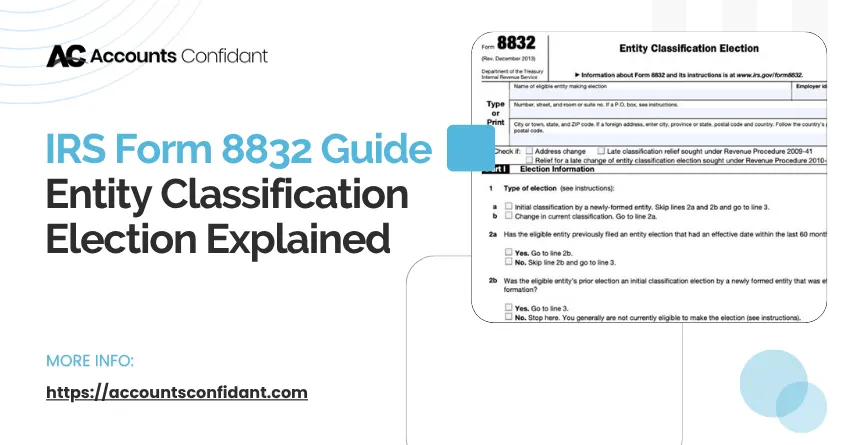
IRS Form 8832, Entity Classification Election, allows eligible business entities to choose how they are treated for federal tax purposes. This is commonly called the “check-the-box election” because the business checks a box to select its preferred tax classification.
For example, a limited liability company (LLC) may choose to be treated as:
- A disregarded entity
- A partnership
- A corporation
The right choice depends on your business structure, tax goals, ownership, and future plans.
This guide explains what Form 8832 is, who can file it, how the election works, deadlines, Form 8832 vs Form 2553 differences, late filing relief, and common mistakes to avoid.
What Is IRS Form 8832?
IRS Form 8832 is a form used by eligible business entities to choose their federal tax classification.
The IRS does not always use the same classification that a business has under state law. Instead, certain entities can choose how they want to be treated for federal tax purposes.
This election is known as the check-the-box election.
A business can use Form 8832 to choose:
- Disregarded entity status for certain single-owner entities
- Partnership status for certain multi-owner entities
- Corporation status for federal tax purposes
The election changes how the IRS views the entity for tax reporting.
For example:
A single-member LLC usually defaults to a disregarded entity. The LLC income is reported on the owner’s tax return.
However, the owner may file Form 8832 to have the LLC treated as a corporation instead.
What Is the Purpose of the Check-the-Box Election?
The purpose of the check-the-box election is to let eligible entities choose their federal tax classification.
Before these rules existed, entity classification decisions were often complicated and depended on many factors.
Today, eligible entities can usually make a simple election based on their tax needs.
Common reasons businesses file Form 8832 include:
- Changing from default LLC taxation
- Creating a corporate tax structure
- Planning for investors
- Organizing international business structures
- Aligning tax treatment with business goals
The election does not change your legal entity under state law.
For example, an LLC filing Form 8832 as a corporation remains an LLC legally. The election only changes federal tax treatment.
Who Can File Form 8832?
Eligible entities that have more than one possible federal tax classification can generally file Form 8832.
Common eligible entities include:
- Single-member LLCs
- Multi-member LLCs
- Certain domestic entities
- Certain foreign entities
The entity must qualify as an eligible entity under IRS classification rules.
Some organizations cannot use Form 8832 because the IRS automatically classifies them under special rules.
Examples include certain foreign corporations listed as per se corporations under IRS regulations.
How Are LLCs Taxed Without Form 8832?
Most LLCs receive a default tax classification if they do not file Form 8832.
The IRS automatically applies default rules.
Single-Member LLC
A single-member LLC usually defaults to a disregarded entity.
This means:
- The LLC does not file a separate federal income tax return
- Business income and expenses are reported on the owner’s tax return
Example:
Sarah creates an LLC for a consulting business. She is the only owner and does not file Form 8832.
The IRS generally treats the LLC as a disregarded entity, and Sarah reports the business activity on her personal tax return.
Multi-Member LLC
A multi-member LLC usually defaults to partnership taxation.
This means:
- The LLC files a partnership tax return
- Owners receive Schedule K-1 forms
- Income passes through to members
Example:
Three partners create an LLC for a real estate investment business. Without an election, the IRS generally treats the LLC as a partnership.
Form 8832 vs Form 2553: What Is the Difference?
Form 8832 chooses basic federal tax classification, while Form 2553 is used specifically to elect S corporation status.
This is one of the most common areas of confusion for business owners.
| Feature | Form 8832 | Form 2553 |
| Purpose | Selects entity tax classification | Elects S corporation status |
| Used for | Disregarded entity, partnership, corporation | S corporation election |
| Available to | Eligible entities | Eligible corporations and LLCs |
| Changes legal entity? | No | No |
| IRS form type | Entity classification election | S corporation election |
A common misunderstanding is that filing Form 8832 creates an S corporation.
It does not.
If an LLC wants S corporation taxation, it generally files Form 2553 instead of using Form 8832 alone.
Some situations may require both forms depending on the entity structure.
When Should You File Form 8832?
You should file Form 8832 when you want your business to have a tax classification different from its default IRS classification.
Common situations include:
- An LLC owner wants corporate taxation
- A foreign entity needs U.S. tax classification
- Business owners are restructuring operations
- A company wants a different tax reporting method
The timing matters because the IRS limits how far back or forward an election can be effective.
What Are the Form 8832 Effective Date Rules?
The effective date on Form 8832 must follow the IRS 75-day backward and 12-month forward rules.
The IRS allows an entity to choose an effective date:
- Up to 75 days before the filing date
- Up to 12 months after the filing date
Example:
A company files Form 8832 on September 25, 2026.
The election date can generally be:
- Backdated to July 12, 2026 (75 days earlier)
- Future dated up to September 25, 2027
If the effective date is outside these limits, the IRS may reject the election.
What Is the Form 8832 60-Month Rule?
The 60-month rule limits how often an entity can change its tax classification.
After an entity makes a classification election, it generally cannot make another election for 60 months.
This prevents businesses from frequently changing tax treatment to gain tax advantages.
There are exceptions in certain situations, but businesses should carefully plan before filing Form 8832.
How to Fill Out Form 8832 Step by Step
Form 8832 has three main parts that collect entity information, election details, and signatures.
A mistake in any section can delay processing.
Part I: Entity Information
Part I collects basic information about the business making the election.
You provide:
- Legal name of the entity
- Employer Identification Number (EIN)
- Address
- Entity type
- Contact information
The information should match IRS records.
A common mistake is filing Form 8832 before obtaining an EIN. The IRS generally needs the EIN to process the election.
Part II: Election Information
Part II explains the tax classification you are choosing.
The entity selects the classification it wants:
- Disregarded entity
- Partnership
- Association taxable as a corporation
This section also includes:
- Effective date
- Previous classification information
- Late election information if applicable
Choosing the wrong effective date is one of the most common Form 8832 errors.
Part III: Signature Requirements
Part III confirms that an authorized person approves the election.
The form must be signed by:
- An owner
- Officer
- Manager
- Authorized representative
Missing signatures can cause rejection.
Can You File Form 8832 Electronically?
Form 8832 is generally filed by mail or fax according to IRS filing procedures, unlike some IRS forms that support online filing.
Before submitting, confirm the latest IRS Form 8832 instructions because filing methods and addresses can change.
Businesses should keep:
- A copy of the completed form
- Proof of submission
- Supporting documents
These records may be needed later for tax filings.
What Is Form 8832 Late Election Relief?
Late election relief allows some businesses to request approval for a missed Form 8832 deadline.
The IRS may provide relief when the failure to file on time was due to reasonable cause.
Common requirements may include:
- Filing the late election
- Providing a reasonable cause explanation
- Including a declaration of consistent tax treatment
- Following IRS procedures
For domestic entities, relief may be available under Revenue Procedure 2009-41.
For certain foreign entities, other procedures may apply.
Can Foreign Entities File Form 8832?
Certain foreign entities can file Form 8832 if they are eligible under IRS rules.
Foreign business owners often use Form 8832 when they need to determine how their entity will be treated for U.S. tax purposes.
Examples include:
- Foreign-owned LLCs
- International holding companies
- Cross-border businesses
However, some foreign entities cannot make this election because they are automatically classified as corporations under IRS rules.
International tax situations often involve additional reporting requirements, such as:
- Form 5471
- Foreign ownership reporting
- Controlled foreign corporation rules
Common Form 8832 Mistakes
Most Form 8832 problems happen because of incorrect information, missed deadlines, or choosing the wrong classification.
Filing Without an EIN
The IRS needs identifying information before processing the election.
Selecting the Wrong Effective Date
The date must follow the IRS timing rules.
Confusing Form 8832 With Form 2553
Form 8832 does not create an S corporation election.
Missing Signatures
An unsigned form may be rejected.
Ignoring the 60-Month Rule
Changing classifications frequently may not be allowed.
Choosing a Tax Classification Without Planning
A classification choice can affect:
- Tax returns
- Payroll
- Owner compensation
- Future investors
Case Study: LLC Owner Choosing a Different Tax Classification
A business owner may use Form 8832 when the default LLC taxation no longer matches business needs.
Example:
A technology consultant creates a single-member LLC. Initially, the business operates as a disregarded entity because income is reported directly on the owner’s tax return.
After growth, the owner wants the LLC taxed as a corporation for business planning reasons.
The owner reviews the tax impact, selects the correct classification, prepares Form 8832, and chooses an effective date within IRS limits.
The important step is not simply filing the form. The owner first confirms that the new tax treatment matches the company’s financial goals.
You May Also Know About: IRS Form 8606?
What Happens After Filing Form 8832?
After filing Form 8832, the entity must use the selected tax classification when preparing future tax filings.
The election may affect:
- Federal income tax returns
- Partnership reporting
- Corporate reporting
- Owner tax treatment
Businesses should keep the approved election records with their tax documents.
Final Thoughts
IRS Form 8832 gives eligible businesses control over how they are classified for federal tax purposes. For LLC owners and international businesses, this election can be an important part of tax planning.
The biggest mistakes usually come from choosing the wrong form, missing timing rules, or assuming Form 8832 and Form 2553 do the same thing.
Before filing, review your current structure, future business plans, and tax goals. A correct entity classification choice can help your business avoid unnecessary tax and compliance problems later.
Frequently Asked Questions
What is IRS Form 8832?
IRS Form 8832 is the Entity Classification Election form that allows eligible entities to choose their federal tax classification.
Can a single-member LLC file Form 8832?
Yes, A single-member LLC can file Form 8832 to choose a different federal tax classification.
When is Form 8832 due?
Form 8832 does not have one fixed annual deadline. The effective date must follow the IRS 75-day backward and 12-month forward rules.
Does Form 8832 make an LLC an S corporation?
No, Form 8832 does not elect S corporation status. An eligible entity generally uses Form 2553 for an S corporation election.
What happens if I do not file Form 8832?
The IRS applies default classification rules based on the entity type.
Can I fix a late Form 8832 election?
Yes, some entities may qualify for late election relief if IRS requirements are met.
Do foreign companies need Form 8832?
Some foreign entities may use Form 8832 to select U.S. tax classification, but eligibility depends on IRS rules.