Understanding IRS Form 940 vs. 941 vs. 944 becomes much easier once you separate the taxes each form reports.
Form 940 is used for federal unemployment tax, or FUTA. Form 941 is generally used every quarter to report federal income tax withheld from employees and Social Security and Medicare taxes. Form 944 serves a similar reporting purpose to Form 941, but it is an annual return available only to certain small employers that have been notified by the IRS.
One important point for 2027: the IRS has not currently published an official announcement saying that Form 944 is being discontinued after 2026. The IRS has a 2026 Form 944 and 2027 Form 944-X materials available, while its draft-form listings also show a 2027 Form 941. That means employers should not switch from Form 944 to Form 941 based only on online claims.
Understanding Form 940, 941, and 944 also requires knowing how federal payroll taxes are calculated. Our guide to payroll tax calculation explains the different taxes that can affect an employer’s payroll.
IRS Form 940 vs. 941 vs. 944 at a Glance
General Difference between Form 940, 941 & 944:-
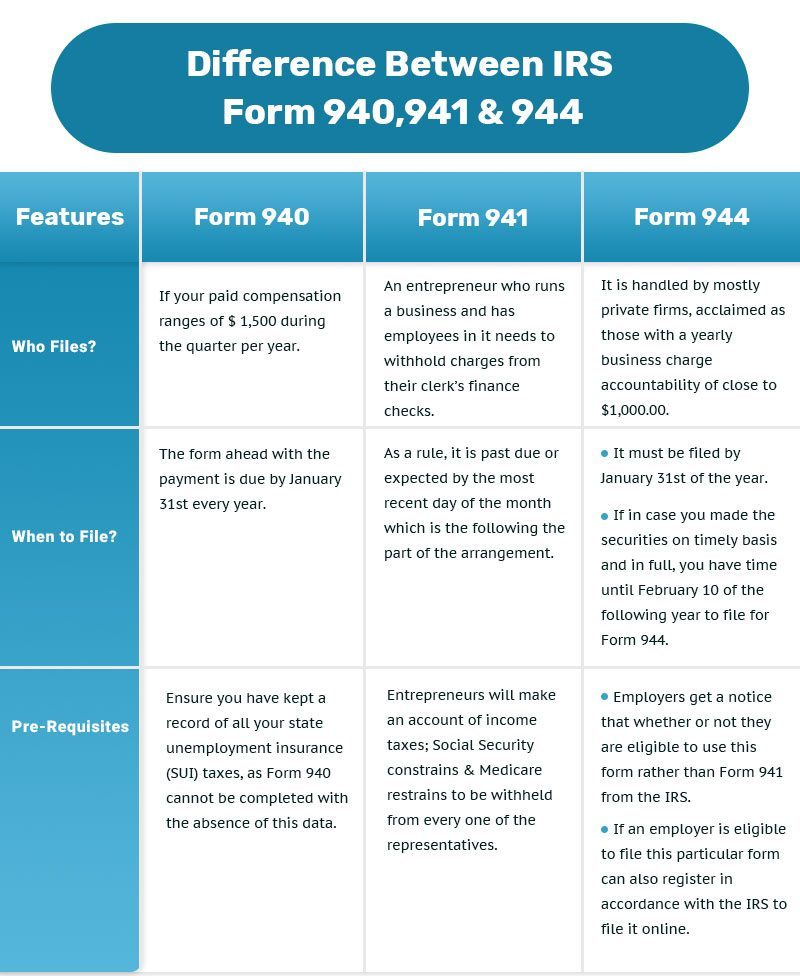
And here are the detailed differences
| Feature | Form 940 | Form 941 | Form 944 |
| Official purpose | Annual Federal Unemployment (FUTA) Tax Return | Quarterly Federal Tax Return | Annual Federal Tax Return |
| Main taxes reported | FUTA tax | Federal income tax withholding, Social Security and Medicare | Federal income tax withholding, Social Security and Medicare |
| Filing frequency | Annual | Quarterly | Annual |
| Typical filer | Employers subject to FUTA | Most employers with employees subject to federal employment taxes | Eligible small employers specifically notified by the IRS |
| Main relationship | Separate from Form 941/944 | Standard payroll-tax reporting form | Annual alternative to Form 941 |
| General filing deadline | January 31 after the tax year | April 30, July 31, October 31, January 31 | January 31 after the tax year |
| Can it replace 941? | No | — | Yes, when the IRS requires/allows the employer to use Form 944 |
| Can it replace 940? | — | No | No |
The IRS explains that employers generally file Form 941 quarterly and that some small employers with annual liability of $1,000 or less may file Form 944 annually instead. Employers generally also file Form 940 annually when they are subject to FUTA.
So, when asking what is a 940 and 941, the simplest answer is:
940 = federal unemployment tax.
941 = federal income tax withholding plus Social Security and Medicare.
944 = annual version of the 941 reporting function for qualifying small employers.
What Is Form 940?
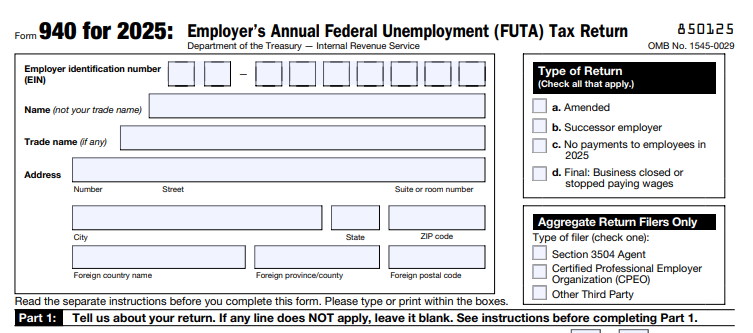
Form 940 is the Employer’s Annual Federal Unemployment (FUTA) Tax Return. It reports an employer’s federal unemployment tax liability for the year.
FUTA is different from Social Security and Medicare taxes because FUTA is an employer-paid tax. You do not normally withhold FUTA from an employee’s paycheck. The IRS says FUTA generally applies to the first $7,000 paid to each employee during the calendar year, subject to applicable exclusions and credits.
Who generally needs to file Form 940?
For the 2025 Form 940 rules, an employer generally needed to file if it either:
- paid $1,500 or more in wages during any calendar quarter, or
- had at least one employee for at least part of a day in 20 or more different weeks.
Special rules apply to agricultural, household, government, and certain other employers. Always use the instructions for the specific tax year being reported.
How much is FUTA tax?
The standard FUTA tax rate is 6% on the first $7,000 of wages subject to FUTA. Employers may generally receive a credit of up to 5.4% for qualifying state unemployment tax payments, producing a net federal rate of 0.6% when the maximum credit applies. Credit-reduction rules can increase the federal liability for employers in certain states.
The 2026 draft Form 940 reflects the 0.6% calculation and continues to use the $7,000 FUTA wage base.
When to file Form 940
Form 940 is generally due on January 31 following the end of the calendar year.
For the 2026 tax year, January 31, 2027 falls on a Sunday. Federal filing rules generally move a deadline that falls on a weekend or legal holiday to the next business day. The IRS has already used February 1, 2027 as the applicable due date in its 2026 employment-tax materials for returns affected by the January 31 Sunday date.
There is an important distinction between filing Form 940 and depositing FUTA tax. If your FUTA liability exceeds $500 for a quarter, you generally need to make a deposit by the last day of the following month. Amounts of $500 or less can generally be carried forward until the accumulated liability exceeds $500.
What Is Form 941?
Form 941 is the Employer’s Quarterly Federal Tax Return.
Employers generally use it to report:
- federal income tax withheld from employees,
- employee and employer Social Security taxes,
- employee and employer Medicare taxes, and
- Additional Medicare Tax withheld from employees when applicable.
The IRS’s 2026 Form 941 instructions confirm that the form is generally filed once for each quarter.
Form 941 deadlines 2026
For calendar-year employers, the regular Form 941 deadlines are:
| Quarter | Wages paid during | Form 941 deadline |
| Q1 | January–March 2026 | April 30, 2026 |
| Q2 | April–June 2026 | July 31, 2026 |
| Q3 | July–September 2026 | October 31, 2026 |
| Q4 | October–December 2026 | January 31, 2027 |
The IRS states that Form 941 is generally due on the last day of the month following the end of the quarter. When all taxes for the quarter were timely deposited in full, an additional 10 days may be available for filing.
Because January 31, 2027 is a Sunday, the Q4 2026 Form 941 filing deadline moves to the next business day, February 1, 2027. The 10-day filing provision for employers that timely deposited all taxes remains a separate rule.
Form 941 is a filing return, not your entire payroll-tax payment schedule
A common mistake is to assume that the date Form 941 is due is also when every payroll tax payment is due.
That is not necessarily the case.
Employers generally use a monthly or semiweekly deposit schedule for federal income tax withholding and Social Security and Medicare taxes. A next-day deposit rule can also apply when an employer accumulates $100,000 or more in employment taxes during a deposit period.
This is why a business can have a Form 941 due at the end of a quarter while having made payroll-tax deposits throughout the quarter.
Because filing deadlines and tax deposits are separate responsibilities, businesses should have a reliable payroll process in place. Our payroll processing services can help keep payroll records organized throughout the year.
Form 944 vs. 941: What’s the Difference?
The easiest way to understand Form 944 vs. 941 is to think of them as two reporting frequencies for similar employment taxes.
Form 941 is normally filed quarterly.
Form 944 is filed annually.
Form 944 is designed for the smallest employers, generally those whose annual liability for federal income tax withholding, Social Security, and Medicare taxes is $1,000 or less.
But there is a critical rule that businesses sometimes miss:
You cannot simply decide to use Form 944 because your payroll is small.
The IRS must notify you that you are required or authorized to file Form 944. The 2026 instructions state that an employer that has not received the required IRS notification generally must file Form 941 instead.
Can you switch between Form 941 and Form 944?
Yes, but the change requires following the IRS procedure.
For 2026, employers that believed they would qualify for Form 944 could request the annual filing arrangement during the first calendar quarter. Conversely, an employer notified to file Form 944 could request to file quarterly Forms 941 instead. In either situation, the employer needed IRS confirmation before using the requested filing method.
This means Form 944 vs. 941 is not simply a business preference.
Do You File Form 940 and Form 941 Together?
In many cases, yes.
This is one of the most important differences in the form 940 and 941 comparison.
Form 940 reports FUTA.
Form 941 reports federal income tax withholding and FICA taxes.
Because these are different employment-tax obligations, an employer may need to file both forms for the same year. Form 940 does not replace Form 941, and Form 941 does not replace Form 940. The IRS specifically directs employers to use Form 940 for unemployment taxes rather than reporting those taxes on Form 941.
For an employer using Form 944, the relationship is similar:
Form 940 can still be required for FUTA, while Form 944 handles the annual reporting of the federal income-tax withholding and Social Security/Medicare taxes covered by the annual return.
What’s Changing in 2027?
The biggest confirmed change relevant to these forms is the calendar-date shift at the beginning of 2027, not the disappearance of Form 944.
January 31, 2027 falls on a Sunday. As a result, applicable federal employment-tax returns normally due January 31 move to the next business day, February 1, 2027. The IRS has already published 2026 materials that recognize January 31, 2027, as a Sunday and February 1, 2027, as the following business-day deadline for relevant employment-tax filings.
Is Form 944 being discontinued?
There is no current IRS announcement establishing that Form 944 is being discontinued after 2026.
This point deserves special attention because searches for “form 944 discontinued” can produce confusing results.
The IRS’s current draft-form listings include a 2026 Form 944, and the agency has also posted 2027 Form 944-X materials for correcting previously filed Form 944 returns. The IRS’s draft-form database also includes a 2027 Form 941.
The fact that the IRS’s currently posted draft-form list does not yet show a regular 2027 Form 944 should not, by itself, be interpreted as an official discontinuation announcement. Draft forms are published on a rolling basis, and the IRS itself warns users not to rely on draft forms or instructions as final guidance.
For that reason, Form 944 filers should continue following their IRS filing notice and the applicable IRS instructions rather than automatically switching to Form 941 for 2027.
What Happens to Form 944 Filers After 2026?
As of September 22, 2026, there is no verified IRS rule requiring all Form 944 filers to move to Form 941 after 2026.
For businesses currently filing Form 944, the safest approach is to monitor the IRS’s official Form 944 guidance and any written IRS notice concerning the employer’s filing requirement.
The important rule remains that an employer should not independently file Form 941 when the IRS has instructed that employer to file Form 944, unless the employer has gone through the IRS process to change the filing requirement.
What If You Had No Employees This Year?
A business that genuinely had no employees and no employment activity generally does not have a payroll-tax return to report for that period. The IRS also notes that when it establishes a filing requirement for a business and later sends a notice requesting a return, the employer should respond to the notice rather than simply assume no filing is necessary.
There is also a different situation for an existing employer that remains active but has a period with no wages. IRS Publication 15 says employers generally must continue filing required employment-tax returns, including zero-wage returns, unless they have filed a final return or qualify for a specific exception.
So the answer depends on whether you had no employees at all or simply no wages during a particular filing period.
Common Mistakes When Comparing Forms 940, 941, and 944
Treating Form 940 and Form 941 as alternatives
They are not.
Form 940 addresses FUTA. Form 941 addresses federal withholding and FICA taxes. An employer may need both.
Filing Form 944 without IRS authorization
A small payroll does not automatically give an employer permission to file Form 944. The IRS notification requirement matters.
Confusing filing deadlines with deposit deadlines
Your Form 941 filing date does not necessarily determine when payroll tax deposits must be made. The deposit schedule depends on IRS rules and the employer’s tax liability. The same principle applies to FUTA deposits reported on Form 940.
Assuming Form 944 is automatically ending in 2027
Current IRS materials do not establish that conclusion. Monitor the IRS’s 2027 forms and instructions rather than relying on an unsupported “Form 944 discontinued” statement.
Final Takeaway
The easiest way to remember Form 940 vs 941 vs 944 is:
Form 940 = FUTA unemployment tax
Form 941 = quarterly payroll tax reporting
Form 944 = annual payroll tax reporting for qualifying employers designated by the IRS
For 2026 payroll, employers should pay particular attention to the regular Form 941 deadlines and FUTA deposit requirements. Looking ahead to 2027, January 31 falls on a Sunday, moving applicable January 31 filing deadlines to February 1, 2027.
Most importantly, do not assume that Form 944 has been discontinued simply because 2027 draft materials are still developing. Check the latest IRS instructions and your business’s filing designation before changing forms.
For help organizing payroll records, employment-tax filings, reconciliations, and accounting compliance, Accounts Confidant provides bookkeeping and payroll support for businesses. Call +1-877-519-7362 for assistance.
Need An Accountant
With our free 30-day trial, you will get a personal team of accountants to track your finances, keep you books updated and make your tax complaint with minimum benefits!

FAQs About Form 940 vs. 941 vs. 944
What’s the difference between IRS Form 940, 941, and 944?
Form 940 reports federal unemployment tax, or FUTA, and is generally filed annually. Form 941 reports federal income tax withheld and Social Security and Medicare taxes and is generally filed quarterly. Form 944 reports similar federal payroll taxes to Form 941, but it is filed annually by eligible employers that have the required IRS filing status.
Is Form 944 being discontinued?
As of September 22, 2026, the IRS has not published an official statement establishing that Form 944 is being discontinued after 2026. The IRS continues to publish Form 944 materials and has posted 2027 Form 944-X materials.
Do I file Form 940 if I have no employees this year?
Generally, if you genuinely had no employees or employment activity, you may not have a Form 940 filing obligation for that period. However, an IRS notice or an existing filing requirement should not be ignored. An employer that remains active and is required to file may have zero-wage filing requirements even when no wages were paid during a period.
How often do I need to file Form 941?
Most employers file Form 941 quarterly. The standard deadlines are April 30, July 31, October 31, and January 31, subject to weekend and holiday rules. Employers that timely deposit all required taxes may have an additional 10 days to file.
What happens to Form 944 filers after 2026?
There is currently no verified IRS announcement requiring Form 944 filers to move automatically to Form 941 in 2027. Employers should follow their IRS filing designation and review the final 2027 Form 944 instructions when issued. The current IRS draft database is not evidence that the form has been discontinued.
Can I choose to file Form 944 instead of Form 941?
Not simply on your own. If you believe your annual employment-tax liability will qualify, you can follow the IRS procedure to request Form 944 treatment, but you must receive the required IRS notification before filing Form 944 instead of Form 941. Similarly, an employer designated to file Form 944 can request permission to file quarterly Forms 941 instead.