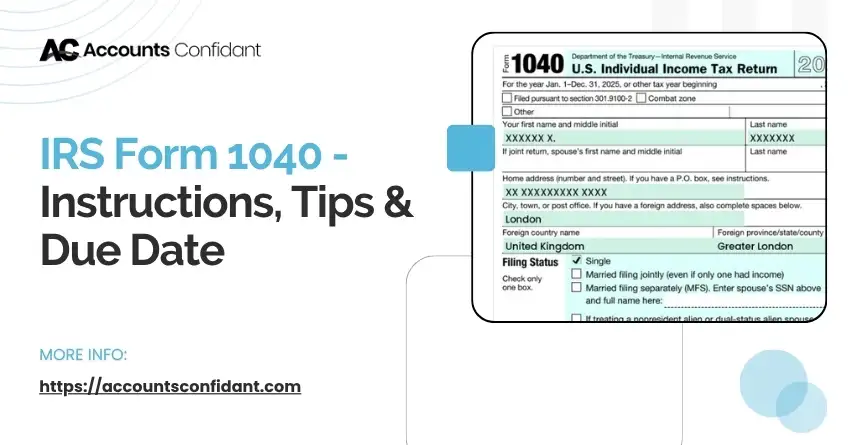
IRS Form 1040 is the main federal income tax return used by U.S. taxpayers to report annual income, deductions, credits, tax, payments, and the resulting refund or balance due.
For the 2026 filing season, the current published individual return is the 2025 Form 1040. The IRS lists the 2025 Form 1040 as the current revision, with the related instructions revised on February 27, 2026.
The 2025 return also introduced Schedule 1-A, an important change for taxpayers who qualify for certain new deductions related to tips, overtime, qualified vehicle-loan interest, and the enhanced deduction for seniors.
Understanding Form 1040 is easier when you separate the return into a few basic stages:
Income → Adjustments → Adjusted Gross Income → Deductions → Taxable Income → Tax and Credits → Payments → Refund or Balance Due
The exact forms and schedules you attach depend on your income, deductions, credits, investments, business activity, and other circumstances.
What Is IRS Form 1040?
Form 1040 is the federal U.S. Individual Income Tax Return.
It is used to report an individual’s annual federal income-tax information to the IRS. The form includes:
- Filing status
- Dependents
- Wages and other income
- Adjustments to income
- Adjusted gross income
- Standard or itemized deductions
- Qualified business income deduction, when applicable
- Additional deductions from Schedule 1-A
- Tax
- Tax credits
- Federal withholding
- Estimated tax payments
- Refund or balance due
The IRS describes Form 1040 as the annual income tax return used by U.S. taxpayers. Form 1040-SR is an optional alternative for eligible taxpayers age 65 or older and uses the same schedules and instructions.
Is Form 1040 the same as a W-2?
No, a W-2 is an information statement issued by an employer showing wages and certain taxes withheld during the year.
Form 1040 is your individual federal tax return.
The W-2 provides information that may be entered on Form 1040, but it does not replace the return.
Similarly, a Form 1099 can report interest, dividends, contractor income, retirement distributions, or other payments, but the information may need to be incorporated into your Form 1040 and related schedules.
Who Needs to File Form 1040?
Whether you must file a federal income tax return depends on factors including:
- Gross income
- Filing status
- Age
- Whether someone can claim you as a dependent
- Self-employment income
- Other special filing requirements
For tax year 2025, the IRS’s general filing thresholds for most taxpayers include:
| Filing status | Age at end of 2025 | Generally file if gross income is at least |
| Single | Under 65 | $15,750 |
| Single | 65 or older | $17,750 |
| Head of household | Under 65 | $23,625 |
| Head of household | 65 or older | $25,625 |
| Married filing jointly | Both under 65 | $31,500 |
| Married filing jointly | One spouse 65+ | $33,100 |
| Married filing jointly | Both spouses 65+ | $34,700 |
| Married filing separately | Any age | $5 |
| Qualifying surviving spouse | Under 65 | $31,500 |
| Qualifying surviving spouse | 65 or older | $33,100 |
These are general thresholds for most taxpayers. Other rules can require you to file even when your gross income is below the applicable amount.
Self-employed taxpayers have an additional filing trigger
If you have $400 or more in net earnings from self-employment, you generally must file a federal income tax return and generally owe self-employment tax, subject to the applicable rules.
That means a freelancer or independent contractor can have a filing requirement even when total income is below the ordinary filing threshold for their filing status.
Other situations can also require filing. For example, certain taxpayers may have to file because they owe special taxes, need to reconcile advance premium tax credits, have certain retirement-account tax, or fall into another IRS filing category.
Why you may want to file even when you don’t have to
A taxpayer can sometimes benefit from filing even without a mandatory filing requirement.
You may need to file to claim a refund of federal withholding or qualify for certain refundable credits.
So “I was below the filing threshold” does not necessarily mean “there is no reason to file.”
Which Tax Year’s Form 1040 Should You Use?
Use the form for the tax year you are reporting, not simply the year in which you happen to file.
For example:
2025 income → 2025 Form 1040 → generally filed in 2026
The IRS currently lists the 2025 Form 1040 as the current revision for individual federal returns.
The form itself states that it is for the year January 1 through December 31, 2025, or another applicable tax year beginning in 2025 for fiscal-year filers.
This matters when filing a late return.
A taxpayer filing an older return should use that year’s form and instructions rather than downloading the current-year form.
What Documents Do You Need to File Form 1040?
The exact documents depend on your financial situation, but most taxpayers should start by gathering every income statement and then collect documents supporting deductions, credits, payments, and special tax situations.
Income documents
Common examples include:
- Form W-2
- Form 1099-NEC
- Form 1099-MISC
- Form 1099-INT
- Form 1099-DIV
- Form 1099-R
- Form 1099-B
- Form 1099-K
- Social Security benefit statements
- Pension statements
- Rental-income records
- Business records
For self-employed taxpayers, bookkeeping records should also support business income and expenses.
Deduction and credit documents
Depending on your circumstances, you may need:
- Mortgage-interest statement
- Property-tax information
- Charitable contribution records
- Student-loan interest statement
- HSA records
- Child-care information
- Education expenses
- IRA contribution information
- Health-insurance information
- Business expense records
Payment records
Also gather:
- Federal income-tax withholding
- Estimated tax payments
- Extension payments
- Prior-year overpayments applied to the current year
The IRS recommends gathering relevant tax records before preparing your return rather than trying to reconstruct information later.
How Form 1040 Works
The first page establishes who is filing and reports much of the taxpayer’s income.
The second page moves through adjusted gross income, deductions, taxable income, tax, credits, other taxes, payments, and the final refund or balance.
The 2025 Form 1040 begins with:
- Taxpayer name
- Social Security number
- Address
- Filing status
- Dependents
- Digital-asset question
It then moves into income reporting.
Step 1: Enter your personal information
Make sure the following information is accurate:
- Name
- Social Security number
- Spouse’s name and SSN, if filing jointly
- Address
- Dependents
The name and Social Security number should agree with the applicable Social Security records.
Step 2: Select your filing status
The 2025 Form 1040 provides these choices:
- Single
- Married filing jointly
- Married filing separately
- Head of household
- Qualifying surviving spouse
Only select a status you actually qualify for.
Choosing a status simply because it creates a lower tax amount can create a filing error.
Step 3: Enter your income
The 2025 Form 1040 includes lines for wages, interest, dividends, retirement distributions, Social Security, capital gains or losses, and additional income from Schedule 1.
For example:
- Wages generally come from W-2s.
- Taxable interest comes from applicable 1099-INT forms.
- Ordinary dividends come from 1099-DIV.
- Capital gains or losses may require Schedule D.
- Business income generally flows through Schedule C and Schedule 1.
Step 4: Calculate adjusted gross income
Once total income and adjustments are determined, you arrive at adjusted gross income, commonly called AGI.
What Is Adjusted Gross Income on Form 1040?
For the 2025 Form 1040, adjusted gross income is reported on line 11a.
The calculation starts with total income on line 9. Adjustments from Schedule 1 are entered on line 10. Subtracting the adjustment amount from total income produces AGI on line 11a.
In simplified form:
Total income
− adjustments to income
= adjusted gross income
AGI can be important because many tax rules use AGI or a modified version of AGI to determine eligibility or phaseouts.
For example, the 2025 Schedule 1-A rules use modified adjusted gross income thresholds when calculating certain new deductions.
That is why a taxpayer should not confuse:
Gross income ≠ AGI ≠ taxable income
They are different stages of the tax calculation.
Schedule 1 vs. Schedule 1-A: What’s the Difference?
The difference between Schedule 1 and Schedule 1-A is especially important on the 2025 Form 1040.
| Schedule | Main purpose | Examples |
| Schedule 1 | Additional income and adjustments to income | Business income, unemployment compensation, certain other income, student loan interest, IRA deduction, self-employed adjustments |
| Schedule 1-A | Additional deductions created by recent legislation | Qualified tips, qualified overtime, qualified passenger-vehicle loan interest, enhanced senior deduction |
The IRS says Schedule 1 is used to report additional income and adjustments that cannot be entered directly on Form 1040. Its additional income generally flows to Form 1040 line 8, while adjustments flow to line 10.
What is new about Schedule 1-A?
For tax year 2025, the IRS introduced Schedule 1-A, Additional Deductions.
It is used for four deductions:
- Deduction for qualified tips
- Deduction for qualified overtime compensation
- Deduction for qualified passenger-vehicle loan interest
- Enhanced deduction for seniors
Taxpayers can generally claim these deductions whether they use the standard deduction or itemize deductions, subject to the specific requirements for each deduction.
The total from Schedule 1-A flows to Form 1040 line 13b for the 2025 return.
Qualified tips deduction
Eligible taxpayers may deduct up to $25,000 of qualified tips, subject to applicable income limits and other rules.
The IRS notes that qualified tip income for 2025 may not be separately identified on every W-2 or 1099, so taxpayers may need supporting tip records such as employer reports, point-of-sale summaries, invoices, or tip logs.
Qualified overtime deduction
Eligible taxpayers may deduct up to $12,500 of qualified overtime compensation, or up to $25,000 for married couples filing jointly, subject to the statutory requirements and phaseouts.
Qualified vehicle-loan interest
Eligible taxpayers may deduct up to $10,000 of qualified passenger-vehicle loan interest.
The IRS states that the loan generally must have originated after December 31, 2024, the proceeds must have been used to purchase an applicable passenger vehicle for personal use, and the loan must be secured by a first lien on the vehicle. The vehicle identification number is reported on Schedule 1-A.
Enhanced senior deduction
A qualifying taxpayer age 65 or older may be eligible for an additional $6,000 deduction, subject to the applicable income limits and SSN requirements. A married couple filing jointly can potentially receive up to $12,000 when both spouses qualify.
Other Common Schedules Used With Form 1040
Not everyone needs the same schedules.
The IRS says some taxpayers may need only Form 1040 or 1040-SR, while others need one or more additional schedules depending on income, deductions, credits, and taxes owed.
Schedule A — Itemized Deductions
Schedule A is used when you itemize deductions rather than use the standard deduction.
Possible itemized deductions include:
- Medical and dental expenses
- State and local taxes
- Mortgage interest
- Charitable contributions
- Certain other deductions
The 2025 state-and-local-tax deduction limit was increased to $40,000, or $20,000 for married taxpayers filing separately, subject to the applicable income-based limitation.
Schedule B — Interest and Ordinary Dividends
Schedule B is used in situations requiring a separate statement of interest and ordinary dividends, including certain taxpayers with amounts above applicable thresholds or foreign-account reporting requirements.
Schedule C — Business Income or Loss
Sole proprietors and many independent contractors use Schedule C to report business income and expenses.
The net profit or loss from Schedule C generally flows into the individual’s Form 1040 return through Schedule 1.
Schedule D — Capital Gains and Losses
Schedule D is used for certain capital gains and losses from investments and other property.
Not every taxpayer with a capital transaction needs Schedule D; the Form 1040 instructions identify circumstances where the transaction can be reported directly on the return.
Schedule E — Supplemental Income and Loss
Schedule E is commonly associated with:
- Rental real estate
- Royalties
- Partnerships
- S corporations
- Estates and trusts
Schedule SE — Self-Employment Tax
Self-employed taxpayers with net earnings of at least $400 generally use Schedule SE to calculate self-employment tax.
Schedule 2 — Additional Taxes
Schedule 2 reports certain additional federal taxes, including specific taxes that do not appear directly on Form 1040.
Schedule 3 — Additional Credits and Payments
Schedule 3 is used for certain credits and payments that do not otherwise have a direct line on Form 1040.
Your tax software will often determine which schedules are necessary based on the information you enter. The IRS notes that e-file software generally identifies the schedules required for your return.
Standard Deduction vs. Itemized Deductions
Most taxpayers choose between the standard deduction and itemized deductions, subject to the applicable rules.
For 2025, the standard deduction for most taxpayers is:
- $15,750 for single or married filing separately
- $31,500 for married filing jointly or qualifying surviving spouse
- $23,625 for head of household
Additional amounts apply in certain situations involving age and blindness.
The standard deduction is generally simpler.
Itemizing can be useful when your qualifying itemized deductions are greater than the standard deduction and you are eligible to use them.
A taxpayer should compare the two methods rather than automatically selecting one because it was used on the previous year’s return.
IRS Form 1040 vs. Form 1040-SR
Form 1040-SR is not a separate tax system.
It is an optional alternative to Form 1040 for taxpayers who are age 65 or older.
The IRS says Form 1040-SR uses the same schedules and instructions as Form 1040.
For the 2025 tax year, a taxpayer generally qualifies to use Form 1040-SR if they were born before January 2, 1961.
The main difference is the form’s design and larger-print presentation, not a different set of underlying tax rules.
How Freelancers and Self-Employed People Report Income on Form 1040
Freelancers, sole proprietors, independent contractors, and other self-employed individuals generally report business activity through Schedule C, which connects to Form 1040.
The basic flow is:
Business revenue
− allowable business expenses
= net business profit or loss
That net result is then incorporated into the individual’s federal return.
Self-employed individuals with at least $400 in net earnings generally also use Schedule SE to calculate self-employment tax.
Keep business and personal records separate
For a freelancer, the tax return can become much more difficult when business and personal expenses are mixed together.
Maintain records for:
- Client payments
- 1099s
- Business expenses
- Mileage
- Equipment
- Advertising
- Software
- Professional services
- Insurance
- Business-use expenses
The IRS says self-employed taxpayers should maintain records that support business income and expenses.
Accounts Confidant’s bookkeeping for tax preparation guide covers the connection between accurate bookkeeping, reconciled accounts, organized records, and tax preparation.
That internal link is especially relevant for self-employed readers who need to turn a year’s transactions into tax-ready records.
How to Download Form 1040
Use the IRS website rather than a third-party website when downloading the form.
The IRS currently lists the 2025 Form 1040, Form 1040-SR, and the corresponding instructions as the current materials for the latest completed tax year.
Download the official 2025 Form 1040:
Read the official 2025 Form 1040 instructions:
Before using a downloaded form, confirm the tax year printed at the top.
A 2024 Form 1040 and a 2025 Form 1040 are not interchangeable simply because their basic structure looks similar.
How to File Form 1040 Online
Electronic filing is generally the easiest way for most taxpayers to submit Form 1040.
The IRS states that e-filing is the fastest and most secure method and provides several online filing options.
IRS Free File
For the 2026 filing season, IRS Free File is available through IRS.gov.
The IRS states that Free File Guided Tax is available to taxpayers with adjusted gross income of $89,000 or less, while taxpayers who prefer to prepare their own federal return can use Free File Fillable Forms.
Paid tax software
Commercial tax software can also prepare and electronically file Form 1040.
The advantage is guided workflows that can ask questions and automatically select many required schedules.
Remember that software can calculate numbers correctly while still producing a wrong return if the information entered is wrong or incomplete.
Tax professional
A qualified tax professional can prepare and file the return on your behalf.
You remain responsible for reviewing the return and providing accurate information.
When Is Form 1040 Due?
For calendar-year taxpayers filing their 2025 federal individual tax return, the regular filing and payment deadline was April 15, 2026.
Taxpayers who requested a valid extension generally received until October 15, 2026, to file.
The important rule is:
An extension gives you more time to file, not more time to pay.
The IRS specifically says taxes owed were still due April 15, 2026, even when the taxpayer received an extension to October 15.
If you owe tax and cannot pay the full amount, file the return or extension on time and consider an IRS payment option.
Accounts Confidant’s IRS Form 9465 guide explains how monthly installment payments work when a taxpayer cannot pay a federal tax balance in full.
What If You Cannot Pay the Balance on Form 1040?
Do not skip the tax return simply because you cannot pay.
The IRS advises taxpayers who cannot pay the full amount to file the return and pay as much as possible. Interest and applicable penalties can continue until the balance is paid.
Depending on your circumstances, options can include:
- Short-term payment arrangements
- Long-term installment agreements
- Offer in Compromise
- Currently Not Collectible status
- Penalty relief in qualifying situations
Accounts Confidant’s IRS tax debt relief guide explains these options in more detail.
The important point is that inability to pay does not eliminate the filing requirement.
Common Form 1040 Mistakes
Using the wrong tax year
Always check the year printed on the form.
Choosing the wrong filing status
Your status must reflect your circumstances and the IRS rules for that tax year.
Forgetting a W-2 or 1099
Missing income is one of the simplest ways to produce an inaccurate return.
Entering the wrong Social Security number
A single incorrect digit can cause an e-file rejection or processing issue.
Claiming the wrong dependent
Verify the dependent’s eligibility, SSN, relationship, and other applicable requirements.
Entering the wrong bank information
Check your routing number and account number carefully before requesting direct deposit.
Missing a schedule
A taxpayer with business income, investment transactions, rental income, self-employment tax, itemized deductions, or other special situations may need additional schedules.
Missing new Schedule 1-A deductions
Taxpayers eligible for the new 2025 deductions should determine whether Schedule 1-A applies rather than assuming Schedule 1 covers every adjustment or deduction.
Assuming tax software catches everything
Software can detect many mathematical and formatting problems, but it cannot know that you forgot a job, entered the wrong business expense, or misunderstood a tax rule.
The IRS specifically recommends reviewing the return even when it was prepared using software or by another person.
Forgetting to sign
A return must be properly signed under the applicable filing rules.
What Happens If You Make a Mistake on Form 1040?
The right response depends on when you discover the problem.
Before filing
Correct the return before submitting it.
The IRS rejects your e-file
A rejected return is different from an accepted return containing an error.
Correct the rejection and resubmit when the filing system permits it. You normally do not amend a return simply because the original electronic submission was rejected.
The IRS accepts the return but you later find an error
You may need to file Form 1040-X, Amended U.S. Individual Income Tax Return, when the change affects items such as income, deductions, credits, filing status, or tax liability.
The IRS says you generally do not need to amend simply because it corrected a math error or requests a missing form or schedule separately.
Accounts Confidant’s common tax return mistakes guide provides additional information about rejected returns, missing documents, filing-status errors, deductions, dependents, and Form 1040-X corrections.
How to Get a Copy of a Previously Filed Form 1040
The IRS provides both transcripts and actual copies.
Tax return transcript
A tax return transcript is free and generally shows most line items from your originally filed Form 1040-series return, along with the associated forms and schedules.
You can access transcripts through your IRS Individual Online Account or request them by mail or Form 4506-T.
For many purposes, a transcript is enough.
Actual copy of the return
If you need an actual photocopy of a previously filed return, use Form 4506, Request for Copy of Tax Return.
The current Form 4506 carries a $30 fee per return requested.
This distinction matters:
Transcript = free in ordinary circumstances
Actual return copy = Form 4506 and generally a $30 fee per return
Form 1040 and Tax Records for Business Owners
For a business owner filing an individual return, personal Form 1040 preparation often depends on records generated by the business.
For example, a sole proprietor may need:
- Profit and loss statement
- Business income records
- Expense records
- Bank reconciliations
- Credit-card records
- Fixed-asset information
- Mileage records
- 1099 information
- Estimated tax payments
The IRS says business records should clearly show income and expenses and provide enough documentation to support the items reported on the return.
That makes year-round bookkeeping useful rather than treating bookkeeping as something that starts only when tax season begins.
Accounts Confidant’s Online Bookkeeping Services cover bookkeeping, account reconciliation, financial reporting, payroll processing, accounts payable, accounts receivable, and tax-preparation support.
A Practical Form 1040 Filing Checklist
Before submitting your federal return, review the following.
Personal information
- Correct name
- Correct SSN or ITIN
- Correct address
- Correct filing status
- Spouse information is accurate
Dependents
- Names and SSNs verified
- Relationship checked
- Eligibility reviewed
- Appropriate credits reviewed
Income
- All W-2s included
- All applicable 1099s reviewed
- Interest and dividends included
- Retirement income reviewed
- Capital gains reviewed
- Business income included
- Rental or other income included
Deductions
- Standard vs. itemized deduction compared
- Schedule 1 reviewed
- Schedule 1-A reviewed if applicable
- Schedule C expenses supported
- IRA/HSA/student-loan adjustments checked
- Qualified deductions documented
Credits and taxes
- Applicable credits reviewed
- Self-employment tax calculated if required
- Additional taxes checked
- Withholding reconciled
- Estimated payments included
Filing
- Required schedules attached
- Bank information verified
- Signature completed
- Copy of return saved
- E-file acknowledgement retained
The IRS recommends reviewing the entire return before filing, including names, Social Security numbers, filing status, dependents, income, deductions, credits, bank information, forms, schedules, and signatures.
Final Takeaway
IRS Form 1040 is the foundation of the federal individual income tax filing process.
The form itself is relatively compact, but the information behind it can be extensive. Your filing status, income sources, business activity, investments, deductions, credits, and tax payments determine which schedules and supporting documents belong with the return.
For the 2025 tax year, filed during the 2026 filing season, taxpayers should pay particular attention to the new Schedule 1-A. It provides a separate place for four new deductions covering qualified tips, qualified overtime compensation, qualified passenger-vehicle loan interest, and the enhanced deduction for seniors.
Before filing, verify the tax year, personal information, income, filing status, dependents, deductions, credits, bank information, required schedules, and payment amounts.
For self-employed taxpayers and business owners, the quality of the Form 1040 often depends on the quality of the underlying bookkeeping. Accurate books, reconciled accounts, and organized supporting documents can make the tax-preparation process considerably easier.
Accounts Confidant provides bookkeeping, reconciliation, financial reporting, payroll processing, and tax-preparation support for businesses and individuals who need organized financial records.
Frequently Asked Questions
What is Form 1040, and why do I need it?
Form 1040 is the main U.S. individual federal income tax return. You use it to report annual income, deductions, credits, payments, and your resulting federal tax, refund, or balance due.
Is Form 1040 the same as a W-2?
No, A W-2 reports wages and withholding from an employer. Form 1040 is the tax return where you report your income and calculate your federal tax.
Do I need to file Form 1040 if I earned very little?
Maybe, for 2025, most taxpayers use income thresholds based on filing status and age, but other rules can create a filing requirement. Self-employed taxpayers generally must file when net self-employment earnings are $400 or more.
Which tax year’s Form 1040 should I use?
Use the form for the tax year you are reporting. For example, a 2025 federal return filed in 2026 uses the 2025 Form 1040.
What documents should I gather before filing?
Gather W-2s, applicable 1099s, interest and dividend statements, retirement records, deduction and credit documents, business records, and federal estimated or extension payment records.
Which schedules do I need with Form 1040?
It depends on your tax situation. Common schedules include Schedule 1, Schedule 1-A, Schedule A, Schedule B, Schedule C, Schedule D, Schedule E, Schedule SE, and Schedules 2 and 3. The IRS says e-file software generally determines which schedules apply.
What is the difference between Schedule 1 and Schedule 1-A?
Schedule 1 reports additional income and adjustments to income. Schedule 1-A is a new 2025 schedule for qualified tips, qualified overtime, qualified vehicle-loan interest, and the enhanced senior deduction.
How do freelancers report income on Form 1040?
Freelancers generally use Schedule C to report business income and expenses, and Schedule SE when required to calculate self-employment tax. The Schedule C result flows into Form 1040 through Schedule 1.
Should I use Form 1040 or Form 1040-SR?
Form 1040-SR is an optional alternative for taxpayers age 65 or older. It uses the same schedules and instructions as Form 1040.
Can I file Form 1040 online for free?
Yes, IRS Free File provides free federal filing options, including guided software for taxpayers with AGI of $89,000 or less and Free File Fillable Forms for taxpayers who want to prepare their own federal return.
Does a filing extension give me more time to pay?
No, an extension generally provides extra time to file, not extra time to pay. Tax owed was still due April 15, 2026 for 2025 calendar-year returns.
What should I do if I cannot pay the balance?
File the return and pay as much as you can. Then review IRS payment options, including installment arrangements and other tax-debt relief programs.
How do I correct Form 1040 after filing?
If the accepted return needs a substantive correction, you may need Form 1040-X. The IRS generally does not require an amendment for every math error or missing document it corrects or requests during processing.
How can I get a copy of a previously filed Form 1040?
For most purposes, request a free tax return transcript through your IRS Online Account, by mail, or with Form 4506-T. For an actual copy of the return, use Form 4506; the current form generally charges $30 per return.