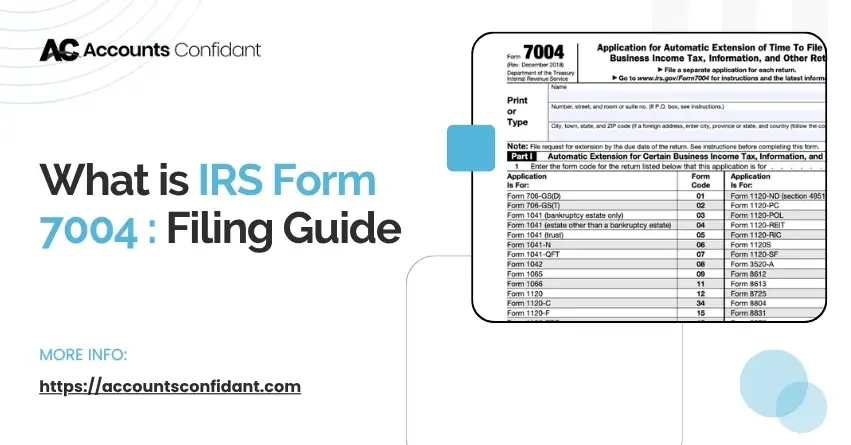
If your business cannot finish its federal tax return by the original due date, IRS Form 7004 can provide an automatic extension of time to file certain business income tax, information, and other returns. The extension gives a business more time to complete and submit the return, but it generally does not give more time to pay tax that is due.
This distinction is important for business owners, CPAs, enrolled agents, and tax preparers. Filing Form 7004 on time can extend the filing deadline, but an unpaid tax balance can still lead to interest and applicable penalties.
The IRS currently lists Form 7004 and its instructions with a December 2025 revision. As of September 2026, this is the current published version on IRS.gov; check the IRS Form 7004 page for later updates before filing.
What Is IRS Form 7004?
IRS Form 7004 is used to request an automatic extension of time to file certain business tax returns. It does not itself pay the tax or extend the payment deadline.
Businesses may use Form 7004 for eligible returns such as certain:
- Partnership returns
- Corporation returns
- S corporation returns
- Estate and trust returns
- Certain information returns
- Other business-related returns listed in the Form 7004 instructions
The form is generally filed separately for each return for which an extension is requested. The IRS does not treat Form 7004 as a blanket extension covering every return a business may have.
What Form 7004 Does
Form 7004 generally gives eligible businesses additional time to file their tax return.
It can help when you need more time to:
- Complete bookkeeping
- Reconcile business accounts
- Prepare financial statements
- Gather tax records
- Finalize partnership information
- Review depreciation and deductions
- Complete tax-return schedules
- Resolve missing information
What Form 7004 Does Not Do
Form 7004 does not generally:
- Extend the tax payment deadline
- Eliminate an existing tax liability
- Automatically extend every business tax form
- Give a blanket extension for all business returns
The IRS specifically states that the extension is for filing, not payment.
Who Can File Form 7004?
Businesses and other eligible filers can use Form 7004 when the underlying return is one of the returns covered by the form.
Eligible filers can include:
- Partnerships
- S corporations
- C corporations
- Certain trusts
- Certain estates
- Other entities filing returns listed in the Form 7004 instructions
For example, a partnership filing Form 1065 can generally use Form 7004 to request an automatic extension. The IRS’s 2026 tax calendar confirms Form 7004 is used to request an automatic six-month extension for Form 1065.
An S corporation filing Form 1120-S can also generally use Form 7004.
However, not every tax return can use Form 7004. Always check the current instructions for the specific return.
What Does Form 7004 Extend?
Form 7004 extends the time to file certain eligible business tax and information returns, not the time to pay the tax.
For example, an eligible business may use Form 7004 to request additional time to file:
- Form 1065
- Form 1120
- Form 1120-S
- Form 1041
- Other eligible returns listed in the instructions
The exact extension period depends on the return and the taxpayer’s circumstances.
Important Exception: Form 1041
Estates and trusts filing Form 1041 generally receive an automatic 5½-month extension rather than six months.
For example, the IRS states that a calendar-year estate or trust filing Form 1041 has an April 15, 2026 filing deadline and can generally use Form 7004 to request an automatic 5½-month extension.
How Long Does Form 7004 Extend a Business Tax Return?
For most eligible business returns, Form 7004 provides an automatic six-month extension, but exceptions apply.
The most important exceptions include:
| Return or situation | General extension |
| Form 1065 partnership return | 6 months |
| Form 1120-S S corporation return | 6 months |
| Form 1120 C corporation return | Generally 6 months |
| Form 1041 estate/trust return | 5½ months |
| Certain C corporations with June 30 year-end beginning before 2026 | 7 months |
| C corporations with tax years beginning in 2026 | 6 months |
The IRS notes that C corporations with tax years ending June 30 and beginning before January 1, 2026 can qualify for a seven-month extension, while tax years beginning in 2026 generally use a six-month extension.
Example: Partnership
A calendar-year partnership generally has a Form 1065 filing deadline of March 16, 2026, because March 15 falls on a Sunday.
A timely Form 7004 generally provides six additional months to file.
The actual deadline should always be calculated based on the applicable tax year’s calendar and weekend/holiday rules.
Does Form 7004 Extend the Time to Pay Taxes?
No, Form 7004 generally extends the time to file, not the time to pay.
This is one of the most important Form 7004 rules.
Suppose a corporation estimates that it owes:
$25,000
but needs another five months to finish its return.
The corporation may file Form 7004 to extend the filing deadline, but it should generally pay the estimated $25,000 by the original payment deadline.
If the business pays too little, interest and applicable penalties can still apply to the unpaid amount.
The IRS recommends paying electronically whenever possible.
A Simple Rule
Think of Form 7004 as:
More time to file ≠ more time to pay.
This is why estimating the tax liability before submitting Form 7004 is important.
When Is Form 7004 Due?
Form 7004 is generally due on or before the original due date of the tax return for which the extension is requested.
You should not wait until the extended deadline to file Form 7004.
For example:
- Original return deadline: March 16
- Form 7004 deadline: March 16
- Extended filing deadline: generally six months later for an eligible return
The exact date depends on the underlying return, tax year, weekends, holidays, and special rules.
Calendar-Year Examples
For common calendar-year businesses:
Partnership — Form 1065
The return is generally due on the 15th day of the third month after the tax year ends.
S corporation — Form 1120-S
The return is generally due on the 15th day of the third month after the tax year ends.
C corporation — Form 1120
For tax years beginning after 2025, the federal return is generally due on the 15th day of the fourth month after the tax year ends.
Because business tax deadlines can change when a due date falls on a weekend or federal holiday, verify the date using the applicable IRS tax calendar.
Form 7004 Instructions 2026: What You Need to Know
The current Form 7004 instructions were revised in December 2025 and explain the filing rules, eligible returns, extension periods, payment requirements, and exceptions.
The current instructions contain several points that business filers should review carefully.
Estimate Your Tax
The IRS states that an extension will be granted when Form 7004 is properly completed, filed by the applicable deadline, and the taxpayer makes a proper estimate of tax when required and pays tax that is due.
The estimate does not mean you need to know the final tax liability with perfect accuracy.
You should make a reasonable estimate based on the information available.
File a Separate Form for Each Return
You generally need a separate Form 7004 for each return that requires an extension.
For example, if an entity has two separate eligible returns requiring extensions, do not assume one Form 7004 covers both.
No Signature Is Required
Form 7004 does not require a signature.
This makes the form relatively straightforward to submit compared with some other IRS forms.
The IRS Usually Does Not Send an Approval Notice
The IRS generally will not send a notification that your automatic extension was approved. The IRS says it will notify you if the request is disallowed.
Keep proof that the form was filed on time.
How to Fill Out Form 7004
To fill out Form 7004, identify the return being extended, enter the tax-year information, provide the required tax estimate, and select the applicable extension information.
The form is divided into two main parts.
Part I: Identification
Part I identifies the return for which the extension is being requested.
You generally need information such as:
- Name of the entity
- Address
- Employer identification number
- Applicable form number
- Tax year information
The form asks you to enter the form code for the return being extended.
Why the Form Code Matters
The form code identifies the tax return covered by the extension.
Entering the wrong code can cause the extension request to apply to the wrong return.
Before filing, compare the form code against the current Form 7004 instructions.
Part II: Information About the Extension
Part II contains information used to determine the extension period and estimated tax.
Depending on the return and circumstances, you may need to provide:
- Tax year dates
- Short-tax-year information
- Reason for a short tax year
- Estimated total tax
- Certain special-status information
- Other applicable details
Line 6: Estimated Total Tax
Line 6 generally asks for the total tax, including applicable nonrefundable credits, that the entity expects to owe for the tax year.
Use the best reasonable estimate available when preparing the extension.
Do not enter an arbitrary amount simply to complete the form.
How to E-File Form 7004
Most Form 7004 requests can be filed electronically through the IRS Modernized e-File system, but certain returns have exceptions.
Electronic filing can help reduce problems associated with mailing the form close to the deadline.
The IRS specifically states that Form 7004 can be e-filed for most returns.
However, it cannot currently be e-filed for certain returns, including:
- Form 8612
- Form 8613
- Form 8725
- Form 8831
- Form 8876
- Form 706-GS(D)
The IRS lists these exceptions in the current instructions.
Who Can E-File?
Businesses generally use:
- Tax preparation software
- Professional tax software
- An authorized tax professional
- An IRS-supported electronic filing provider
Tax preparers should confirm that their software supports the specific return and Form 7004 combination before the filing deadline.
Keep Proof of Filing
After e-filing, retain:
- Submission confirmation
- Acceptance record
- Date and time of transmission
- Taxpayer identification details
- Copy of the submitted Form 7004
This documentation can be useful if the IRS later questions whether the extension was timely filed.
Where to Mail Form 7004
If Form 7004 cannot or will not be filed electronically, mail it to the IRS address listed in the current Form 7004 instructions for the applicable return.
There is not one universal mailing address for every Form 7004.
The correct address depends on factors such as:
- Type of return
- Location of the business
- Taxpayer type
- Other filing circumstances
For this reason, do not rely on an old Form 7004 mailing address found on a third-party website.
The IRS provides the applicable addresses in the current instructions.
Mailing Tip
If mailing Form 7004:
- Use the address for the specific return.
- Check the tax year.
- Keep a complete copy.
- Use a mailing method that provides evidence of timely mailing.
- Do not wait until the last day if avoidable.
The IRS also has specific rules for designated private delivery services.
Form 7004 vs. Form 4868
Form 7004 is generally for eligible business returns, while Form 4868 is generally used by individuals to request an automatic extension for their individual income tax return.
| Feature | Form 7004 | Form 4868 |
| Primary use | Certain business and related returns | Individual income tax returns |
| Common filer | Partnership, corporation, S corporation, estate or trust | Individual taxpayer |
| Automatic extension | Yes, for eligible returns | Yes |
| Extends filing time | Yes | Yes |
| Extends payment deadline | No | No |
| Used for Form 1040 | No | Yes |
| Used for Form 1065 | Yes | No |
| Used for Form 1120-S | Yes | No |
The IRS separately identifies Form 4868 as the automatic extension form for individual income tax returns.
So if a business owner personally needs more time to file Form 1040, Form 4868 may be relevant to the individual return.
If the business itself needs more time to file an eligible business return, Form 7004 may be the appropriate form.
What Happens If You Miss the Form 7004 Deadline?
If Form 7004 is filed after the original due date, the automatic extension may not be available.
The IRS instructions state that Form 7004 generally must be filed by the due date of the applicable return.
This creates two separate issues:
1. Filing Deadline
If the extension request is late, the business may lose the automatic extension.
2. Payment Deadline
Even a timely Form 7004 does not extend the payment deadline.
So if tax was due but not paid by the original deadline, interest and applicable penalties can still apply.
If You Already Missed the Deadline
Do not simply assume the situation is hopeless.
Review:
- Original return due date
- Date Form 7004 was submitted
- Whether payment was made
- Amount of tax owed
- Applicable reasonable-cause rules
- Whether another extension rule applies
For a significant balance or unusual filing situation, a tax professional can review the specific facts.
Special Form 7004 Extension Rules
Some taxpayers have special extension rules that can change the normal six-month period or may provide an automatic extension without filing Form 7004.
These rules are particularly important for certain foreign corporations, domestic corporations, and partnerships.
Certain Foreign and Domestic Entities
The current instructions identify certain entities that may qualify for an automatic extension of time to file and pay under special rules in Treasury Regulation §1.6081-5.
These include certain:
- Partnerships maintaining books and records outside the United States and Puerto Rico
- Foreign corporations with a U.S. office or place of business
- Domestic corporations maintaining books and records outside the United States and Puerto Rico
- Domestic corporations whose principal income comes from U.S. territories
These entities can have special filing and payment deadlines.
If the special extension is insufficient, Form 7004 can be used to request an additional extension of time to file, but not an additional extension of time to pay.
This is an area where using a generic six-month rule can produce the wrong deadline.
Common Form 7004 Mistakes
Most Form 7004 problems come from filing late, choosing the wrong return, misunderstanding payment rules, or using an incorrect extension period.
1. Filing Form 7004 After the Original Deadline
The form generally must be filed by the original due date.
An extension filed after that date may not provide the intended automatic extension.
2. Assuming the Extension Delays Payment
This is the most important mistake to avoid.
Form 7004 extends filing time, not the general payment deadline.
3. Using Form 7004 for an Individual Return
Form 7004 is not the standard extension form for Form 1040.
Individuals generally use Form 4868 for an automatic extension of their individual return.
4. Using One Form for Multiple Returns
The IRS requires a separate Form 7004 for each return for which an extension is requested, subject to rules for consolidated groups.
5. Using the Wrong Form Code
The form code identifies the return being extended.
Check the current instructions before submitting the form.
6. Assuming Every Business Gets Exactly Six Months
Six months is the general rule, but exceptions exist.
For example, certain Form 1041 filers receive 5½ months, and certain June 30 C corporations can have different extension periods.
7. Ignoring Short Tax Years
Short tax years can have different calculations and special instructions.
If the business has a short tax year, complete the applicable tax-year information carefully.
8. Not Keeping Filing Evidence
The IRS generally does not send an approval notice for a properly filed automatic extension.
Keep your filing confirmation and supporting records.
Case Study: A Partnership Needs More Time
This is an illustrative example, not a reported client case.
Imagine a calendar-year partnership that operates several locations.
The partnership’s tax preparer is still waiting for:
- Final depreciation records
- Year-end bank reconciliations
- Several expense records
- Information needed for partner Schedule K-1s
The partnership cannot reasonably complete Form 1065 by its original filing deadline.
Step 1: Identify the Return
The business is filing:
Form 1065 — U.S. Return of Partnership Income
Step 2: Check Form 7004 Eligibility
Form 1065 is an eligible return for Form 7004.
Step 3: File by the Original Due Date
The partnership submits Form 7004 on or before the original Form 1065 deadline.
Step 4: Estimate Tax
The preparer provides the required estimated tax information based on the available records.
Step 5: Pay Any Tax Due
The partnership does not treat the extension as a payment holiday.
Step 6: Finish the Return
The partnership uses the additional filing time to complete the return and related schedules.
The key lesson is simple:
An extension gives the preparer more time to complete the return; it does not generally create extra time to pay the tax.
Form 7004 PDF: Where to Get the Official Form
The official IRS website is the best source for the current Form 7004 PDF and instructions.
The IRS’s Form 7004 page provides access to:
- Current Form 7004
- Current instructions
- E-file information
- Prior revisions
- Related IRS guidance
As of September 2026, the IRS lists Form 7004 as a December 2025 revision and the corresponding instructions as revised in December 2025.
Avoid relying on an old third-party Form 7004 PDF when a current IRS version is available.
Form 7004 Filing Checklist
A short checklist can help business owners and tax preparers avoid the most common extension errors.
Before submitting Form 7004, verify:
- Identify the exact tax return being extended.
- Confirm the return is eligible for Form 7004.
- Check the original filing deadline.
- Determine the correct extension period.
- Complete the taxpayer identification information.
- Enter the correct form code.
- Check the tax-year dates.
- Complete short-tax-year information when applicable.
- Estimate the tax liability.
- Pay the expected tax due by the original payment deadline.
- File Form 7004 on time.
- Confirm e-file eligibility.
- If mailing, use the correct IRS address.
- Keep proof of filing.
- Calendar the extended filing deadline.
Final Takeaway
IRS Form 7004 gives eligible businesses more time to file certain federal tax returns, but it generally does not give them more time to pay the tax.
For a smooth filing:
- Identify the correct business return.
- Check its original filing deadline.
- Confirm Form 7004 is available for that return.
- Determine the correct extension period.
- Estimate the tax liability.
- Pay the expected tax by the original payment deadline.
- File Form 7004 by the original return deadline.
- Keep proof that the extension was submitted.
- Calendar the extended filing date.
As of September 2026, the IRS’s current published Form 7004 instructions are the December 2025 revision. The IRS also recommends checking IRS.gov/Form7004 for later developments before filing.
Frequently Asked Questions
What is IRS Form 7004?
IRS Form 7004 is used to request an automatic extension of time to file certain business income tax, information, and other returns.
Who can file Form 7004?
Eligible businesses and other taxpayers filing returns covered by Form 7004 can use it. Common examples include partnerships, S corporations, C corporations, and certain estates and trusts.
How long does Form 7004 extend a business tax return?
The extension is generally six months, but exceptions apply. Form 1041 estates and trusts generally receive a 5½-month extension, while certain C corporations can have different periods.
Does Form 7004 extend the time to pay taxes?
No, Form 7004 generally extends the time to file, not the time to pay.
When is Form 7004 due?
Form 7004 is generally due on or before the original due date of the return for which the extension is requested.
How do I fill out Form 7004?
Enter the taxpayer’s identifying information, identify the return being extended, provide tax-year information, complete applicable special questions, and provide the required estimated tax information.
Can I e-file Form 7004?
Yes, Form 7004 can be electronically filed for most eligible returns. Certain returns are excluded from e-filing.
Where do I mail Form 7004?
If you are filing on paper, mail Form 7004 to the IRS address listed in the current instructions for the specific return being extended. There is no single mailing address for every Form 7004.
What is the difference between Form 7004 and Form 4868?
Form 7004 is generally used for eligible business and related returns. Form 4868 is generally used by individuals requesting an automatic extension for their individual income tax return.
What happens if I don’t file Form 7004 by the deadline?
You may lose the automatic extension if Form 7004 is not filed by the original due date. The underlying return can then become late, potentially resulting in applicable penalties and interest.
Can I file Form 7004 for a partnership, corporation, or trust?
Yes, when the applicable return is eligible. Partnerships, corporations, and certain estates and trusts commonly use Form 7004. The extension period can differ by return type.
What are common mistakes on Form 7004?
Common mistakes include filing after the original deadline, using the wrong form code, assuming the extension delays payment, using one form for multiple returns, and overlooking special extension periods.